Welcome to the world of Church Acoustics

Teaching the highest quality in Church Sound excellence

  • Supported by

    Contact:
    Ph # 519-582-4443
    email: jdb@jdbsound.com

    The Bible is the de facto standard for all church worship needs including sound and acoustics.

    2 Timothy 2:15

  • Archives

  • For additional contact information scan the QR code below

    link to jdbsound.com

Posts Tagged ‘Solomon’s Temple’

What happens when Church Architecture, Technology, Science, and meets up with the Bible.

Posted by jdbsound on April 24, 2020


The Bible has a lot to say about how a modern church should be designed.  Solomon’s Temple was not just a house for God to dwell in, it was also meant to be a tool to help preach and spread the Gospel in the present.

After reading this article, please pass it on and make comments below.

***  Article: Gods Authority in Church Design ***

This article is the most comprehensive study of King Solomon’s Temple I have ever written.  If you believe John 1:3, then you know who really designed Solomon’s Temple.  King David only penned the details of the new temple.  King David told his son Solomon that it was the hand of God that guided his hand.  What was so important for God to design the temple rather than letting a man design in with whatever came into his thought?

This article gives a stronger case for what the “Inspired Word of God” means.

Winning people to Christ is not a game or something given to chance.  We need all the tools possible to have an impact on this world.  Jesus is Lord, and if your church is dedicated to God, Jesus is Lord over your church building too.

Posted in Church Acoustics, Church Sound Systems | Tagged: , , , , , , , , , , , , , , , , , , , , , , , , | Comments Off on What happens when Church Architecture, Technology, Science, and meets up with the Bible.

What are your Church Priorities about sound when it comes to preaching the Gospel?

Posted by jdbsound on February 25, 2020


Is the performance of your worship space a priority?  Is the message always crystal clear in every seating position, and over 60% of the congregation is singing all the time?  If you say no to either or both questions, and you want your church to sound right for speech and music, the biggest obstacle is often the acoustics.  The second is money.  The third is aesthetics.

Fix the room!  How?  Follow what the Bible says, and you will not be disappointed.  After all, it is God’s plan, not man’s idea.  Do you think that the results will be less than perfect if you follow His plan completely? Isn’t the Bible the Living Bible?  Since when did the Bible stop teaching us new things about science?  Check out Solomon’s Temple, and the answers are there.  They always have been. It’s just taken a while to join the dots.

But it costs too much!  Oh, you mean the cost of a few floor monitors or a couple of wireless microphones considered too much?  That is often the cost of the Bible’s way of fixing the acoustics or about $3.50USD per seat for a 300 seat church. (Not including the price for the knowledge of knowing what to do.)  Replacing a mixer costs about $15.00-21.00 per seat.  Replacing pews for chairs cost about $75.00 per seat.  Buying 10 Shure SM58 mics with cables and mic stands – costs about $1,500.00.  Fixing the acoustics of a church is cheaper than you think.

If the look of any acoustical treatment is a concern, ask yourself this.  Are you there to worship God or the building?  Fixing the acoustics is like saying you are more interested in hearing what God has to say through your minister.  Putting up with acoustical problems, poor quality congregational singing, and accepting a sound system with limited performance is like saying the building is more important than the message and having fellowship with other believers.

It all comes down to priorities.  The primary purpose of any building that is a dedicated House of God is the preaching of the Gospel.  A place where the Gospel message can be spoken without distortion or interface.  That includes making the room behave as God would want us to have it.  The second priority is the breaking of bread and drinking of wine in remembrance of what Jesus did for all of us.  The worship space has to support this event as often as each church chooses to remember.  The next priority is congregational singing.  There isn’t any other experience that can replace the joy and excitement of a room where more than 75% of the audience is singing.  Songs that tell stories of Jesus, his atonement of our sins, and of people who follow Jesus are powerful in bringing people together.  It takes the same quality of acoustics to hear clear speech as well as great congregational singing.  These are the things that matter when you are a part of the Kingdom of God.

While I do have a business about church acoustics and sound, there is no possible way for one person or one company to fix all of the churches out there that need help.  By making this public, it means that no one can patent it and force churches to pay a license fee. It means that no one can control it and inflate the cost of fixing existing and new churches.  Churches should use the Bible’s methods with confidence, to apply in faith what God teaches, even without expert help.  When churches take such a leap of faith, in most cases, the results are outstanding.

This information is being shared because I care more about winning people for Christ through better sound than creating a business empire.  By revealing what the Bible teaches, by showing that science backs it up, that it is affordable for every church to have excellent acoustics, this is all part of the Great Commission.  If more people with a passion and skills like mine, were to apply what the Bible teaches about sound, we could make a difference.  Mat-7:15.  Beware of false prophets, which come to you in sheep’s clothing, but inwardly they are ravening wolves. (KJV)  If you have the chance, read the rest of what Jesus said in Mathews 7:15-20. Don’t trust me.  Trust the Bible.

Posted in Church Acoustics, Church Sound Systems | Tagged: , , , , , , , , , , , , , , , , , , , , , , , , , | Comments Off on What are your Church Priorities about sound when it comes to preaching the Gospel?

Is Solomon’s Temple a Myth?

Posted by jdbsound on February 6, 2020


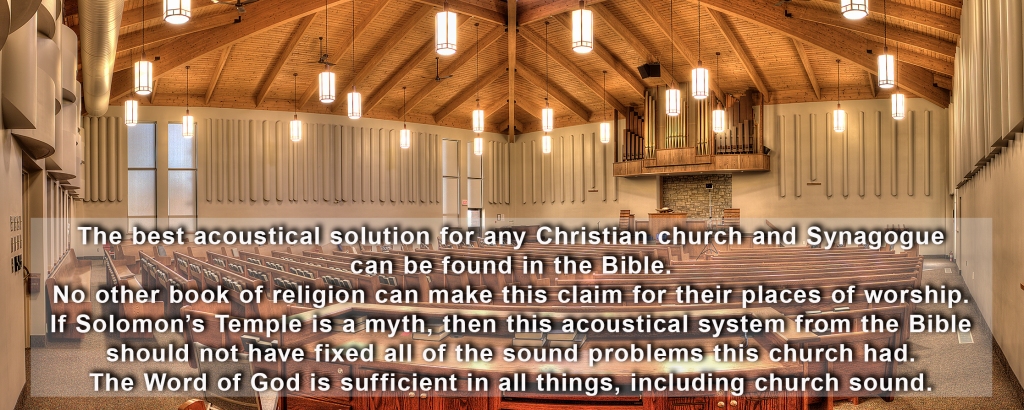
A myth can’t fix a church. The Word of God Can!
Both Physically – including the acoustics of a church, and Spiritually.
Share this if you believe that it is true.

Posted in Church Acoustics | Tagged: , , , , , , , , , , , , , , , , , , , , , , | Comments Off on Is Solomon’s Temple a Myth?

The Father of Modern Day Acoustics, Wallace Sabine and Solomon’s Temple

Posted by jdbsound on February 5, 2020


Introduction

In the field of acoustics and sound, many have said that Wallace Clement Sabine is considered the father of modern-day architectural acoustics. His scientific work was not only the foundation for concert hall acoustics, but few are aware of how his work has impacted the church community around the world. According to several sources, he was raised in a protestant home, but as an adult belonged to no church and professed no religious faith, yet his work has impacted churches in ways even Wallace could not have imagined. Wallace’s work included figuring out a prediction model of how to apply absorption to tame a room. He also proved that the reverberation time alone is not enough in helping performance spaces with their sound needs. He laid down a foundation, showing that you need much more detailing and care to create suitable sounding spaces, not just for concert halls, but for full Christian worship too.

Shortly after his discoveries and successes, most acoustical experts, Architects, engineers, and audio experts have focused on one thing, the reverberation time of a room – ignoring much of his actual contributions to modern acoustics. When Wallace created the first equation to calculate how much absorption is needed, most people thought that this equation was something magical. It was almost as if a single number could solve all sound problems for concert halls and performance spaces. While such a numeric value is essential, it was a small part of a much larger picture. Sure, Wallace did devote a lot of his time to such studies. Unfortunately, the absorption calculation moved from being a small tool as part of a broader view of performance acoustics to becoming the only thing that mattered. This equation gained mythological-importance to the point that for many laypeople….

To read the rest of this article, download the PDF file with this link. https://www.jdbsound.com/art/father%20acoustics.pdf

Once again we see science and the Bible in almost perfect harmony. Within science, there are many tools. For acoustics, there are specific tools. With the help of the Bible, it requires a set of tools that are unique to churches. For concert halls, recording studio’s and other entertainment venues, there are a set of tools for each one. Most of those tools do not apply to churches. When the tools of an acoustical consultant don’t use the Biblical tools exclusively, you will always get the acoustical performance of what those tools were based on. If you have only concert hall or studio or entertainment tools, then the results will not meet all of the needs of the church. If you use Biblical tools, you wind up with a House of Worship as the Christian community should have, but most churches don’t have a clue of what they are missing out.

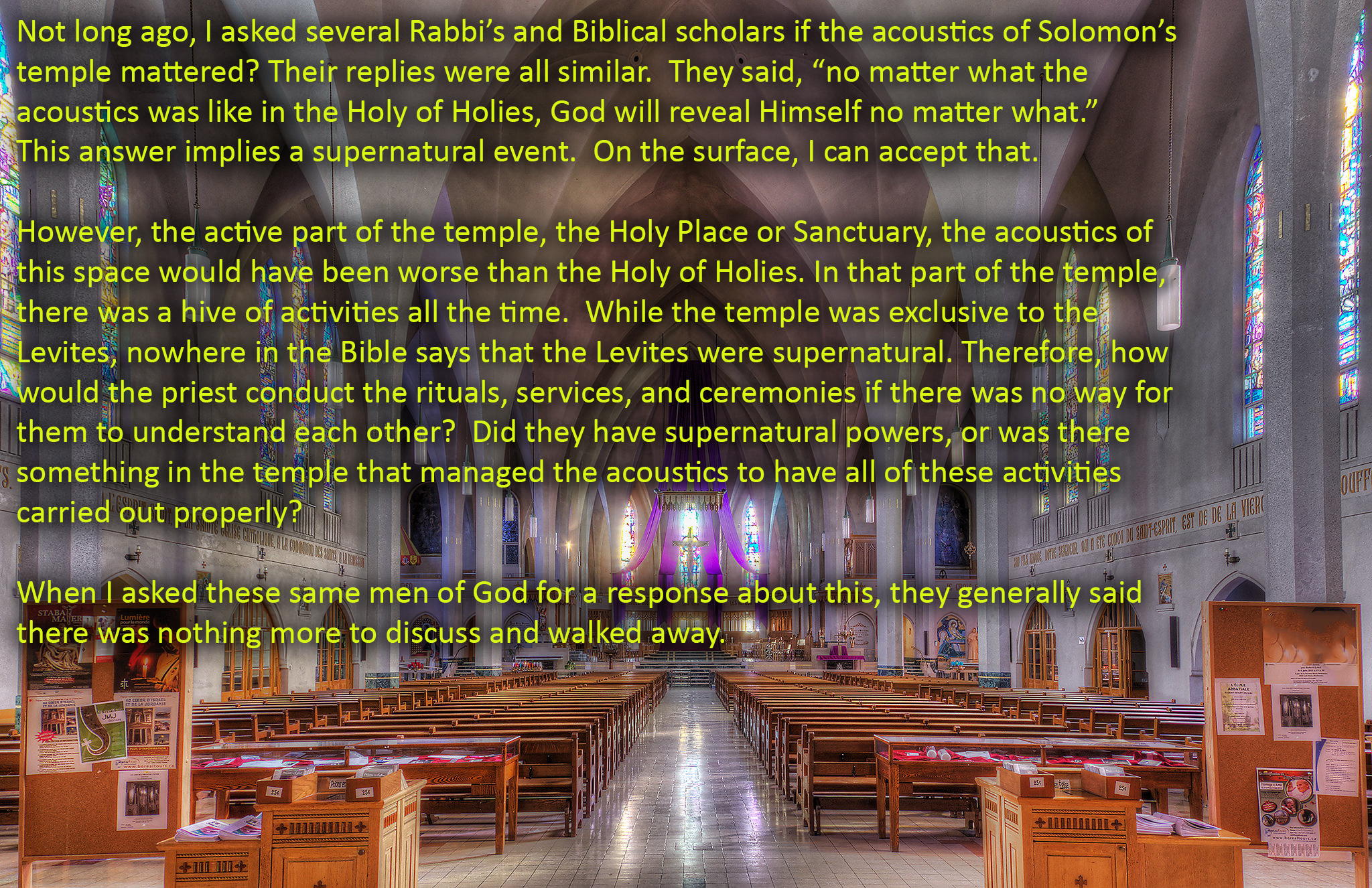
Solomon’s Temple was very detailed in how it sounded. If you believe in the Trinity as I do, because of John 1:3 you know that Jesus design the temple that Solomon built. Without the acoustical planning in Solomon’s temple, the Levites would of had to have super natural powers to hear each other within the walls of the temple. There is no record of the Levites having such powers. What did they do to the temple to make it possible for people to hear in such are large space?

Here is something to consider. If Solomon’s temple is a myth, then the details of how the temple walls were completed should not have survived over history. After all, there is no record of the interior of Herod’s Temple other than some carving on the ceiling that Herod ordered which is not in the Bible. If someone says the Scriptures are not the inspired word of God, then the details of Solomon’s temple wouldn’t matter. But what happens when you apply the details of Solomon’s temple to an existing church? If it is a myth, nothing should happen. If it fixes a church, doesn’t that prove God, Jesus and the Holy Spirit? What does that mean if over 400 churches have applied such a system in faith, using the same methods from the Bible to make the acoustics of their churches as best as they can be?

The details of Solomon’s temple matters. Nothing in the Bible is about trivial nonsense. Everything in the Bible has a purposes and the details of Solomon’s Temple is a roadmap to fixing existing churches and it should be a template for new churches today now that we understand why such details were persevered for us in the scriptures today. How many more churches need to be convinced before it becomes a normal way to complete our houses of worship?

If anyone with normal hearing in a church has trouble understanding what is being said in God’s House of Worship, the Bible has the solution for that. And that solution is very affordable. Please enjoy the rest of the article.

The Father of modern acoustics

By Joseph De Buglio (c) 2020

Posted in Church Acoustics, Church Sound Systems, Educational Must Read Articles | Tagged: , , , , , , , , , , , , , , , , , | Comments Off on The Father of Modern Day Acoustics, Wallace Sabine and Solomon’s Temple

Is Church Acoustics Easy?

Posted by jdbsound on December 23, 2019


There are two answers to this question. When you follow just the science, the correct answer is no. When you follow what the Bible teaches, the answer is yes.  Church acoustics is simple, but many will tell you otherwise. While it is easy to change how a room sounds, it is another thing to change the sanctuary to perform appropriately for a complete Christian Worship experience regardless of the denomination or congregation you belong. Christian Church worship is unique and the acoustical requirement of any church cannot be found, practiced or learned outside of any church community adequately.

Concert halls, recital halls, recording studios or any room where non-Christian people revere as great places for music or live stage performances and entertainment, these places have clouded, (Mat 7:15) the judgment of churches communities all over the world for years of what Christian worshipers need in a large room. When we turn to the Bible for the kind of worship space we are supposed to have, the answers most Christians are looking for are right there.

Science has not caught up with what is required for church acoustics. It is not able to predict the perfect acoustics a church needs. In each generation of computer modeling, it is getting much better. The good news is that we don’t have to wait for science to catch up to modeling proper worship space acoustics. The Bible has always had the solution as a tool to solve or plan church acoustics, even in the 2100 century. When such planning is applied the outcome is still what a congregation wants and needs. Here is a prime example of Biblical Scientific Foreknowledge at work. When we look past the Golden walls and floors and peel back the details of how Solomon’s Temple was designed and finished, we discover a worship space that every Christian congregation should have today.

The Bible has always had the proper teaching or formula for large room “Worship” acoustics. Did you know that without God’s design for acoustics, the Levites would not have been able to do any ceremonies or teaching in the temple? In Solomon’s Temple, there was an acoustical system given to Solomon that was applied. When employed in modern churches today, it solves almost all of the acoustical problems we can often hear and it makes the worship space better for congregational singing every time. Hundreds of churches have already been fixed or planned in this way. How many more before we can trust the Bible for modern church sound needs?

For church worship, whether in a classical or modern church structure, a commercial space, or converted space, there are many performance requirements to obtain the full worship experience which includes hearing the Gospel unfiltered by the poor acoustical performance of a sanctuary. (Poor acoustics acts like a changing filter that pollutes the Gospel. It can make similar words sound different which changes the meaning of what was said. For people familiar with the Bible, this may not be that big of an issue but for a person who has never been to church or is unfamiliar with church speak/language, when the room changes the pronunciation of a word, it can change the meaning of what they thought they heard. A church with the proper acoustics will prevent most of these mistakes regardless of what a sound system can do.) There is preaching, prayer, congregational singing, testimonies, choirs, worship teams and worship concerts. All of these parts of worship have to perform equally.

Church acoustics is not straightforward without the Bible. It is very complicated and any person designing an acoustical change should be including all aspects of worship, not just making a quick fix because of an irritation. As more churches recognize this truth, many are fixing existing past acoustical treatments that were done with good intentions and without help from the Bible. For example: Many people working in live sound don’t know that most hotspots and deadspots are acoustical problems and made worse when the wrong sound system design is installed. If your church has the right sound system design and there are still places where the sound levels and speech intelligibility is a problem, the sound system is telling you or screaming that it is a room problem -even if there is not feedback noise.

Church acoustics can be confusing, even with Biblical help. Experience has shown that there can be three churches that can have the same shape, dimensions, and age, and all three worship spaces different acoustical fixes. On the other hand, you can have three churches of different shapes, different dimensions, the same seating capacity and from three different ages and yet the acoustical solutions look almost the same to get the best performance for speech, prayer, congregational singing, choral singing and worship team performances. These differences in acoustical treatments are not easy to figure out regardless of the sound system design, equipment, and operating skills.

If the reverberation time is too long, don’t just fix the reverberation time. There are always at least two to five other problems that are being masked by the long reverberation or long time of noise. Correcting only the long reverb time, in most cases, exposes or creates bass problems that weren’t audible before, but the acoustical measurements said that such a predicament would happen. When the subs don’t sound good, you put a cage around the drums and you can’t mic the choir. When the floor monitors are too loud or as loud as the FOH speaker system and you are forced to get in-ear monitors. Then you have to get the worship team members to sign a waiver to not sue the church for premature hearing loss. Fix the room properly to meet all aspects of worship and you can avoid all of these issues.

Church acoustics is complicated and people who do Recording Studio, Concert Hall, Recital Hall, and noise control acoustics all have good intentions in wanting to help out a church. If their solutions are not based on what the Bible teaching, sure, they can change how a room sounds, but will their fixes be what a congregation needs? The choice is yours.
What is rarely taught or shared except on this website, is that a sound system is a magnifier of how a room performs. If the acoustics and shape of a worship space work, the sound system will tell you by how well it performs. If the acoustics are wrong, the sound system will be limited in what it can do. If after changing the sound system twice in the last eight to ten years, didn’t make that much of an improvement, do you really think a third sound system will be any better?

What is also not taught is that it is cheaper to bring a sanctuary up to worship space requirements that support all aspects of worship than to upgrade a typical church speaker system that can only make an incremental improvement for amplified sound. Fixing a room that meets worship space requirements often makes the current sound system perform profoundly better (unless the sound system is so poorly fabricated that it needs to be redesigned and reinstalled if the hardware is up to the task.)

Church acoustics can be easy when you follow the scriptures. Jesus never spoke of this because he already has given us the plans. Jesus said in Mat 5:17 “Do not think that I have come to abolish the Law or the Prophets; I have not come to abolish them but to fulfill them.” The Bible also says that all things were made through Him from the beginning. Jesus could not abolish the laws He created with His Father and the Holy Spirit (John 1:1-4.) There are many churches out there with poor sound, poor acoustics and have members who want to experience the full Christian life including the complete worship experience we all should be having. When you look past the gold and wealth surrounding Solomon’s temple, you will discover a blueprint from Jesus of how all worship spaces should sound. If that means duplicating Solomon’s Temple, that is what we should be doing. How is that so different in the fact the every church practices communion in one form or another. Every church has prayer, singing, reading of the scriptures, sermons and fellowship of its followers. Every part of a person’s life is in the Bible, whether any person can follow it 100% of the time or not. The same should apply to the houses we call churches that are dedicated to our Lord Jesus Christ.

Joseph De Buglio
A Servant of Jesus Christ.

Posted in Church Acoustics, Church Sound Systems | Tagged: , , , , , , , , , , , , , , , , | Comments Off on Is Church Acoustics Easy?

The Scientific Foreknowledge the Bible Teaches about Church Sound?

Posted by jdbsound on July 26, 2019


Here is a fresh look at Solomon’s Temple and how it relates to Modern Churches today. Here is link to a 13 page article about church acoustics from the Bible’s point of view.
The Scientific Foreknowledge the Bible Teaches about Sound and Acoustics?

Introduction

The quality of church worship is critical to the health of a church.  The better the excellence of worship is, the stronger the church will be.  Quality of worship is not about packing the church full of people for the sake of filling a worship space so much that it becomes necessary to keep building bigger buildings.  We worship God, not buildings or pastors or knowledge.  It is the Gospel, the Bible that leads us to God.  It is God’s words that keep us in a relationship with Him.  The strength of a church is not measured in numbers in the seats or money.  Jesus taught us to feed the hungry, clothe the poor, and shelter the homeless.  The Bible teaches over and over again that we are to live by example (Psalms 1:1-6), to be a light in the world (Matt 5:16), when they see that we are different (James 2:14-26), it will be that difference that will attract people to God.

The strength of a church is measured by how people support each other, and by how much a congregation supports each other as a family first, as brothers and sisters, and then the local community.  Is the church feeding the hungry, clothing the poor, and sheltering the homeless?  The modern version of Jesus teaching for us in countries with a democracy and wealth should look like this.  Is the church cutting lawns, clearing driveways, cleaning people’s homes, fixing up members and non-members homes?  How often are church members spending time with the widows, the singles who have never had a partner, or the elderly?  Are these not the things included in what Jesus told us to do?  Are not these the same teachings in the Old Testament?  This is just a small sample of how Christianity should look like to the secular world.

___________________________________________________________________
After reading the full article, please comment on it. We want to get this right as the church community needs this knowledge. If you have any questions, want to learn more or see a presentation about Solomon’s Temple and the Modern Church, contact me here – jdb@jdbsound.com

You church may be one of those that has great sound for all parts of the worship service. If it is, you should let everyone know as it will help to bring more people in. You should let us know so we can tell others. If you find this article helpful, please pass it on. Pass it on to your pastor, your friends and family. Give them the chance to learn what God can do for them today!

Thank you.

All modern churches can benefit from Biblical Acoustics
All older churches can benefit from Biblical Acoustics

Posted in Church Acoustics, Educational Must Read Articles | Tagged: , , , , , , , , , , , , , , , , , , , , , , , | Comments Off on The Scientific Foreknowledge the Bible Teaches about Church Sound?

Seeking the Truth

Posted by jdbsound on July 18, 2019


As an expert in Church Acoustics and in the pursuit of the truth, I have also been passionate about finding ways for all churches to afford an acoustical solution that will solve just about every sound problem most churches run into. What can be more exciting than knowing that the cheapest and best acoustical solution in the world for all churches comes from the book that all Christians follow and obey – the Bible. When a church uses the Bible’s method for acoustical management, sound problems almost all go away and in most cases, a sustained higher church attendance happens after around 18 months. God is the author of Church Acoustics and it is time for churches to seek God first for answers and God will reveal His way to solve sound problems in His Houses of Worship. Whenever a church is dedicated to God, doesn’t it become His House?

Joh_14:6 Jesus saith unto him, I am the way, the truth, and the life: no man cometh unto the Father, but by me. If we take that a step further, Jesus was present in the design of Solomon’s Temple. While Millions have already been saved in the past, present and hopefully the future, how many more can be added if all Houses of Worship were built or brought up to the same acoustical standards as in Solomon’s Temple? Since most churches don’t have that quality of room acoustics, I guess we may never know!

Posted in Church Acoustics, Church Sound Systems, Rants | Tagged: , , , , , , , , , , , , , | Comments Off on Seeking the Truth

Was Solomon’s Temple for real? If it was, how would it sound?

Posted by jdbsound on May 7, 2019


Was Solomon’s Temple a fairy tale? I don’t think so. I think Solomon’s Temple was as real as touching your own skin. Why? Solomon’s Temple was designed over 3,000 years ago. When you study the sound quality of the two rooms, it describes spaces that were purpose built for specific functions. The room that reflects modern day acoustics is the Holy Place or Sanctuary as we like to call it today. How can the design of a room from 3000 years ago be so good if it was never built or a fairy tale or myth? Do you think that King David or Solomon knew anything about acoustics back then? Did God tell King David and Solomon’s how to design rooms where hearing would be easy or difficult? Could the acoustics of the Holy Room reflect todays demanding needs of sound for worship? Yes. Absolutely!

The only difference between what a traditional worship space and a contemporary worship space would be the need for is adding carpeted floors and padded seating for worship team lead services. Churches with similar dimensions and shape as Solomon’s Temple have a way better worship experience over churches that have other room shapes. That is not to say you can’t have a good worship experience in other room shapes, but if you can remember your best worship experience in other rooms with good acoustical sound management, it is way better when the room is a rectangle. This only happens when the room is twice as long as it is wide, and with a very high ceiling that is 75% of the rooms length. With those dimensions and with the same type of acoustical treatment system as used in Solomon’s temple, regardless of your worship style, the only experience better than that would be in Heaven. And yes, the carvings of Cherub, Palm Trees and open flowers was actually an acoustical system designed by God. The updated version of it work great in modern churches today.

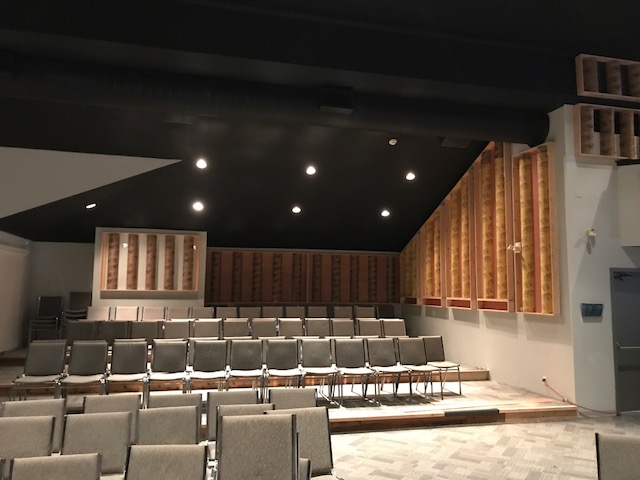
The modified version use half round shapes like the Palm tree. An affordable way to fix any church is with cardboard tubes. Such tubes using a water based glue meets fire codes in almost any place around the world, and does as good of a job as the carvings in Solomon’s Temple. For churches that have little to no money to spare, this is the cheapest way to breath life into all of those existing churches out there regardless of their room shapes. This is the only acoustical system that improves congregational singing (even is dead rooms), and doubles the loudness of the sound systems performance without distortion and without buying more equipment. (assuming that the equipment you already have is up to the task of performing at these levels in the first place.)

Now when I say doubles loudness of the sound system, it means that if you total the components of your speaker system, amplifiers and processors, and multiply the equipment 10 times, that is doubling the loudness. Remember that doubling the equipment or doubling the power only gives you a 3dB increase, but it take 10 times the power to double the loudness without distortion which is equal to 10dB. In most churches, an acoustical fix such as this has a one time costs of about $5.00 per seat. A typical speaker system for a church cost around $30.00 per seat and up. To get the same performance through sound equipment as a room treated with Cardboard Tubes, the speaker system goes up to $300.00 per seat or ten times the cost. If you do a reality check, you would actually have to spend more because you are still fighting the room to keep the sound distortion free. Even at $500.00 per seat, you may not be able to get double the loudness without distortion. To apply this kind of acoustical system as in a church as in Solomon’s temple, it lowers the cost of a sound system while increasing it’s performance. There is no other acoustical system that can do that.

Now Solomon’s Temple was built over 3000 years ago. How did they know how to do acoustical treatment that works in churches today? How is it that something designed 3000 years ago is so sound system friendly? The reality is, God inspired it’s design. Many Christians believe that the Bible is sufficient in all things and that should including church design and acoustics. Shouldn’t we be following what the Bible says and teaches, even in worship space design? (Ecclesiastes 1:9)  The thing that hath been, it is that which shall be; and that which is done is that which shall be done: and there is no new thing under the sun. If there is nothing new under the sun, then why do churches keep trying to design something original or different when there is nothing better out there? Worse yet, why don’t churches know that for preaching the Gospel there is no better room than a room with the dimension ratio’s as in Solomon’s Temple? Furthermore, why are so many churches determine to solve acoustical problems with electronics when they don’t have to?

Solomon’s temple was small. It could only seat around 150 people if used as a church today. Apparently, you can scale the room up to any size and have the same performance results. Why hasn’t the church community figured this out? (Why aren’t Synagogues built this way either?) From my own experience, if you use these dimensions, such a room will sound amazing as long is the walls have the right shapes added on them. At the same time this room will awful if you don’t include the same type of acoustical system as used in Solomon’s Temple. Please notice that I use the term “System”, and not “Treatment.” When you call it a system it is about a planned acoustical space or a system that treats the whole room. When you call it a treatment, it is as if the acoustical products are used as an after-thought. Such acoustical products are used only do spot treatments and they provide minor room fixes, and cost so much more expensive.

The most important roll of a House of Worship is to preach the Gospel. No other room shape, dimensions and wall finishing’s does it better. Why would any church design the most important room with a lesser goal? The foyer, fellowship halls, classrooms, office and the shell of the building can be any shape you want but the worship space should be designed for the sole purposes of teaching the Gospel and for a full worship experience. All other room shapes and treatments, regardless of the sound system design and equipment fall short in meeting the standard found in Solomon’s temple.

If you believe as I do that the Bible is sufficient, then it should be sufficient in the design on your next church sanctuary. Oh, didn’t anyone tell you? A room built to Solomon’s dimensions costs less to build, heat and cool and maintain. Solomon’s Temple is a fine example of “Nothing new under the sun.”

For the 400 plus churches that already have such an acoustical system, what further proof do you need that Solomon’s temple was real? If you want to take it a step further, since science cannot predict how this acoustical system works, a system that you have to apply in faith, does that constitute a miracle?

Posted in Church Acoustics, Educational Must Read Articles | Tagged: , , , , , , , , , , , , , | Comments Off on Was Solomon’s Temple for real? If it was, how would it sound?

Where are the Carboard Tubes

Posted by jdbsound on August 28, 2017


Churches use a lot of Cardboard Tubes in acoustical room fixes because they are very effective in getting the room performance they want and need.  Cardboard Tube not only outperform all other acoustical products in churches but they are also the most affordable.  There is nothing that can do what half-round tubes can do, even at 40 times the cost.

Ok then, what if you don’t like the look of cardboard tubes around your worship space.  Here is an option some churches have been willing to spend a little extra for.

image10

These look like standard 5 inch deep absorbing panels.  They are not.  These are Sono Tubes mounted in a wooden frame and covered with cloth.

image9

The cloth was an added expense and it was worth it.  The fire rated cloth is expensive and before covering the panels, you want to make sure the acoustical system is going to work and work it did.  The church is very happy with the results and they are enjoying the room.

image8

This is what the installation looked like before it was covered.  The wooden frame has no effect on the performance of the half round tubes.  The cloth only affects frequencies above 10,000 Hertz which means they have no effect on speech or music.  In this installation, three sizes of tubes were used.

image7

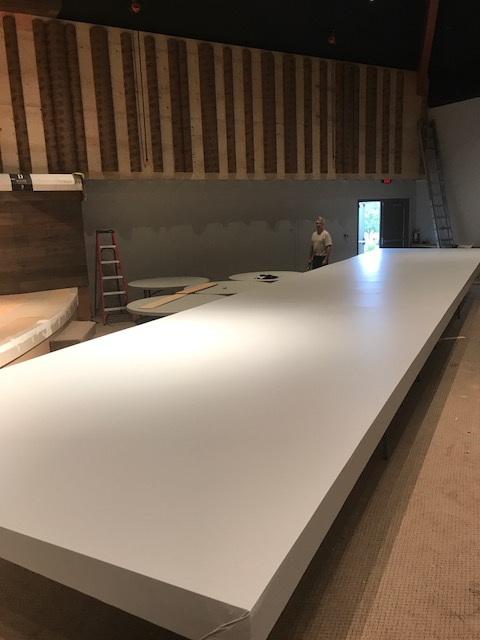
At the bottom is a huge video wall screen.  On the wall are the Sono Tubes.  Yes, the tubes will work behind a vinyl screen.  If you notice the pattern of the diffusers on the wall. that pattern was needed to control lower mids and bass sound energy.  This pattern was pretested in our test room.

northside church video wall

Here is the finished installation of the video system.  It takes three projectors for each screen.  The center screen is a video wall.

Photos courtesy of Frederic Lachance of Northside Church in Coquitlam BC, 2017.

Posted in Church Acoustics, Educational Must Read Articles, Photos of Church Projects | Tagged: , , , , , , , , , , , , , , , , , , , , , | Comments Off on Where are the Carboard Tubes