

Large-room acoustics, especially in churches, is rather straightforward. However, the solutions are often inconvenient and often mean a change in the room’s aesthetics. The thing is, the aesthetic issues come up when an acoustic fix doesn’t work, and the church has to look at it for the next 30 years before it can afford to attempt another fix.
Acoustic problems always come in layers. They can be fixed one layer at a time, or all of them can be fixed in one step.
There are two main approaches to acoustic solutions. Biblical or Secular. The first is the point-and-shoot secular method.
In the point-and-shoot method, a person with some acoustic knowledge and training in secular acoustics makes noise, claps their hands, and takes measurements. They find an offensive surface, and they apply an acoustic fix that can be absorptive, diffusive or a combination product. The acoustic fix works. However, shortly after the acoustic fix is applied, another acoustic problem arises, and it is annoying enough to also need to be fixed. Either the same consultant or another consultant makes noises, claps their hands, and takes measurements. They discover another offending surface and recommend another acoustical fix.
Shortly after the second acoustic fix is applied, another problem shows up. What! Why didn’t the acoustical consultant or expert anticipate the problem? Simple. The secular method addresses one layer at a time. Most acoustical experts don’t have the training or experience to drill down deep to provide a complete acoustical solutions. Over the years, some consultants have said, this is how to get repeat customers. Fix the room just enough to prove you are the expert, to come back when new problems show up. The truth is, their training was reactive, not preventative. There is no training program that shows how to anticipate acoustical problems and how to prevent them from becoming an issue.
It is similar to how some Medical Doctors know how to maintain a person on a drug dependency system and never heal the person of their illness. The first drug makes the current problem manageable, but there is another drug needed to manage the side effects. Months later, as a new side effect shows up, the Doctor prescribes another pill to treat the second side effect. Patients are treated as ATM machines for the drug companies. This cycle never ends, and the person never gets better or healed. Likewise, acoustical experts are good at providing enough of an acoustic fix that allows the audio people to be more inventive and dependent on technology to limp along. The audio community then acts as if the laws of physics don’t apply to them, and they launch into endless research to find an audio device that circumvents the “laws of physics”, or makes the physics bend to their wishes. After spending thousands of dollars on the latest and greatest technology, the problems persist.
The point-and-shoot method of acoustic fixes rarely ends with a happy client or church congregation. This approach is more like trying to win the lottery rather than creating a permanent solution. The point-and-shoot method is costly. From surveys done in the 1990’s, the sound and acoustic quality in a church can affect church attendance up to 15%. Not only does quality sound affect those with hearing problems, which can be up to 10% of church members and adherents, but a growing number of people, between 4 to 18%, would rather watch a worship service at home, where the sound quality is better, rather than attend the service in person in a poorly sounding room. When people are not attending, they are not giving, which is an added cost to putting up with poor acoustics and sound. For some churches, a loss of 10% in attendance can translate to an annual 5% loss of income for every year the church puts up with the acoustical problem. For a 600-seat church, that can be a loss of over $310,000 in 10 years. That is about the cost of replacing a church roof. The point-and-shoot method of acoustical management never stops costing a church until it is properly fixed.
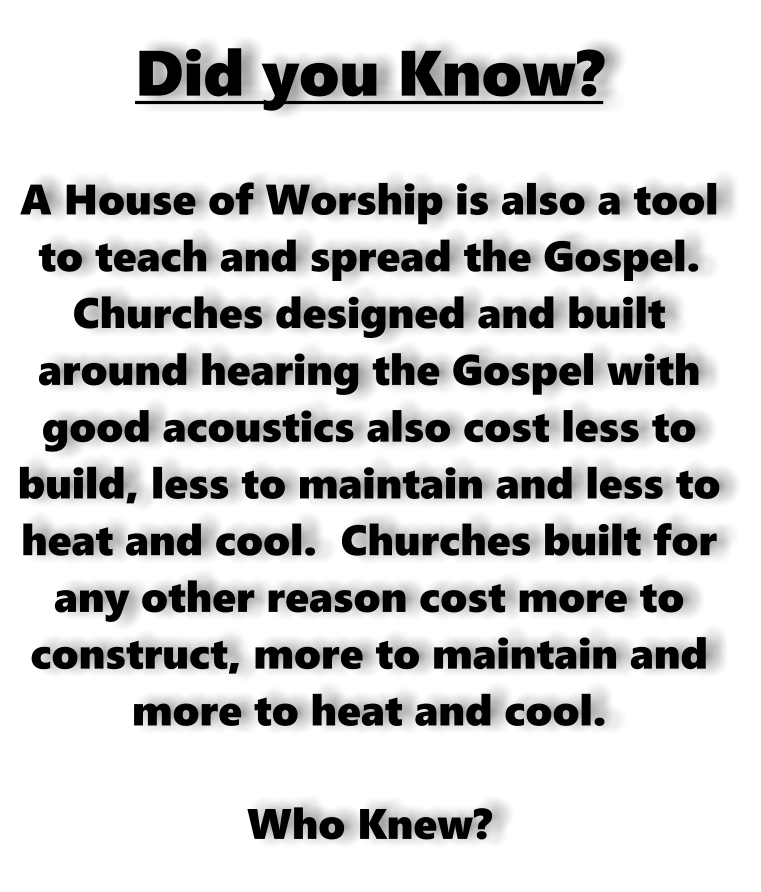
The second method of managing large room acoustics is to see the solutions as a complete system where every possible problem is prevented before it can happen. Added to that, for a church, the room also has to be interactive to support congregational singing, the second most important activity for worship, with hearing the sermon (speech) the most important activity.
The steps in church sound and large room sound are as follows.
- Creation of the sound. Singing or spoken word or the playing of a musical instrument.
- Recording of the sound. If there is a need to amplify the sound, you need to have microphones to record those sounds.
- Next is an amplifying system that records the sounds, mixes them, and then broadcasts the sound to the rest of the room. Here is where things get crazy.
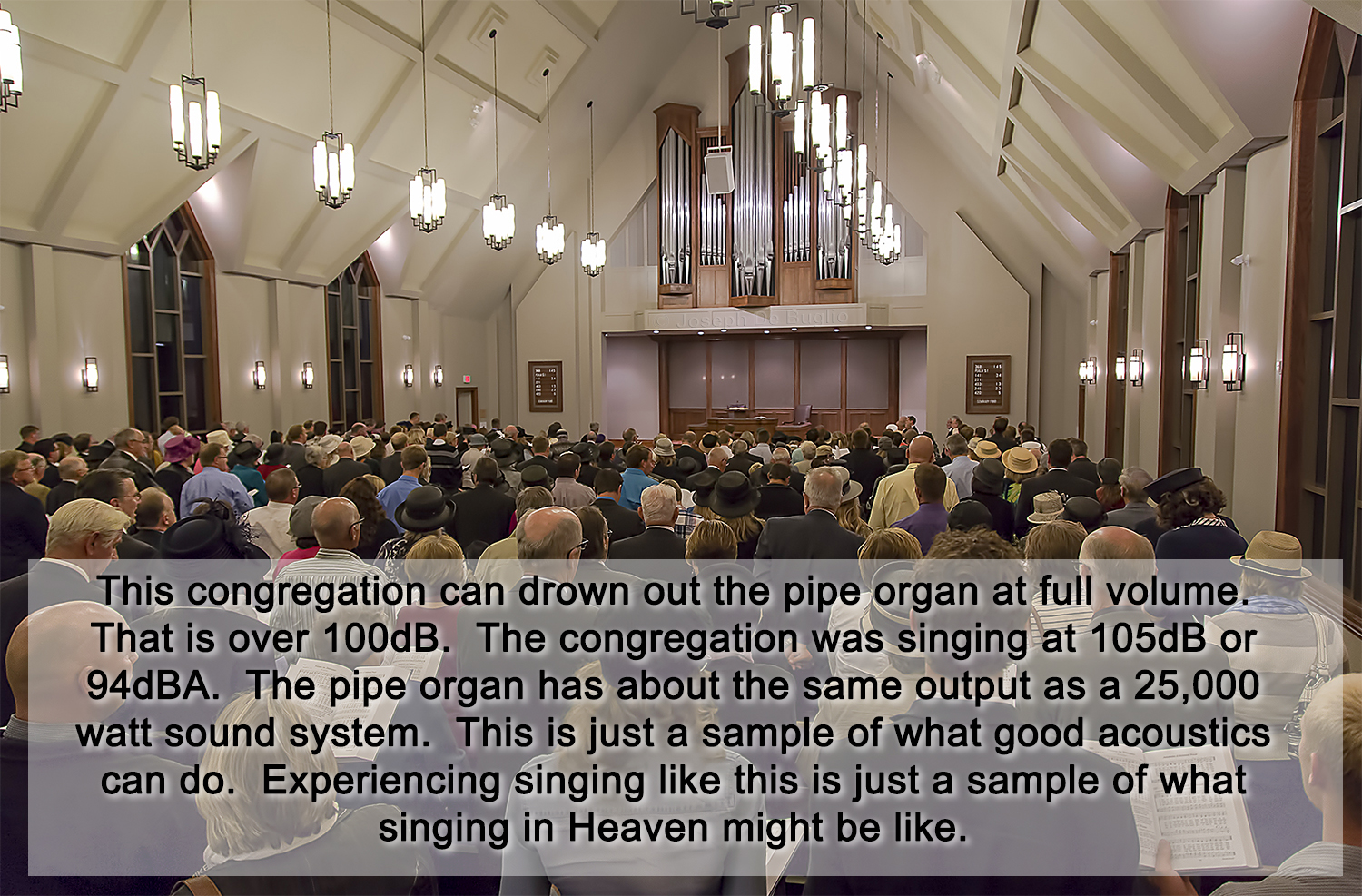
In a good room, the speakers for the sound system are laid out to meet the needs of the listeners in the seats. The acoustics don’t get in the way of the performance of the microphones, the floor monitors or the instruments on stage. Good acoustics will support congregational singing. Good acoustics don’t interfere with a properly designed sound system.
People are designed to look at what they hear, and a properly designed system will support that in a good room. In such cases, the sound system is just a tool, and it is barely noticed during worship. No feedback, no dead spots, no interruptions. A church with good acoustics often has extra funds for higher-quality equipment that never gets in the way of worship.
In a poor room, a room treated by secular methods, sound engineers jump through hoops with speaker layouts that create an unnatural-sounding solution. They get creative in finding ways to attempt to circumvent physics in the hope of manufacturing a compromised solution that falls short in meeting the needs of the listeners. There is little success and a high level of acceptance of compromise on a weekly basis. Such sound systems cost thousands of dollars more, with each upgrade providing only incremental fixes rather than meaningful solutions and often the congregational singing gets worse.
Did you know that drum booths and in-ear monitors(I.E.M.) are acoustic-driven? In a good room, the drummer can hear the stage full of musicians and play more quietly. The drummer doesn’t have to compete with others when they can hear themselves and all the other performers. Likewise, in a good room, floor monitors work just fine, where the musicians can hear the audience and the floor monitors without any effort.
In a good room, there is no time when the floor monitor needs to be louder than the front of house speakers. Yet in a bad room, the floor monitors need to turn up so loud and the drummer can’t hear themselves that it drives people to IEM’s and drum booths. When a church gets its acoustics fixed, the drum booth and IEM disappear. Did you know that for many churches, the drum booth and IEM system cost more than fixing the acoustics?
Which takes us back to the real issue, aesthetics. Whether your church does point-and-shoot acoustical fixes or a complete acoustical fix, it will change the appearance of the space. In the end, whose church is it?
Have you ever wondered what the purpose of the palm tree carvings in the holiest temple on the planet was? It says in 1st King, 6:29 that on all the walls were carvings of Cherubs, Open Flowers and Palm Trees. The carvings of flowers and cherubs are easy to explain and are supported spiritually. What is spiritual about palm trees? The carvings of palm trees were to solve an acoustic problem along with the veil. Put the carvings and veil together, and you have a recipe for a universal acoustical fix that works in all existing churches. Can it be that simple? Afterall, isn’t this a house of God, or a place for God’s people to worship in? If this acoustical treatment was used in God’s house, it should be good enough for your church.
Currently, over 400 churches worldwide have applied this acoustic fix, and the results have been successful every time. Does it change the aesthetics? Yes, it does. Do people complain about it? Always until they hear it. Once people experience it, especially the congregational singing, they say it adds character to the room. This has led people to find creative ways to blend the aesthetics. If palm tree shapes were good enough for God’s house that Jesus designed, then how much more can your church benefit from a complete acoustical fix rather than a point-and-shoot approach?
Another way of saying it, following the scriptures provides a simple, straightforward and affordable solution to church sound issues that meets everyone’s needs in one step. All other sound and acoustic fixes are secular, and the secular methods are complex, confusing, hyped, and always very expensive, rarely meeting the needs of performers and listeners at the same time. The secular method to church sound is a money pit that has marginal returns on investment, whereas the Biblical method heals the room, which, in turn, this high-quality sound pays for itself every 18 to 24 months. That is stewardship.

 Welcome to the world of Church Acoustics