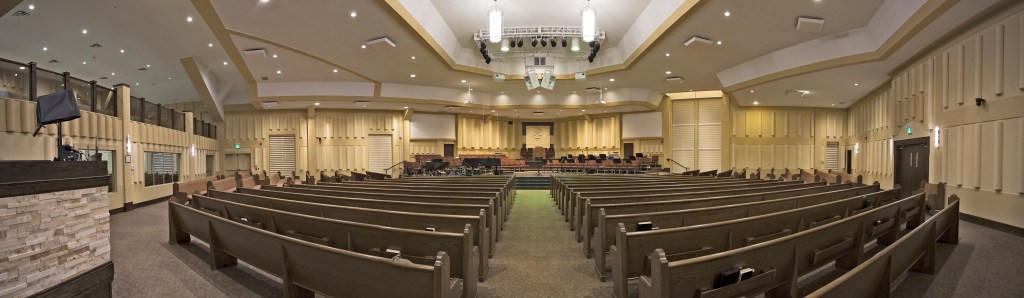
Welcome to the world of Church Acoustics

Teaching the highest quality in Church Sound excellence

  • Supported by

    Contact:
    Ph # 519-582-4443
    email: jdb@jdbsound.com

    The Bible is the de facto standard for all church worship needs including sound and acoustics.

    2 Timothy 2:15

  • Archives

  • For additional contact information scan the QR code below

    link to jdbsound.com

Posts Tagged ‘Jesus’

Effective Church Acoustic Solutions for Better Worship Experience

Posted by jdbsound on February 27, 2026


Large-room acoustics, especially in churches, is rather straightforward.  However, the solutions are often inconvenient and often mean a change in the room’s aesthetics.  The thing is, the aesthetic issues come up when an acoustic fix doesn’t work, and the church has to look at it for the next 30 years before it can afford to attempt another fix.

Acoustic problems always come in layers.  They can be fixed one layer at a time, or all of them can be fixed in one step. 

There are two main approaches to acoustic solutions.  Biblical or Secular.  The first is the point-and-shoot secular method.

In the point-and-shoot method, a person with some acoustic knowledge and training in secular acoustics makes noise, claps their hands, and takes measurements.  They find an offensive surface, and they apply an acoustic fix that can be absorptive,  diffusive or a combination product.  The acoustic fix works.  However, shortly after the acoustic fix is applied, another acoustic problem arises, and it is annoying enough to also need to be fixed.  Either the same consultant or another consultant makes noises, claps their hands, and takes measurements.  They discover another offending surface and recommend another acoustical fix. 

Shortly after the second acoustic fix is applied, another problem shows up.  What!  Why didn’t the acoustical consultant or expert anticipate the problem?  Simple.  The secular method addresses one layer at a time.  Most acoustical experts don’t have the training or experience to drill down deep to provide a complete acoustical solutions.  Over the years, some consultants have said, this is how to get repeat customers.  Fix the room just enough to prove you are the expert, to come back when new problems show up.  The truth is, their training was reactive, not preventative.  There is no training program that shows how to anticipate acoustical problems and how to prevent them from becoming an issue. 

It is similar to how some Medical Doctors know how to maintain a person on a drug dependency system and never heal the person of their illness.  The first drug makes the current problem manageable, but there is another drug needed to manage the side effects. Months later, as a new side effect shows up, the Doctor prescribes another pill to treat the second side effect.  Patients are treated as ATM machines for the drug companies.  This cycle never ends, and the person never gets better or healed.  Likewise, acoustical experts are good at providing enough of an acoustic fix that allows the audio people to be more inventive and dependent on technology to limp along. The audio community then acts as if the laws of physics don’t apply to them, and they launch into endless research to find an audio device that circumvents the “laws of physics”, or makes the physics bend to their wishes.  After spending thousands of dollars on the latest and greatest technology, the problems persist.

The point-and-shoot method of acoustic fixes rarely ends with a happy client or church congregation.  This approach is more like trying to win the lottery rather than creating a permanent solution.  The point-and-shoot method is costly.  From surveys done in the 1990’s, the sound and acoustic quality in a church can affect church attendance up to 15%.  Not only does quality sound affect those with hearing problems, which can be up to 10% of church members and adherents, but a growing number of people, between 4 to 18%, would rather watch a worship service at home, where the sound quality is better, rather than attend the service in person in a poorly sounding room. When people are not attending, they are not giving, which is an added cost to putting up with poor acoustics and sound.  For some churches, a loss of 10% in attendance can translate to an annual 5% loss of income for every year the church puts up with the acoustical problem.  For a 600-seat church, that can be a loss of over $310,000 in 10 years.  That is about the cost of replacing a church roof.  The point-and-shoot method of acoustical management never stops costing a church until it is properly fixed.

The second method of managing large room acoustics is to see the solutions as a complete system where every possible problem is prevented before it can happen.  Added to that, for a church, the room also has to be interactive to support congregational singing, the second most important activity for worship, with hearing the sermon (speech) the most important activity.  

The steps in church sound and large room sound are as follows.

  1. Creation of the sound.  Singing or spoken word or the playing of a musical instrument.
  2. Recording of the sound.  If there is a need to amplify the sound, you need to have microphones to record those sounds. 
  3. Next is an amplifying system that records the sounds, mixes them, and then broadcasts the sound to the rest of the room.  Here is where things get crazy.

In a good room, the speakers for the sound system are laid out to meet the needs of the listeners in the seats. The acoustics don’t get in the way of the performance of the microphones, the floor monitors or the instruments on stage.  Good acoustics will support congregational singing.  Good acoustics don’t interfere with a properly designed sound system.

People are designed to look at what they hear, and a properly designed system will support that in a good room.  In such cases, the sound system is just a tool, and it is barely noticed during worship.  No feedback, no dead spots, no interruptions.  A church with good acoustics often has extra funds for higher-quality equipment that never gets in the way of worship.

In a poor room, a room treated by secular methods, sound engineers jump through hoops with speaker layouts that create an unnatural-sounding solution.  They get creative in finding ways to attempt to circumvent physics in the hope of manufacturing a compromised solution that falls short in meeting the needs of the listeners.  There is little success and a high level of acceptance of compromise on a weekly basis.  Such sound systems cost thousands of dollars more, with each upgrade providing only incremental fixes rather than meaningful solutions and often the congregational singing gets worse.

Did you know that drum booths and in-ear monitors(I.E.M.) are acoustic-driven?  In a good room, the drummer can hear the stage full of musicians and play more quietly.  The drummer doesn’t have to compete with others when they can hear themselves and all the other performers.  Likewise, in a good room, floor monitors work just fine, where the musicians can hear the audience and the floor monitors without any effort.

In a good room, there is no time when the floor monitor needs to be louder than the front of house speakers.  Yet in a bad room, the floor monitors need to turn up so loud and the drummer can’t hear themselves that it drives people to IEM’s and drum booths.  When a church gets its acoustics fixed, the drum booth and IEM disappear.  Did you know that for many churches, the drum booth and IEM system cost more than fixing the acoustics?

Which takes us back to the real issue, aesthetics.  Whether your church does point-and-shoot acoustical fixes or a complete acoustical fix, it will change the appearance of the space.  In the end, whose church is it?

Have you ever wondered what the purpose of the palm tree carvings in the holiest temple on the planet was?  It says in 1st King, 6:29 that on all the walls were carvings of Cherubs, Open Flowers and Palm Trees.  The carvings of flowers and cherubs are easy to explain and are supported spiritually.  What is spiritual about palm trees?  The carvings of palm trees were to solve an acoustic problem along with the veil.  Put the carvings and veil together, and you have a recipe for a universal acoustical fix that works in all existing churches.  Can it be that simple?  Afterall, isn’t this a house of God, or a place for God’s people to worship in?  If this acoustical treatment was used in God’s house, it should be good enough for your church. 

Currently, over 400 churches worldwide have applied this acoustic fix, and the results have been successful every time.  Does it change the aesthetics?  Yes, it does.  Do people complain about it?  Always until they hear it.  Once people experience it, especially the congregational singing, they say it adds character to the room.  This has led people to find creative ways to blend the aesthetics. If palm tree shapes were good enough for God’s house that Jesus designed, then how much more can your church benefit from a complete acoustical fix rather than a point-and-shoot approach?

Another way of saying it, following the scriptures provides a simple, straightforward and affordable solution to church sound issues that meets everyone’s needs in one step.  All other sound and acoustic fixes are secular, and the secular methods are complex, confusing, hyped, and always very expensive, rarely meeting the needs of performers and listeners at the same time.  The secular method to church sound is a money pit that has marginal returns on investment, whereas the Biblical method heals the room, which, in turn, this high-quality sound pays for itself every 18 to 24 months.  That is stewardship. 

Posted in Church Acoustics, Church Sound Systems | Tagged: , , , , , , , , , , | Leave a Comment »

The Original Golden Ratio for Church Acoustics

Posted by jdbsound on January 22, 2025


or The Bible’s Ratio for Church Acoustics

Every church is dedicated to God as a house of worship. The designers, builders, and congregations all seek that perfect balance between speech, congregational singing, and music. Most churches never experience this balance because they don’t follow the plan laid out in the Bible. Yes, the Bible does in fact lay out the perfect example for all churches to adhere to. The following is the standard. It starts with the ideal room shape for Christian Worship. The rest of the standard is how to complete the interior of the worship space.

Width 1
Height 1.5
Length 2

Example: 30 feet wide, 45 feet high, 60 feet long. Churches with this ratio are perfect when they complete the interior details that conform to the Biblical standard. However, from experience, the height ratio decreases as the room gets bigger. That is something the Golden ratio doesn’t cover. Church acoustics is very unique and very different from the needs of any secular music or entertainment venue.

The Following is that standard.

Absorption Ratio
• 30% of the total surface area of the room needs to be absorptive.
• For most churches, the carpet and padded seating are enough.
• For taller and higher-volume spaces, additional absorption high on the side of the walls will be needed to meet that 30% rule.
o In such cases, only 3 to 8% of the available wall space must be covered with extra absorption.
Reflection Ratio
• The total amount of untreated reflective surface space will be 52-55%
• There are to be no bare wall areas perpendicular to the stage/altar area greater than 49 square feet where the length to width of the exposed space is less than a 3:1 ratio, including windows.
• Reflective areas are to be combined with diffusive surfaces to maintain a balanced ratio.
Diffusion Ratio
• The average amount of diffusion from half rounds is 15 to 18% of the total wall space.
• The length of the tubes needs to be 2/3rds of the wall height.
• The ideal tube sizes needed are 8-, 12-, and 16-inch half rounds.
• The tube spacing, groupings, and sizes can be combined to give the room the flat frequency response it is supposed to have to correct any acoustical irregularities from improper worship space building practices in the existing space already have.
• The ideal Tube spacing should be 17 to 23 inches centers or less (depending on tube sizes.)
• All the walls need diffusion, no exceptions.
• All sidewalls to the seating audience need to have diffusers at ear height when sitting down.
• The half-round tubes don’t work if they are mounted horizontally.
The Ideal Reverberation Time
• Reverberation for Church Worship should never be greater than 1.7 seconds between 300 – 3000 Hertz regardless of the size of the room.
• The reverberation from 50 to 300 Hertz should never exceed 1.4 seconds.
Frequency Response of Worship Spaces
• The frequency response of the room should be:
o +/- 6dB from 20 to 100 Hertz and
o +/- 5dB from 100 to 4000 Hertz and
o +/-4dB from 4000 to 8000 Hertz and
o 6dB per octave roll-off from 8000-20000Hz.
Signal-To-Noise Ratio
• The ideal signal-to-noise ratio is to be 20dB or greater at 512 and 1024 Hertz.

This standard is universal. It has been applied in rooms with all kinds of shapes and sizes. It doesn’t matter what style of worship your church practices; this standard works every time it is followed, and hundreds of churches have already implemented it. If your church is seeking better congregational singing, better sound system performance, or better speech clarity, this standard will solve those problems and improve the overall quality of worship. I don’t make that promise, but God does because this is from Him. Imagine a 3500-year-old recipe that solves all the church sound problems in the twenty-first century.

Posted in Church Acoustics, Educational Must Read Articles | Tagged: , , , , , , , , , , | Leave a Comment »

What costs more? Drum Booth or Fixing a Sanctuary?

Posted by jdbsound on June 10, 2020


What costs more?  Or, what will give you the most bang for the buck?  Did you know that for less than the cost of a fully enclosed drum booth, you can fix all of the acoustical issues of a typical sanctuary and not need a drum booth?

Here is a typical drum booth churches are buying.  This booth retails for $4,300.00 and is often on sale for $3,000.00 plus shipping.

Here are all of the sound problems the drum booth solved. Keeps the drums out of the mix, and the people in the front of the church have less noise from the drum kit. The downside to all of this is that often, the drummer plays louder, which leads to many getting tennis elbow.  Plus, hearing damage often occurs.  There is one extra cost to include.  Often drummers need headsets or floor monitors to hear everyone else on stage.  What is often overlooked is that churches should have the drummer sign a liability waiver that the drummer will not sue the church for premature hearing loss and permanent damage to their arms due to tennis elbow.  Drummers often have to play louder in order to hear themselves inside a drum booth or shield.

MiniMegaDG-large

Here is an example of a modest church that decided to fix the worship space instead of getting a drum shield or booth.  The material costs, including the paint, were $1,000.00.  Three people over 3 Saturdays completed the installation.  If you look carefully at the photo below, six months later, there is no drum booth around the drummer.  They don’t need one anymore.

TSB_49155343726_4193845ed6_k

The following is a list of the planned sound issues solved:

  1. No more standing waves
  2. No more deadspots or hotspots
  3. Eliminate flutter echoes often heard off the back walls on stage.
  4. No more excessive bass

Bonus fixes included and no extra cost:

  1. Better speech intelligibility
  2.  Increases the signal-to-noise ratio to 21dB throughout the room
  3. Most of the floor monitor spill was gone
  4. Less sound system distortion
  5. No more bass distortion
  6. Equalized the room to remove excess energy at 400 Hertz -20dB
  7. Went from 18 inches to 38 inches of before feedback,
  8. The room is +/- 1.5dB throughout the room
  9. Makes the room easier for the musicians to perform
  10. Improved sound for people with hearing aids
  11. Before, about 15% of the congregation was singing, now it’s around 60% after 4 months
  12. The sound team is having an easier time mixing.
  13. No drum shield of any kind
  14. Drummers are playing quieter without being asked to.
  15. The drummer can hear everyone on stage with minimum floor monitor support
  16. The pastor is less fatigued after preaching
  17. No more sound complaints if the sound is too loud
  18. The sound system sounds so much better
  19. The bass from the sound system is much more dynamic
  20. The bass from the bass guitar is cleaner and not overpowering any of the other instruments

These are all of the comments various church members, musicians, and the sound team shared after the first 4 months of the acoustical changes.  All they were hoping for was less bass drowning out everyone on stage, eliminating hotspots and deadspots in the audience area and on stage, and stopping the loud reflections off the back wall affecting the musicians and the pastor when preaching.  The diffusers gave them 23 improvements instead of just three of them.  No other custom or “off the shelf” acoustical system can do all of that in one step unless you have unlimited cash at 30 times the cost.

Drum Shield or Fixing a worship space.  For the cost of a drum booth, you can fix up a church seating to 800 with some sweat equity and not need a drum booth and all the supporting technology.

Posted in Church Acoustics, Church Sound Systems | Tagged: , , , , , , , , , , , , , , , | Comments Off on What costs more? Drum Booth or Fixing a Sanctuary?

Article Published in Church Sound Magazine

Posted by jdbsound on March 30, 2020


Late last year, Kevin Young, freelance music and tech writer, professional musician, and composer ask to write up a profile article on JdB Sound Acoustics.  After several interviews, he submitting the article to Church Sound Magazine which is part of Pro Sound Web.  Pro Sound Web has published a number of my projects over the years and they are a great resource for churches for all things about church sound, lighting, and AV.

Removing Barriers: The Motivations Of Long-Time Worship Acoustics & Systems Designer Joseph De Buglio

Post below any comments, questions about the article or about church sound in general.

Link to a PDF version of the article. Removing Barriers

Thank you.

Posted in Church Acoustics | Tagged: , , , , , , , , , , , | Comments Off on Article Published in Church Sound Magazine

The Father of Modern Day Acoustics, Wallace Sabine and Solomon’s Temple

Posted by jdbsound on February 5, 2020


Introduction

In the field of acoustics and sound, many have said that Wallace Clement Sabine is considered the father of modern-day architectural acoustics. His scientific work was not only the foundation for concert hall acoustics, but few are aware of how his work has impacted the church community around the world. According to several sources, he was raised in a protestant home, but as an adult belonged to no church and professed no religious faith, yet his work has impacted churches in ways even Wallace could not have imagined. Wallace’s work included figuring out a prediction model of how to apply absorption to tame a room. He also proved that the reverberation time alone is not enough in helping performance spaces with their sound needs. He laid down a foundation, showing that you need much more detailing and care to create suitable sounding spaces, not just for concert halls, but for full Christian worship too.

Shortly after his discoveries and successes, most acoustical experts, Architects, engineers, and audio experts have focused on one thing, the reverberation time of a room – ignoring much of his actual contributions to modern acoustics. When Wallace created the first equation to calculate how much absorption is needed, most people thought that this equation was something magical. It was almost as if a single number could solve all sound problems for concert halls and performance spaces. While such a numeric value is essential, it was a small part of a much larger picture. Sure, Wallace did devote a lot of his time to such studies. Unfortunately, the absorption calculation moved from being a small tool as part of a broader view of performance acoustics to becoming the only thing that mattered. This equation gained mythological-importance to the point that for many laypeople….

To read the rest of this article, download the PDF file with this link. https://www.jdbsound.com/art/father%20acoustics.pdf

Once again we see science and the Bible in almost perfect harmony. Within science, there are many tools. For acoustics, there are specific tools. With the help of the Bible, it requires a set of tools that are unique to churches. For concert halls, recording studio’s and other entertainment venues, there are a set of tools for each one. Most of those tools do not apply to churches. When the tools of an acoustical consultant don’t use the Biblical tools exclusively, you will always get the acoustical performance of what those tools were based on. If you have only concert hall or studio or entertainment tools, then the results will not meet all of the needs of the church. If you use Biblical tools, you wind up with a House of Worship as the Christian community should have, but most churches don’t have a clue of what they are missing out.

Solomon’s Temple was very detailed in how it sounded. If you believe in the Trinity as I do, because of John 1:3 you know that Jesus design the temple that Solomon built. Without the acoustical planning in Solomon’s temple, the Levites would of had to have super natural powers to hear each other within the walls of the temple. There is no record of the Levites having such powers. What did they do to the temple to make it possible for people to hear in such are large space?

Here is something to consider. If Solomon’s temple is a myth, then the details of how the temple walls were completed should not have survived over history. After all, there is no record of the interior of Herod’s Temple other than some carving on the ceiling that Herod ordered which is not in the Bible. If someone says the Scriptures are not the inspired word of God, then the details of Solomon’s temple wouldn’t matter. But what happens when you apply the details of Solomon’s temple to an existing church? If it is a myth, nothing should happen. If it fixes a church, doesn’t that prove God, Jesus and the Holy Spirit? What does that mean if over 400 churches have applied such a system in faith, using the same methods from the Bible to make the acoustics of their churches as best as they can be?

The details of Solomon’s temple matters. Nothing in the Bible is about trivial nonsense. Everything in the Bible has a purposes and the details of Solomon’s Temple is a roadmap to fixing existing churches and it should be a template for new churches today now that we understand why such details were persevered for us in the scriptures today. How many more churches need to be convinced before it becomes a normal way to complete our houses of worship?

If anyone with normal hearing in a church has trouble understanding what is being said in God’s House of Worship, the Bible has the solution for that. And that solution is very affordable. Please enjoy the rest of the article.

The Father of modern acoustics

By Joseph De Buglio (c) 2020

Posted in Church Acoustics, Church Sound Systems, Educational Must Read Articles | Tagged: , , , , , , , , , , , , , , , , , | Comments Off on The Father of Modern Day Acoustics, Wallace Sabine and Solomon’s Temple