Jesus would build exactly what he has already designed for us. Christian don’t follow what Jesus designed because most view anything from the Old Testament as something that is irrelevant today. That is from the old covenant. Oh!
In the New Testament, Jesus did not hint or suggest how houses of worship or churches should be designed, or did he? In Matthew 5:17 Jesus said “Do not think that I came to abolish the Law or the Prophets; I did not come to abolish but to fulfill.” Next we have to look at John 1:3 “All things came into being through Him, and apart from Him nothing came into being that has come into being.” When you read the first 5 verses of the Gospel of John, he is talking about Jesus. Jesus was there for creation, and all things were created through Jesus. Then when you skip to 1 Chronicles 28:19, King David told his son, Solomon, that it was the hand of God that guided him in the design of the temple. God also made him to understand what was being designed. When you put the other parts together, beginning with all things were created through Jesus, and nothing was created without Him, then that means it was Jesus who guided the hand of King David.
As a relic from the past, I can understand why people are so fascinated about Solomon’s Temple. The Ark of the Covenant, the gold on all of the walls and floor, and the gold covering the two giant sized Cherubs over the Ark of the Covenant. It all seems too good to be true, or is it? Since the temple was built and destroyed, many scholars, scientists and historians have been either, trying to validate its existence, seeking something spiritual, or think that there is something supernatural about the building. There are also people waiting in the sidelines for the chance to rebuild another temple. They all have their reasons, but most of them believe that there will be some kind of restoration, and building a third temple will move revelations forward. When man decides to build the third temple in Jerusalem, will not change God’s timing for future events. God will decide that and the unsaved people of the world will have one more chance to change where they will spend eternity.
When you think about it, the second temple, which was built with the best of intentions, was turned into an atrocity and few hundred years later. The temple was symbolizing all of the corruption and enslavement of the Israelites who were beaten into submission by the heavy burden of legalism enforced by the Priests, Pharisees, Sadducees, and scribes, long before the Roman Empire ruled Israel. When the Romans arrived, the religious leaders simply added some more rules to keep the peace with their new roman masters.
When you put it all together, Jesus designed the temple Solomon built. When you look at the temple from the perspective that Jesus designed it, then you should be asking the questions Why, and does it have relevancy today?
The knowledge of Solomon’s Temple that I am exposing has nothing to do with anything mysterious, supernatural or any mysticism. When Jesus cast the money changers out of the temple, he said “My House” in Matthew and Mark and said My Father’s House in John. Jesus said that the temple was His and His Father’s house. This was a copy, and a poor quality version compared to the first temple. Did Jesus claim this house because it was dedicated as God’s house or did He claim ownership because of where it was located?
For those who have come to realize this truth, Jesus didn’t have to give us a new church design in the New Testament. He already gave us that in the Old Testament, and when Jesus said he came to fulfill the law, I think he was also saying that anything that was designed in the past is a gift for us today. This may seem like a stretch, until you start applying modern science to Solomon’s Temple. You know – the temple Jesus designed.
Wait a second, are you saying that modern churches should be designed like Solomon’s Temple? Are you out of your mind? Who can afford such a building – consider this. When you remove the gold, you have the most compatible worship space to modern Christian Worship. They building method of the temple in modern times is a very affordable building that includes all the space a typical church these days needs. Ok then, are all churches going to look the same? The Holy Place or sanctuary portion of the temple is a roadmap that should not be compromised. How you design the rest of the building is up to you. Why would we want to design such a space? Perhaps it is because it is the ideal space to have the best worship experience possible on earth before going to heaven. It could be the closest thing to heaven we can experience here on earth, but we don’t know for sure because there is no building around that is completely designed that way.
Consider this, most church buildings cannot physically support all of the worship, detailed in the Bible in both the Old and New Testament, however, Solomon’s Temple, without the gold can. (There are already hundreds of churches that are using sound management from the Bible that suggests that Solomon’s design would perform even better.) Jesus had to have designed Solomon’s Temple. Why? So it can lay in a pile of dirt under a Mosque? Why else would Jesus guide the hand of David? What was so important in the design of the temple for the only man in History, David, to be touched by God? Many in the Bible have seen or been touched by Angels, but is was different for King David. The reason why it was Jesus that touched David, is because Jesus had touched people later on in the New Testament. Not even Moses or anyone else had such an experience until Jesus came to us in the flesh years later. Jesus said He came to fulfill the law. He had to, because He wrote them. It is possible that Solomon’s Temple was meant to be a gift for us to use today? Isn’t it time that we study God’s Word from a different perspective and embrace that gift and start experiencing church worship as God wants for us, or have we been too prideful and sinful to recognize His teachings, even when it comes from the Old Testament?
For those of you who think that Solomon’s Temple was a myth, how does a myth fix the performance of sound systems and acoustics in over 400 modern churches today? How many churches have to be fixed before using the methods from the Bible are considered standard practice in the Christian Church Community?
To learn of these secrets, have a look at this PDF file and let me know what you think.
Sound system design has nothing to do with the equipment you use. It is about the location of speakers used to broadcast into a room and the interaction of the room with the speaker system design. It doesn’t matter if you are using line arrays or point-and-shoot speakers. If speakers are placed in the wrong position, both systems will have the same limitations. It is all about cause and effect. A sound engineer needs detailed knowledge, experience, and wisdom in understanding room acoustics or when to know enough to ask help from an acoustician to understand when to use which system. Did you know that the room will tell you where the best places are to put speakers?
The room will tell you when to use one of the following techniques:
Distributed Sound System
Central Cluster or single speaker system
Left Center Right system or cluster
Left Right System
Live Stereo Hybrid System
Hybrid Distributed Sound System
The geometry, reverberation, surface materials, acoustical management system, and room volume must be accounted for before creating a sound system design profile. After all of this is done, you can start to determine the size of the sound system needed.
If you think you need to do some acoustic treatment or the church has already been treated, it should not be using the spot treatment method, which means placing a few panels on a wall or two. Adding something to one wall or any part of a wall affects the whole room. This also includes the placement of screens, lighting, and other items related to multimedia. Even room renovations change how a room sounds. It is all about cause and effect. The acoustics of a church must use a planned system that treats the whole room.
A spot fix is when enough panels are added to solve one problem. When there is a problem in acoustics, there are always other glitches that mask other difficulties that you can’t hear and often are not shown in acoustical measurements. Here is an example: Placing sound absorbers on a balcony’s front face will eliminate an echo. However, the added absorption often strengthens the mids and bass, making speech and music sound muddier. This then requires adding expensive bass traps. While you can use aggressive equalization to improve the sound system for speech, you will need a different equalization for music. While these efforts can somewhat help with amplified sound, as long as someone remembers to switch the EQ settings, the congregational singing is degraded until bass traps are added. Add the bass traps. It is all about cause and effect.
However, you may have noticed that after treating the front face of the balcony and adding the bass traps, there is now a softer echo off the back wall, or the reflections off the side walls are much worse depending on the shape of the room. Reflections off the side walls are detected when clapping from the front of the center stage. Those reflections from the sides or back interfere with speech and music intelligibility. It is all about cause and effect. Change the EQ of the sound system. Helps with speech but doesn’t help with music at all. Despite changes to the sound system, speech is worse in the back half of the room. Add speakers to the back half of the room. It helps people with good hearing and doesn’t help with hearing aids. Add a delay to the speakers. People with hearing aids do better, but they are still not happy because someone is sitting in their spot where they know the sound is better.
If you apply something to the sidewalls, the echo off the back wall becomes much more pronounced and interferes with hearing on stage. Switch to in-ear monitors. It’s all about cause and effect.
Now the drums are too loud. Add panels to the stage or get a drum shield that costs more than fixing all of the acoustical problems in one step. With the drum shield, the drummer plays louder because they can’t hear themselves properly. The insides of the drum enclosures are easily overloaded, making it harder for the drummer to hear all the different drums and cymbals. After additional dampening to the drums, the drummer played even louder, getting elbow and wrist injuries. Sound is still bleeding through the shield, even after adding a roof to it. Some churches have turned the drum shield into a self-contained room with air-conditioning as a permanent fixture on the stage. It is all about cause and effect.
For the time being, congregational singing has become a chore for most, resulting in less than 20% of the audience singing. To get people singing again, you pay singers and musicians to lead the worship and keep the talent sticking with the music entertainment program. This helps for a while, and before long, you are back to less than 20% of the audience singing. Bring in larger screens, add lighting effects, and use lighting to help create a mode to encourage people to sing. Again, this helps for a while, but participation drops back to 20%. These objects change the acoustics of the room, and everyone just puts up with the sound degradation. It’s all about cause and effect.
In the meantime, the sound system has been replaced, and church attendance is up, but fewer people come to prayer meetings or Bible studies. Turn to home groups. At first, home groups bring in more people, but as the church continues to grow, more people are slipping through the system and are not included in the home groups or any spiritual support. Fewer people are growing as there is no alternative for mid-week meetings at the church. The preaching is dynamic; the entertainment is awesome, fewer people are actively involved in the church, and more people become adherents with no real motivation to join, become members, and learn more about their faith. The church is full of Sunday worshipers unable to defend the Gospel, but they know and sing the choruses sung by the church all the time. It is about being part of something free of guilt, responsibility, and not knowing what salvation is. It’s all about cause and effect.
Wait a minute, what does any of this have to do with acoustics and sound system? The sound system is just equipment and technology. The room is just a set of walls, floor, and ceiling. When empty, they do nothing. When energized with sound, an immediate cause and effect impact every part of the worship service. Sound affects how people react to events in a church. Consider how people respond to movies at a theatre. When the sound is excellent, the audience will tell you how good the picture looks. When the sound is poor, people don’t come back. How much more does that impact a church? Again, it’s all about cause and effect.
Next, check the acoustical condition of your church. Have your church properly tested for all aspects of worship, not just the sound system and hardware performance. Test for congregational singing. Test for audience participation for prayer and testimonies from the seating area of your church. Check for the signal-to-noise ratio on the stage and in the audience. Check the frequency response of the room and ignore the reverberation time if there is more than a 20dB difference in the response of the worship space. If your worship space passes, then you don’t need any help. Your sound system is already working perfectly. If you have any concerns or want better performance from your sound system, fix the room. It’s all about cause and effect.
After upgrading the sound system and worship space, start mid-week Bible Studies at the church. The congregation will become stronger and healthier if people come to the church mid-week. Congratulations, you have just upgraded your church’s sound to meet all a congregation’s needs.
The story you have just read happens in many churches. It is based on the testimonies of hundreds of churches around the world. If this doesn’t sound like your church, have your worship space tested anyway if it hasn’t ever been properly tested. The results can be a surprise or a blessing.
Congregational singing is perhaps the third most important part of worship. Prayer and preaching of the Gospel come first and second. In many church publications and websites, there are many articles about how to improve congregational singing. When you say improve congregational singing, what are you truly asking for? In almost every case, they are asking how to get more people to sing. And the theory is, that the more people are singing, the more they will be engaged. The means of how they attempt this is with a high power sound system and strong leadership of the lead singer in a praise band. You never hear them suggesting to fix the room.
Here are some of those titles.
7 Tips To Encourage Singing in Your Church – Gavin Adams
Nine Reasons People Aren’t Singing in Worship
12 Things to Avoid for Better Congregational Singing
Fifty Ways to Guarantee Poor Congregational Singing
How to improve congregational singing: 4 suggestions to …
A Simple Way to Improve Congregational Singing: Get Rid of the Carpet
There are many more.
The ideas recommended are extraordinary, and most of the time, they are putting the bulk of the load on the church leaders, including the pastors and song leaders. This is so wrong. The truth is, all of the recommendations outlined are the results of trying to put a square peg into a round hole. There is a simple solution to all of this. When you read the articles, what church leaders are doing is a direct result of compensating for poor acoustical conditions. Choosing the right keys to sing in, choosing a better selection of songs, hiring professional singers, and performers, in the end, it only helps things slightly. The thing is, what the audience keeps telling me is that when they are singing, they feel like they are singing alone, it creates a sense of loneliness. People feel as if no matter how loud they were singing, their efforts have no contribution to the overall volume of the congregation. When you can’t even hear yourself, most people just give up and don’t bother singing. Some may just mouth the words.
Sure, there are times when we see people at a concert singing a particular song, and it sounds impressive, but the reality is, those people will not sing the whole show at that volume. It is more about having an emotional high and nothing more. It is doing something to capture a moment for personal gratification and bragging rights. That is not worshiping in any sense of the word.
My take on how to get the congregation to sing is by first identifying the source of why people don’t sing in your church. In 90% of the churches that I have helped solve their congregational singing issue, it has always been around one reason – acoustics. Here is some background you should know.
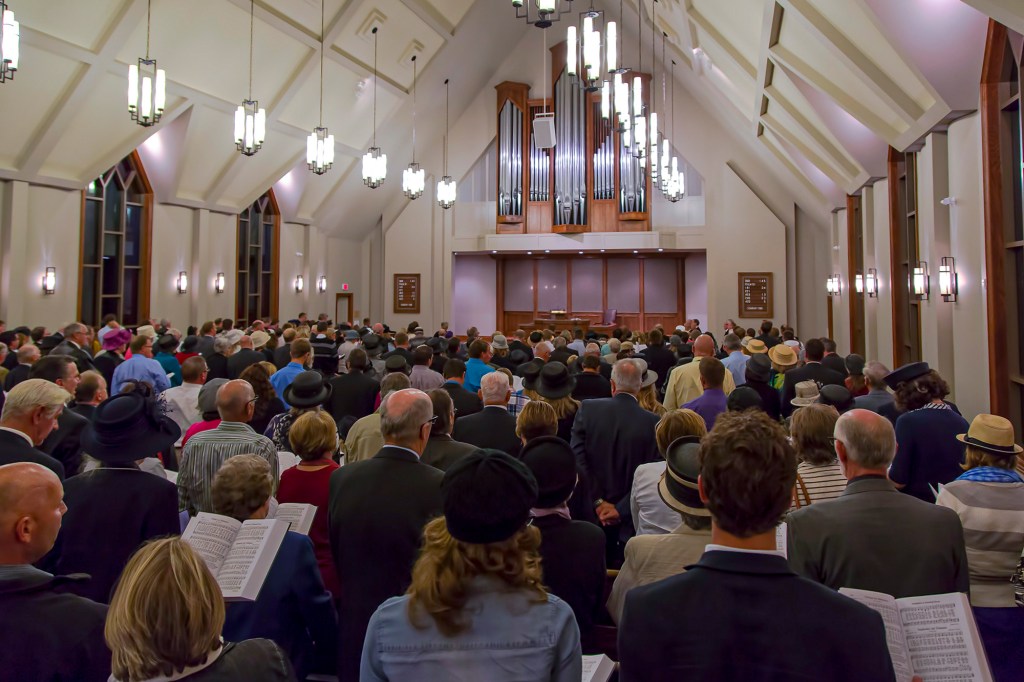
This is a new church with diffusers built into the walls. The quality of this room is such that when this photo was taken, the congregation drowned out the Pipe Organ. The organist said he pulled all the stops and he could not hear the organ for some of the songs they sang. At one point he stopped playing. With a sound meter recorder at the pulpit, the congregation hit 105dB several times and no one complained that it was too loud.
The struggles of congregational singing started long before the sound system was invented. It is my belief that Choirs were formed originally, because when Christians first started to worship in existing pagan temples, (after the edict of tolerance,) most likely, those temples had such poor acoustics that the congregations back then had the same problem of not hearing themselves. Then some talented singers found that if they stood in a particular part of a room, they could hear themselves and create an awesome sound of choral singing within the pagan temple. That talent was later included as part of the worship. When Christians started to build churches, when the buildings were finished, they asked the better singers to go to the part of the worship space where their voices were effective in creating this big sound where a few people would sound like many.
In the end, as more and more churches were built, the choir became the focus of congregational singing, and even though the congregation was encouraged to sing, the choir was the focus, not the congregation. This continued throughout church history in one form or another. Sure, some large cathedrals have these amazing sound effects. (Sound effects do not support congregational singing or speech.) Still, in the end, it is the choir and the organ that dominated worship, not authentic worship singing or hearing the Gospel.
Throughout the Reformation period to today, churches have been experimenting with worship space designs to discover the Rosetta stone of church acoustics. Churches have been trying to create a worship space without any acoustical planning. It hasn’t happened yet that we know of and if there is a church out there that works, where is it? Why would it be kept as a secret? When the room helps the singing of the congregation, the congregation will sing, and they will sing as loud as they are inspired to. The same properties that makes congregational singing work, speech will be equally as good. Around the world if there are such churches that have the proper balance of sound, for speech and congregational singing, why has no one documented these jewels or studied them to see what makes those churches better than others. No one has made permanent records for future churches to follow.
It seems that when a church gets known for its musical performance quality, it usually suffers from speech, and for years people have been brainwashed into believing that you can’t have a worship space that is good for both speech and music. That comment is true, for a musical performance space or concert hall. This is not what a church needs. A church needs a room to support congregational singing, not musical performances.
When I get hired to fix a church, one comment that is repeated often is, we can’t afford or don’t want a concert hall. That is the whole point. You don’t want a concert hall, and it would be detrimental to a church to have such a space. Concert halls do not support congregational singing, none of them do. Concert halls are awful for speech. If you look at most concert halls today, when it comes to speech, they close curtains, expose absorption panels, and they rely on costly sound systems to broadcast speech events. Concert halls are either-or spaces. They cannot support speech and music equally. Furthermore, they don’t support audience singing at all. How do I know that? When I go to most of the churches that I have fixed in the past, when the attendance is around 90%, the congregation can drown out the pipe organ, the electronic organ, and the amplified worship team. Yes, it is possible for the congregation to drown out a sound system with professional Christian performers leading the music. That is what good acoustics can do in a worship space. When people try to sing like that in a concert hall, it sounds like chanting in a sporting event. It is not very musical and singing in four part harmony is out of the question. In a worship space, a well-motivated congregation can sing over 105dB with the sound system off when the acoustics are managed for congregational singing. If only the sound system could perform that loud without distortion and without the congregation complaining about the loudness.
Consider this, the invention of the sound system and its introduction into churches merely ushered in over time, the ability for contemporary worship, with the goal to get more people singing. Yes, many churches tried amplifying the choir as a means to get the congregation to sing, it didn’t work. When it came time for speaking, the sound system failed as well to amplify speech properly without feedback – This created a dilemma. To make the sound system perform better for speech, churches add absorptive flat panels, and that usually means killing the room, which in turn, discourages singing. The sound system was believed to be the solution to improving worship, but the truth is, the sound system can only amplify what the room allows. In this struggle between the sound system and church worship, no one looks at the room as being the limiting factor. Instead, observers and people asking whomever as to what can be done, the fingers point to the technology, the pastor, the song leader, and the soundmen who get all the blame. All of the other recommendations are meaningless until the room is fixed.
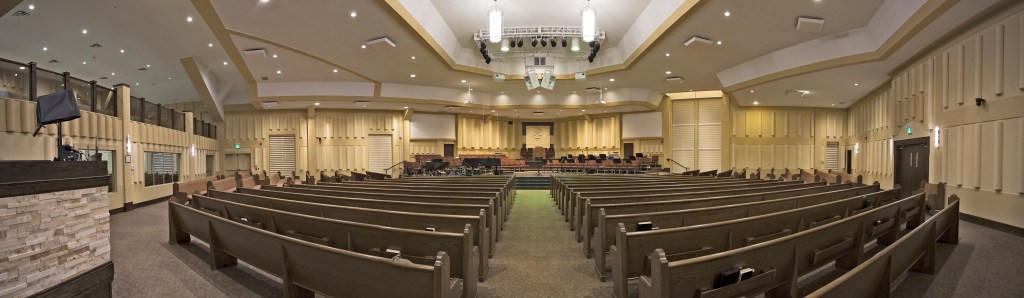
The only complaint this church has is that congregational singing is much louder up front.
As I mentioned earlier, I fix the sound in churches all over the world. Without changing the leadership, the pastor or song leaders, and without changing how worship is conducted, with the methods I use, most congregations go from 10 to 30% of the audience singing to 65 to 90% of the audience singing when the room is fixed. That happens because there is a way to make the room very responsive to exactly what people need to hear and feel during the singing portion of worship. At the same time, the same system improves the quality of speech, and as a bonus, the performance of the sound system increases substantially more. Doing church acoustics correctly, is being able to have a room that does both speech and congregational singing equally well. It also winds up being a good room for Christian concert and drama performances. Is it really possible to have a worship space that does everything well? Yes. Should you think that this is about a compromise? Think again, it is not.
The method of sound management that I have been using in churches is not of my design. I cannot take direct credit for these successes. I learned from an expert in Church sound. This sound management system that is now in over 450 churches, is the same method as originated by the hand that guided the fingers of King David, who designed King Solomon’s Temple. The acoustical system that I use is the same system that was designed by God. As I said, I can’t take credit for the success in the churches that have this system. Here is condensed version of how I learned about it.
Years ago, I had read or heard this verse in 1 Kings 6:29, which says that on all of the walls within and without, there were carvings of Cherubs, Palm Trees, and open flowers. Then one day and as the pastor was reading this passage from the pulpit, it dawned on me that the palm trees seemed out of place. They have no aesthetic value. There is no spiritual, nor ritual reason for having palm tree carvings on the wall. Then the acoustical knowledge I was learning at the time kicked in. If there was no acoustical treatment within the temple, the Levite Priests would have not been able to understand each other. That room would have been ringing well over 5 seconds. Under those conditions, even at 24 inches, the reverberation would have made it difficult to impossible to understand speech. It says that in the large room of the temple called the Holy Place, that the priests taught, they read the laws, they played musical instruments, they sang and prayed. They also did rituals that would have involved speaking. What was in the room that allowed them to do all of those activities, which are also the same actions we do in churches today?
After doing a lot of testing and experimenting, I discovered that the shape of the palm tree could be mimicked with cardboard, wood or plaster tubes which come in a range of costs, depending on how important aesthetics are and the budget your church can afford. This changes the performance of any existing church into a high-quality worship space that supports both congregational singing and speech. Before installing any churches with cardboard tubes, we tested a number of churches. For the first church tested with cardboard tubes, we used 10 and 12 foot long tubes, leaned them against the walls of a church and left them there for three weeks. At the end of three weeks, not only was speech so much better, but the number of people participating in congregational singing doubled. This was a huge surprise, and it was unexpected. We repeated this test in a dozen churches, and all of them had similar results. With those outcomes, I started recommending churches to use half-round tubes around their worship spaces, and every time as a new installation was completed, the results were almost all the same. (Let’s face it, some room shapes are better than others.) Speech improved, and congregational singing always was much better.
In most cases, at the 6th month follow up to an installation, the contact person would tell me two things. The first was an attendance increase. The second was that 65 to 90% of the congregations were singing every song. In most cases, there was no change in leadership, or order of worship or how singing was conducted. All of the deadspots in the room were gone. Now you could sit anywhere and sing out and feel like you are part of something big. Sometimes I also got glowing reviews of how the sound system was fixed when nothing was done to the system except for some equalization.
Since around 1994, over 450 churches have applied this method of managing the sound in their worship spaces. All of them have reported similar results. The interesting thing was, most of these churches didn’t hire me to fix their congregational singing. They hired me to improve the performance of their sound systems. They wanted better speech intelligibility. The half rounds tubes are the most cost-effective solution to improving the performance of any sound system. This method fixes the sound system much better than using any absorptive panel.
There is also a unique feature that half-round tubes have that no other acoustical system can do. The half-round tubes, when laid out in a specific pattern, can equalize a room. By adjusting the spacing, the sizes, and when using prime number sequences, if there is enough wall space, you can cut up to 40dB of excess sound energy from 50 to 1200 Hertz. If your worship space has excess energy, for example, at 400 Hertz and it feeds back there all the time, you can space the diffusers to cut out that frequency range. No other acoustical system in the world can do that. The most powerful acoustical system in the world comes from the Bible, and it is designed by God. Many people say that the Bible is sufficient in all things, and this is another example of that Biblical truth.
We have to stop blaming worship leaders, song leaders, and pastors for the lack of congregational singing. Saying things like changing the key to sing in or changing the order of music is blaming the worship leaders, and because of acoustics, all of their efforts cannot get any significant results because the room will cancel their efforts. Song leaders are always searching high and low for answers, and if you watch them carefully, they are constantly trying new things to get the congregation to engage more. Sure, for the short term, they might get an additional number of people singing, but after a few weeks, it goes back down to where it was before. It’s not that people don’t want to engage; it is because the room will not allow them to participate in group singing. This is the real reason why so many churches with contemporary worship styles have sanctuaries that are as good or better that performance clubs in Las Vegas. So many churches have turned to an entertainment style of worship. How un-Biblical is that!
On the internet, there are plenty of videos of young people in churches with hands up in the air and swaying to the music, but if you look closely, most of them are just mouthing the words, they are not singing. That is not worship. When what goes on in a sanctuary looks more like a rock concert, it is not church or worship. It is just clean, mostly unspiritual entertainment.
If there is any blame to go around, here is an uncomfortable truth. When I am hired to help a church, congregation members always tell me how, for years, they have been complaining to the church elders. Since churches are so reluctant to share their experiences about sound to other congregations, most church elders feel helpless because there are no standards for church sound and acoustics for them to turn to. When they ask consultants for help, they say, ask 10 sound guys what to do, and you get 10 different answers. This madness has to stop. The Bible has the answers to church sound, and it is a solution that is superior to any other system at any cost.
The best way to improve congregational singing is by fixing the worship space to the same standards as outlined in the Bible. In the end, this is the only option. If your church already has more than 65% of the audience singing, you are most likely not having an issue of the congregation being engaged in worship. For the rest of the churches out there, seek out what God can do for you. You don’t need an expert or acoustical consultant or sound system engineer to have a successful transformation. Churches can do this on their own. All you have to do is look at the examples on my website and copy whatever layout you see. If you need more help and can afford the cost of a consultant, hire one who understands the Biblical way to solve church sound problems and congregational singing. There is no mystery or formula or program when solving the congregational singing issue God’s way. Congregational singing is also a spiritual issue. It is what binds up together as believers. Stop solving spiritual problems using mans’ ways. God’s way always works. Don’t take my word for it. Trust God.
When sharing the Gospel, so many times, someone has said that they didn’t like what the minister said during a worship service, so they left the church. They thought the minister was preaching a false message. Some people have told me that they walked out of a worship service upon hearing the distorted message. I would ask them if other people left the service at the same time. In every case, they said no. That is when I try to retrieve the audio record of that specific service. As it turned out, on the recording, the minister said the right things, but why was it heard in the sanctuary as something else?
The next step was to play the recording over the sound system and sit in the same spot the person complained about what he heard. Sure enough, the same gibberish that got the person upset was heard in that spot. When you moved several feet over in any direction, the sound was clearer, yet in other places, different words were being twisted. With the recording on a loop, we found dozens of other places where the minister’s words were warped into something else. Doing this exercise did get one person to try church again, but in most cases, when something like this happens, most people will not return to a church where the Gospel is preached.
Sound quality matters. What good is excellent speech intelligibility in one spot and a failure in another? Sound quality can save people and their souls. I have never met a person who was saved by a song, but I had met many people who were saved when they heard the clear and undistorted message of Jesus Christ and become followers of the Messiah because the message was clearly understood.
I often wonder how many other people have experienced hearing something different than what the minister said in a sanctuary. For many ministers and church leaders, it would never occur to them that the sound system was the cause of some people not returning to church. The unfortunate truth is, many churches have questionable acoustics, and when a person sits in a spot where words, syllables, or the sound volume is too low, what was said and what is heard were not the same.
Sound systems cannot fix the acoustical problems of a church. Adding more speakers or applying the latest state of the art technology tricks are no match to Architectural failures in room design and unmanaged sound sequencing around a room. Absorptive panels are often the first weapon used to tame a room. Cutting down on the noise and reflections with absorption cannot fix deadspots or hotspots. Absorptive panels cannot change the path of sound reflections that causes uneven sound distribution. Absorptive panels have been known to make the sound harder to understand in those poor locations throughout the room, not better. What is needed is a different weapon to defeat poor sound.
To eliminate hotspots and deadspots, you need to be able to distribute sound more evenly. Scattering the sound is the most effective way to create a unified sound field throughout the whole sanctuary. When sound is managed in this way, not only does it eliminate deadspots and hotspots of any speech problems, but it makes congregational singing, praise and worship bands clearer, the stage sound is corrected, and for many churches, they bring back choral music because it sounds better than what a worship team could do before the room was fixed. In most cases, scattering the sound costs less to do than absorbing sound.
Acoustical solutions for churches that work should be common knowledge as these concepts have been around for years. Fixing a church can often be restricted by how a solution may look. It is high time that the aesthetic police take a back seat from preventing the Gospel message to be preached clearly. If aesthetics are a big deal, alternatives are always possible. In the end, it is all about priorities. You have to choose between hearing the Gospel or have a Church that looks good. What will your church do?
In the field of acoustics and sound, many have said that Wallace Clement Sabine is considered the father of modern-day architectural acoustics. His scientific work was not only the foundation for concert hall acoustics, but few are aware of how his work has impacted the church community around the world. According to several sources, he was raised in a protestant home, but as an adult belonged to no church and professed no religious faith, yet his work has impacted churches in ways even Wallace could not have imagined. Wallace’s work included figuring out a prediction model of how to apply absorption to tame a room. He also proved that the reverberation time alone is not enough in helping performance spaces with their sound needs. He laid down a foundation, showing that you need much more detailing and care to create suitable sounding spaces, not just for concert halls, but for full Christian worship too.
Shortly after his discoveries and successes, most acoustical experts, Architects, engineers, and audio experts have focused on one thing, the reverberation time of a room – ignoring much of his actual contributions to modern acoustics. When Wallace created the first equation to calculate how much absorption is needed, most people thought that this equation was something magical. It was almost as if a single number could solve all sound problems for concert halls and performance spaces. While such a numeric value is essential, it was a small part of a much larger picture. Sure, Wallace did devote a lot of his time to such studies. Unfortunately, the absorption calculation moved from being a small tool as part of a broader view of performance acoustics to becoming the only thing that mattered. This equation gained mythological-importance to the point that for many laypeople….
Once again we see science and the Bible in almost perfect harmony. Within science, there are many tools. For acoustics, there are specific tools. With the help of the Bible, it requires a set of tools that are unique to churches. For concert halls, recording studio’s and other entertainment venues, there are a set of tools for each one. Most of those tools do not apply to churches. When the tools of an acoustical consultant don’t use the Biblical tools exclusively, you will always get the acoustical performance of what those tools were based on. If you have only concert hall or studio or entertainment tools, then the results will not meet all of the needs of the church. If you use Biblical tools, you wind up with a House of Worship as the Christian community should have, but most churches don’t have a clue of what they are missing out.
Solomon’s Temple was very detailed in how it sounded. If you believe in the Trinity as I do, because of John 1:3 you know that Jesus design the temple that Solomon built. Without the acoustical planning in Solomon’s temple, the Levites would of had to have super natural powers to hear each other within the walls of the temple. There is no record of the Levites having such powers. What did they do to the temple to make it possible for people to hear in such are large space?
Here is something to consider. If Solomon’s temple is a myth, then the details of how the temple walls were completed should not have survived over history. After all, there is no record of the interior of Herod’s Temple other than some carving on the ceiling that Herod ordered which is not in the Bible. If someone says the Scriptures are not the inspired word of God, then the details of Solomon’s temple wouldn’t matter. But what happens when you apply the details of Solomon’s temple to an existing church? If it is a myth, nothing should happen. If it fixes a church, doesn’t that prove God, Jesus and the Holy Spirit? What does that mean if over 400 churches have applied such a system in faith, using the same methods from the Bible to make the acoustics of their churches as best as they can be?
The details of Solomon’s temple matters. Nothing in the Bible is about trivial nonsense. Everything in the Bible has a purposes and the details of Solomon’s Temple is a roadmap to fixing existing churches and it should be a template for new churches today now that we understand why such details were persevered for us in the scriptures today. How many more churches need to be convinced before it becomes a normal way to complete our houses of worship?
If anyone with normal hearing in a church has trouble understanding what is being said in God’s House of Worship, the Bible has the solution for that. And that solution is very affordable. Please enjoy the rest of the article.
Here is a collection of 445 photos of 46 churches that completed most or all of their sound system and acoustical plan. My job is to design a solution that will solve all or almost all sound problems in one step. For most churches, this means getting the most accomplished in one step as most churches can’t afford to keep chasing sound problems without truthful help. The road back to great sound in the church is in the Bible, and that is what these churches did.
All of the installations of the acoustical systems and the sound systems were completed by church members or local contractors when those churches were able to afford professional installers. The final appearances are what those churches selected. I work closely with all churches for alternative aesthetics regardless of any budget limitations. When a church has to choose between aesthetics vs. performance of the 400 plus churches that have just simple painted cardboard tubes on the walls, those churches spoke with what they installed.
These churches demonstrated that they care more about hearing the Gospel than having a sanctuary that looks good. There is a high spiritual cost for poor acoustics and sound system designs. Poor sound does get in the way of people hearing the Word, and for some, it can deny people from understanding the Gospel message of salvation, and that is a cost no church can afford.
For professional, no compromise help, we can provide the highest level of expert assistance that will fulfill the Great Commission as Jesus taught. Having the skills of the world helps but God’s plan for churches demands His way of doing Church Sound. Without that knowledge, the worlds way of doing church sound always comes up short in meeting the standard that God demands of us.
Click the photo above or the link below to see what other churches have done to have great sound for speech, congregational singing and total worship in general.
The quality of church worship is critical to the
health of a church. The better the excellence of worship is, the stronger
the church will be. Quality of worship is not about packing the church
full of people for the sake of filling a worship space so much that it becomes
necessary to keep building bigger buildings. We worship God, not
buildings or pastors or knowledge. It is the Gospel, the Bible that leads
us to God. It is God’s words that keep us in a relationship with
Him. The strength of a church is not measured in numbers in the seats or
money. Jesus taught us to feed the hungry, clothe the poor, and shelter
the homeless. The Bible teaches over and over again that we are to live
by example (Psalms 1:1-6), to be a light in the world (Matt 5:16), when they
see that we are different (James 2:14-26), it will be that difference that will
attract people to God.
The strength of a church is measured by how people
support each other, and by how much a congregation supports each other as a
family first, as brothers and sisters, and then the local community. Is
the church feeding the hungry, clothing the poor, and sheltering the
homeless? The modern version of Jesus teaching for us in countries with a
democracy and wealth should look like this. Is the church cutting lawns,
clearing driveways, cleaning people’s homes, fixing up members and non-members
homes? How often are church members spending time with the widows, the
singles who have never had a partner, or the elderly? Are these not the
things included in what Jesus told us to do? Are not these the same
teachings in the Old Testament? This is just a small sample of how
Christianity should look like to the secular world.
___________________________________________________________________ After reading the full article, please comment on it. We want to get this right as the church community needs this knowledge. If you have any questions, want to learn more or see a presentation about Solomon’s Temple and the Modern Church, contact me here – jdb@jdbsound.com
You church may be one of those that has great sound for all parts of the worship service. If it is, you should let everyone know as it will help to bring more people in. You should let us know so we can tell others. If you find this article helpful, please pass it on. Pass it on to your pastor, your friends and family. Give them the chance to learn what God can do for them today!
Thank you.
All modern churches can benefit from Biblical AcousticsAll older churches can benefit from Biblical Acoustics
As an expert in Church Acoustics and in the pursuit of the truth, I have also been passionate about finding ways for all churches to afford an acoustical solution that will solve just about every sound problem most churches run into. What can be more exciting than knowing that the cheapest and best acoustical solution in the world for all churches comes from the book that all Christians follow and obey – the Bible. When a church uses the Bible’s method for acoustical management, sound problems almost all go away and in most cases, a sustained higher church attendance happens after around 18 months. God is the author of Church Acoustics and it is time for churches to seek God first for answers and God will reveal His way to solve sound problems in His Houses of Worship. Whenever a church is dedicated to God, doesn’t it become His House?
Joh_14:6 Jesus saith unto him, I am the way, the truth, and the life: no man cometh unto the Father, but by me. If we take that a step further, Jesus was present in the design of Solomon’s Temple. While Millions have already been saved in the past, present and hopefully the future, how many more can be added if all Houses of Worship were built or brought up to the same acoustical standards as in Solomon’s Temple? Since most churches don’t have that quality of room acoustics, I guess we may never know!
Here is a simple test anyone can do to determine the acoustical condition of a church. Physics says that when the power* is doubled or when doubling the number of speakers, the sound level will increase 3dB. This result is real when outdoors. This outcome can be false indoors. When it is false indoors, it is because there are acoustical problems. Please notice that it is problems,not a problem. When adding a second speaker failing to increase the sound 3dB, this test shows that it is never a single acoustical issue. It is not a sound system problem. The sound system is exposing the root problem. (If the second speaker is wired out of phase, the sound will decrease in level.)
Outdoors, sound follows the basic rules of physics.
When outdoors, if there are two loudspeaker playing with the same volume of pink noise side by side or up to 6 feet apart, and set up a test microphone or SPL meter 30 feet away. (An iPad or phone with testing software can be used if it is calibrated.) When the second speaker is turned on or off, the sound level will change 3dB. This result is constant in physics. The reason this is always true is that there are no barriers around to limit the sounds from spreading out or returning from a reflection that can interfere with the direct sound.
When indoors, depending on the size of the room, often this is not true. This failure is noticed the most with Subs and sound energy below 500 Hertz. Doing the same test at 30 feet inside of a church, the sound level change is often 1, 1.5, or 2dB. If the result is 3dB, there are either a lot of open windows, lots of doors that are open, the church has more than 3000 seating or the church has great acoustics.
Indoors, sound is confronted with many other rules of physics which changes how the first rule works.
Here are the most common reasons for the sound failing to increase 3dB when doubling the power or speakers.
Standing waves
Dimensions of the room
Too much-stored energy in the corners
Too much high-frequency absorption
Standing Waves
Standing waves are excessive amounts of energy between parallel walls within a confined space. The effect of standing waves are not always apparent. Standing waves are usually excess mid and bass frequencies of energy that masks the highs. You can’t hear a standing wave but you can hear the effects of it. To identify if your church has standing waves, go between any parallels walls. Stand about 4 feet from one of the side walls. Make a loud, sharp noise like a hand clap once. If a person hears any rapid pinging sounds, this is a sign of the presence of standing waves. The sound heard is often a higher range of frequencies, and they usually called flutter echoes. Flutter echoes are a symptom of standing waves. Bass sounds, which have longer wavelengths can’t produce the same volume of sound to hear as a flutter between parallel walls. Whenever a person hears flutter echoes, excess bass energy present too. This result is also true for all other room shapes when flutter echoes or flutters from a simple hand clap occur
A second clue to standing waves is when standing at a pulpit or where a minister preaches from. With a hand clap, if the reflected sounds are coming from the side walls or behind you, the standing waves are the cause of it. The standing waves are masking the highs, creating the effect as if it is preventing a large portion of the sound from reaching the other side of the room, and what is reflected back is being canceled out by the standing waves a second time which in turn prevents you from hearing the returning clap. Standing waves have other detrimental effects too. It has the effect of isolating everyone from each other in the room. This result is also why the drums seems to sound so loud and yet, this is also why most drummers strike the drums harder than they have too. It is because they can’t tell how loud they are playing at any volume level. This outcome is also why many people sitting in the pews comment that they can’t hear themselves when singing, and it makes them feel alone in a room full of people. This is the number one cause of people being discouraged from singing.
Any church with parallel walls will have standing waves if there is nothing to manage them
The reason the sound doesn’t increase 3dB when adding a second loudspeaker is because of the excess bass energy created by the standing waves in the worship space. The excess air pressure is like putting a finger lightly on the woofer. The excess air pressure acts as an acoustical load on the woofer, and that dampens the amount of sound coming from the loudspeaker.
Standing waves can only be
removed with diffusion or some form of sound scattering.
If people try to use absorption to fix this problem, while it will remove the flutter or in some cases, shift the flutters to a lower frequency, the untreated bass energy will make the standing wave problem more pronounced. It will increase the feeling loneliness and discourage the congregation from singing even more.
The dimensions of the room
In churches with low ceilings or seating less than 200 people, the room is too small to be free from surface related sound inference reflections. In a larger church space with a flat ceiling less than 16 feet high, the room will have standing waves floor to ceiling which limits the ability to increase sound 3dB with just doubling the speakers.
The reason the sound doesn’t increase 3dB when adding a second loudspeaker is that the room is limiting how much the space can support. The excess air pressure from the extra speaker is like putting a finger lightly on the woofer. The excess air pressure acts as an acoustical load on the woofer, and that dampens the amount of sound coming from the loudspeaker.
The only option is to diffuse
all of the room if a small church. If a
low ceiling, diffusers will have to be added to the ceiling. Acoustical tiles and drop ceilings cannot
correct this issue.
Too much-stored energy in the
corners
Another principal of physic is
how sound is affected by boundaries. A
loudspeaker on a 10-foot pole measures 60dB.
We call that free space. When we
put the speaker on the ground, the speaker will be 6dB louder. That is referred to as “half space.” When we add a wall and the floor, we call
that “1/4er space” and the sound increases 12dB or doubles in loudness. When we add a second wall to the floor and
create a corner, that is “1/8th space,” and the sound rises
18dB.
Corners collect the air pressure that is created by longer wavelength sounds that accumulate on the flat surface of the wall. With nothing to direct the sound, the sound pressure moves in all directions. Eventually, the excess bass energy makes its way to the corners. Depending on a lot of variables, the amount of energy that builds up is often too much. Churches will low ceilings, large flat walls, or flat ceilings tend to have too much excess bass in the corners. All other church shapes, except for domes have varying levels of corner issues if not managed. Excess corn energy has a similar effect as standing waves. When there is too much bass, it masks the highs. This, in turn, creates hotspots and coldspots throughout the room. Hotspots and Coldspots are frequency dependent. If the sound level changes are of a narrow range of frequencies, it was most likely found them with instruments. When a person notices them with their ears, it means anyone with a hearing problem will miss out on some of what is being said, or what they heard and what was said was different.
When the front of a church is in the corner, everything is either 18dB louder or 18dB quieter when compared with churches that have the front on an end wall.
The reason the sound doesn’t increase 3dB when adding a second loudspeaker is because of the excess bass energy created by the bare walls in the worship space. The excess air pressure is like putting a finger lightly on the woofer. The excess air pressure acts as an acoustical load on the woofer, and that dampens the amount of sound coming from the loudspeaker.
Keeping excess sound out of
the corners is best done with diffusion.
It cannot be done with absorption unless the absorbers are as thick as
the wavelength of the sound waves.
Too much high-frequency
absorption
Sound arrives at our ears as
air pressure vibrating at a rapid rate.
The faster the air vibrates, the higher the sound pitch. The slower the sound vibrates, the lower the
pitch. The vibrations are referred to as Hertz.
Sound travel at 1130 feet per second.
At 100 Hertz, a bass sound has the wavelength of just over 11.3
feet. At 1,000 Hertz the sound waves are
1.13 feet, and at 10,000 Hertz the sound waves are 0.11 feet or 1.3 inches.
When there is too much absorption in the room, what is left is too much bass. The excess bass masks the highs.
For most churches, carpeted floors and padded seating is all the absorption needed. When this much absorption is add, the congregational singing is very dull and people have to be super motivated to see more that 20% of the audience singing.
The reason the sound doesn’t increase 3dB when adding a second loudspeaker is because of the excess bass energy created by too much absorption. The excess air pressure is like putting a finger lightly on the woofer. The excess air pressure acts as an acoustical load on the woofer, and that dampens the amount of sound coming from the loudspeaker.
The fix for such a problem is
by removing the right amount of absorption panels and replace them with
diffusers. Then complete the room by adding
more diffusion throughout the sanctuary to correct the frequency response of
the room.
These four issues are never a singular issue. They are often in combinations or can include all four. Along with these problems, there are often reverberation issues, echoes, excess late reflections, the poor frequency response of the room, and other room problems that have little to do with this simple 3dB test, but they are usually there as well. These problems can be heard when a person learns what to listen for. Looking at how sound system is equalized is another clue of room problems. The issues have the result of the high numbers of the congregation not singing. (In a church with good acoustics, they will often have more than 80% of the congregation singing every they are familiar with.)
Getting two loudspeakers and doing this test is simple and easy to do. If the sound doesn’t increase 3dB, this means that adding more subs or more speakers into a worship space will not get the expected outcome. For example. If the goal is to increase the bass in a worship space 3dB, and sound system has only one subwoofer, do this test, If the bass increased only 1.5dB with the second box, then it will take two more speakers just to get a 3dB increase for a total of 4 boxes. Think of the cost of adding three speaker boxes and all of the related hardware required to support that. An alternative would be to fix the room with diffusion, the gain will be 6 to 10dB of performance without doing anything to the sound system. It would be equal to adding 8 or 16 subwoofers depending on other acoustical or architectural considerations.
Science is amazing when appropriately used to provide real solutions. Pseudo-Science or fake data is often used under the disguise of science and can be used to lead churches to false conclusions. Many experts in audio and acoustics who see the same data, know these problems are present. If they are not being addressed, it is because they lack the experience in knowing how to solves such issues. If a person has done this test and the sound system provider or acoustical expert is not addressing these issue, they are not qualified for correcting sound problems in a church. It’s like asking a Doctor who specializes in kidney problems to do Brain Surgery. What is needed a Brain Surgeon who knows how to fix both the acoustics and to design a proper sound system.
Get the church correctly evaluated before investing in that next sound system. It can save those responsible a lot of disappointments down the road. Fixing a room can cost less than replacing a sound system, or it could mean reducing the size of the suggested new sound system.
* Doubling the power required calibrated volume controls or switches to
set up correctly as a viable test.






 Welcome to the world of Church Acoustics