Welcome to the world of Church Acoustics

Teaching the highest quality in Church Sound excellence

  • Supported by

    Contact:
    Ph # 519-582-4443
    email: jdb@jdbsound.com

    The Bible is the de facto standard for all church worship needs including sound and acoustics.

    2 Timothy 2:15

  • Archives

  • For additional contact information scan the QR code below

    link to jdbsound.com

Posts Tagged ‘Church acoustics’

1 + 1 = 3 or When is Doubling the Power, not +3dB?

Posted by jdbsound on June 17, 2019


Here is a simple test anyone can do to determine the acoustical condition of a church.  Physics says that when the power* is doubled or when doubling the number of speakers, the sound level will increase 3dB.  This result is real when outdoors.  This outcome can be false indoors.  When it is false indoors, it is because there are acoustical problems.  Please notice that it is problems, not a problem.  When adding a second speaker failing to increase the sound 3dB, this test shows that it is never a single acoustical issue.  It is not a sound system problem.  The sound system is exposing the root problem. (If the second speaker is wired out of phase, the sound will decrease in level.)

Outdoors, sound follows the basic rules of physics.

When outdoors, if there are two loudspeaker playing with the same volume of pink noise side by side or up to 6 feet apart, and set up a test microphone or SPL meter 30 feet away. (An iPad or phone with testing software can be used if it is calibrated.) When the second speaker is turned on or off,  the sound level will change 3dB.  This result is constant in physics.  The reason this is always true is that there are no barriers around to limit the sounds from spreading out or returning from a reflection that can interfere with the direct sound.

When indoors, depending on the size of the room, often this is not true.  This failure is noticed the most with Subs and sound energy below 500 Hertz.  Doing the same test at 30 feet inside of a church, the sound level change is often 1, 1.5, or 2dB.  If the result is 3dB, there are either a lot of open windows, lots of doors that are open, the church has more than 3000 seating or the church has great acoustics. 

Indoors, sound is confronted with many other rules of physics which changes how the first rule works.

Here are the most common reasons for the sound failing to increase 3dB when doubling the power or speakers.

  • Standing waves
  • Dimensions of the room
  • Too much-stored energy in the corners
  • Too much high-frequency absorption

Standing Waves

Standing waves are excessive amounts of energy between parallel walls within a confined space. The effect of standing waves are not always apparent. Standing waves are usually excess mid and bass frequencies of energy that masks the highs. You can’t hear a standing wave but you can hear the effects of it. To identify if your church has standing waves, go between any parallels walls. Stand about 4 feet from one of the side walls. Make a loud, sharp noise like a hand clap once. If a person hears any rapid pinging sounds, this is a sign of the presence of standing waves. The sound heard is often a higher range of frequencies, and they usually called flutter echoes. Flutter echoes are a symptom of standing waves. Bass sounds, which have longer wavelengths can’t produce the same volume of sound to hear as a flutter between parallel walls. Whenever a person hears flutter echoes, excess bass energy present too. This result is also true for all other room shapes when flutter echoes or flutters from a simple hand clap occur

A second clue to standing waves is when standing at a pulpit or where a minister preaches from. With a hand clap, if the reflected sounds are coming from the side walls or behind you, the standing waves are the cause of it. The standing waves are masking the highs, creating the effect as if it is preventing a large portion of the sound from reaching the other side of the room, and what is reflected back is being canceled out by the standing waves a second time which in turn prevents you from hearing the returning clap. Standing waves have other detrimental effects too. It has the effect of isolating everyone from each other in the room. This result is also why the drums seems to sound so loud and yet, this is also why most drummers strike the drums harder than they have too. It is because they can’t tell how loud they are playing at any volume level. This outcome is also why many people sitting in the pews comment that they can’t hear themselves when singing, and it makes them feel alone in a room full of people. This is the number one cause of people being discouraged from singing.

Any church with parallel walls will have standing waves if there is nothing to manage them

The reason the sound doesn’t increase 3dB when adding a second loudspeaker is because of the excess bass energy created by the standing waves in the worship space.  The excess air pressure is like putting a finger lightly on the woofer.  The excess air pressure acts as an acoustical load on the woofer, and that dampens the amount of sound coming from the loudspeaker.

Standing waves can only be removed with diffusion or some form of sound scattering. 

If people try to use absorption to fix this problem, while it will remove the flutter or in some cases, shift the flutters to a lower frequency, the untreated bass energy will make the standing wave problem more pronounced.  It will increase the feeling loneliness and discourage the congregation from singing even more.

The dimensions of the room

In churches with low ceilings or seating less than 200 people, the room is too small to be free from surface related sound inference reflections.  In a larger church space with a flat ceiling less than 16 feet high, the room will have standing waves floor to ceiling which limits the ability to increase sound 3dB with just doubling the speakers.

The reason the sound doesn’t increase 3dB when adding a second loudspeaker is that the room is limiting how much the space can support.  The excess air pressure from the extra speaker is like putting a finger lightly on the woofer.  The excess air pressure acts as an acoustical load on the woofer, and that dampens the amount of sound coming from the loudspeaker.

The only option is to diffuse all of the room if a small church.  If a low ceiling, diffusers will have to be added to the ceiling.  Acoustical tiles and drop ceilings cannot correct this issue.

Too much-stored energy in the corners

Another principal of physic is how sound is affected by boundaries.  A loudspeaker on a 10-foot pole measures 60dB.  We call that free space.  When we put the speaker on the ground, the speaker will be 6dB louder.  That is referred to as “half space.”  When we add a wall and the floor, we call that “1/4er space” and the sound increases 12dB or doubles in loudness.  When we add a second wall to the floor and create a corner, that is “1/8th space,” and the sound rises 18dB. 

Corners collect the air pressure that is created by longer wavelength sounds that accumulate on the flat surface of the wall.  With nothing to direct the sound, the sound pressure moves in all directions.  Eventually, the excess bass energy makes its way to the corners.  Depending on a lot of variables, the amount of energy that builds up is often too much.  Churches will low ceilings, large flat walls, or flat ceilings tend to have too much excess bass in the corners.  All other church shapes, except for domes have varying levels of corner issues if not managed.  Excess corn energy has a similar effect as standing waves.  When there is too much bass, it masks the highs.  This, in turn, creates hotspots and coldspots throughout the room. Hotspots and Coldspots are frequency dependent. If the sound level changes are of a narrow range of frequencies, it was most likely found them with instruments.  When a person notices them with their ears,  it means anyone with a hearing problem will miss out on some of what is being said, or what they heard and what was said was different. 

When the front of a church is in the corner, everything is either 18dB louder or 18dB quieter when compared with churches that have the front on an end wall.

The reason the sound doesn’t increase 3dB when adding a second loudspeaker is because of the excess bass energy created by the bare walls in the worship space.  The excess air pressure is like putting a finger lightly on the woofer.  The excess air pressure acts as an acoustical load on the woofer, and that dampens the amount of sound coming from the loudspeaker.

Keeping excess sound out of the corners is best done with diffusion.  It cannot be done with absorption unless the absorbers are as thick as the wavelength of the sound waves.

Too much high-frequency absorption

Sound arrives at our ears as air pressure vibrating at a rapid rate.  The faster the air vibrates, the higher the sound pitch.  The slower the sound vibrates, the lower the pitch. The vibrations are referred to as Hertz.  Sound travel at 1130 feet per second.  At 100 Hertz, a bass sound has the wavelength of just over 11.3 feet.  At 1,000 Hertz the sound waves are 1.13 feet, and at 10,000 Hertz the sound waves are 0.11 feet or 1.3 inches.  

When there is too much absorption in the room, what is left is too much bass. The excess bass masks the highs. 

For most churches, carpeted floors and padded seating is all the absorption needed. When this much absorption is add, the congregational singing is very dull and people have to be super motivated to see more that 20% of the audience singing.

The reason the sound doesn’t increase 3dB when adding a second loudspeaker is because of the excess bass energy created by too much absorption.  The excess air pressure is like putting a finger lightly on the woofer.  The excess air pressure acts as an acoustical load on the woofer, and that dampens the amount of sound coming from the loudspeaker.

The fix for such a problem is by removing the right amount of absorption panels and replace them with diffusers.  Then complete the room by adding more diffusion throughout the sanctuary to correct the frequency response of the room.

These four issues are never a singular issue.  They are often in combinations or can include all four.  Along with these problems, there are often reverberation issues, echoes, excess late reflections, the poor frequency response of the room, and other room problems that have little to do with this simple 3dB test, but they are usually there as well.  These problems can be heard when a person learns what to listen for.  Looking at how sound system is equalized is another clue of room problems.  The issues have the result of the high numbers of the congregation not singing. (In a church with good acoustics, they will often have more than 80% of the congregation singing every they are familiar with.)

Getting two loudspeakers and doing this test is simple and easy to do.  If the sound doesn’t increase 3dB, this means that adding more subs or more speakers into a worship space will not get the expected outcome. For example.  If the goal is to increase the bass in a worship space 3dB, and sound system has only one subwoofer, do this test, If the bass increased only 1.5dB with the second box, then it will take two more speakers just to get a 3dB increase for a total of 4 boxes. Think of the cost of adding three speaker boxes and all of the related hardware required to support that.  An alternative would be to fix the room with diffusion, the gain will be 6 to 10dB of performance without doing anything to the sound system.  It would be equal to adding 8 or 16 subwoofers depending on other acoustical or architectural considerations.  

Science is amazing when appropriately used to provide real solutions. Pseudo-Science or fake data is often used under the disguise of science and can be used to lead churches to false conclusions.  Many experts in audio and acoustics who see the same data, know these problems are present.  If they are not being addressed, it is because they lack the experience in knowing how to solves such issues.  If a person has done this test and the sound system provider or acoustical expert is not addressing these issue, they are not qualified for correcting sound problems in a church.  It’s like asking a Doctor who specializes in kidney problems to do Brain Surgery. What is needed a Brain Surgeon who knows how to fix both the acoustics and to design a proper sound system.

Get the church correctly evaluated before investing in that next sound system.  It can save those responsible a lot of disappointments down the road.  Fixing a room can cost less than replacing a sound system, or it could mean reducing the size of the suggested new sound system.

* Doubling the power required calibrated volume controls or switches to set up correctly as a viable test.
Posted in Church Acoustics, Church Sound Systems, Educational Must Read Articles | Tagged: , , , , , , , , , , , | Comments Off on 1 + 1 = 3 or When is Doubling the Power, not +3dB?

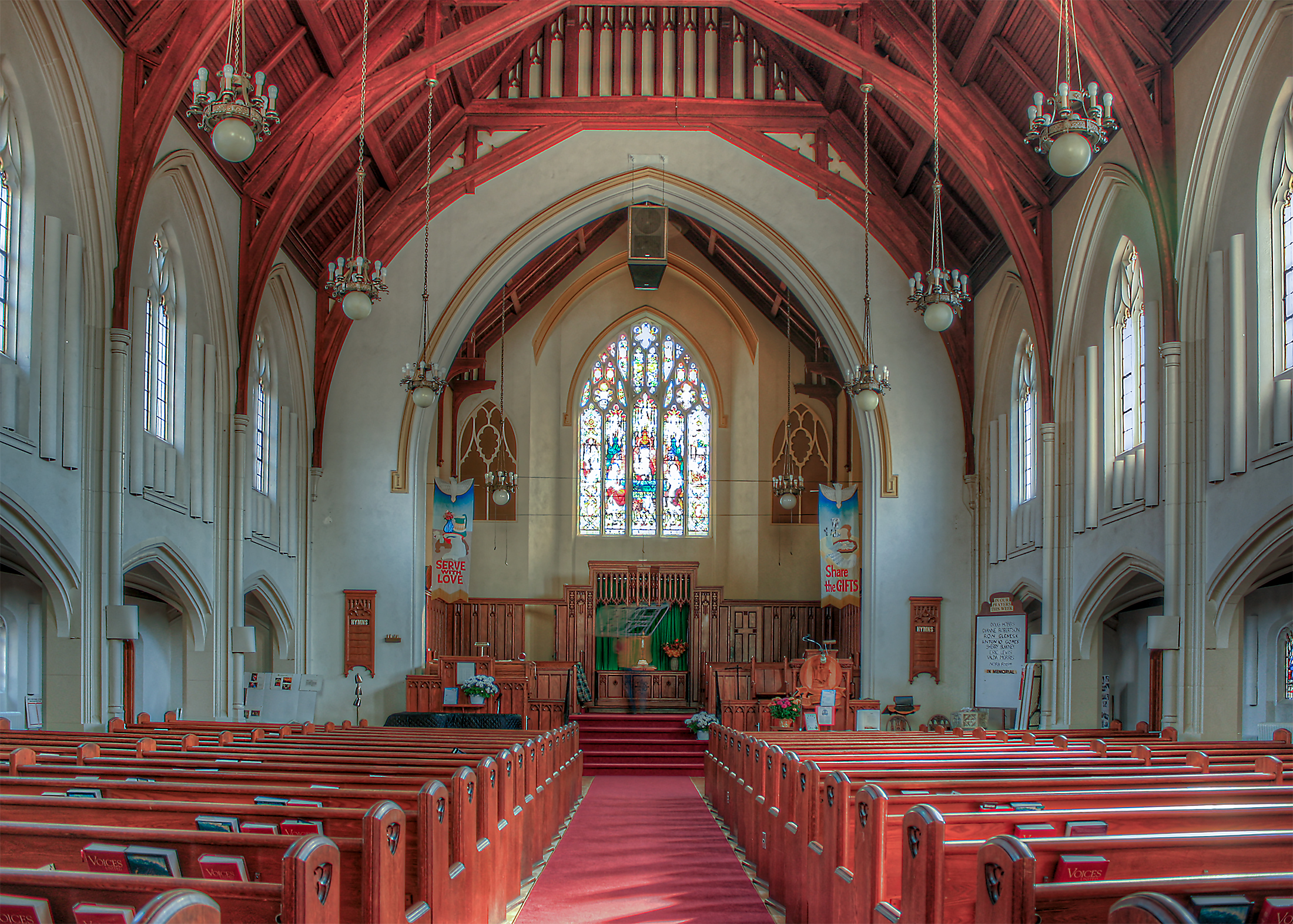
Ten years later Kingston Rd United Church

Posted by jdbsound on May 29, 2019


Kingston Road United Church had sound issues. They tried several sound system designs with no real success. Someone suggested JdB Sound Acoustics.  When I arrived, an elderly lady came to me and said, “If you can’t fix this room, then this church will not be around much longer.” Somehow, several people on the sound committee believed that if the church sounded better, they stood a better chance at keeping the doors open.

In 2008, I was hired to fix the room. I designed for them an acoustical and sound system solution. The sound system was completely replaced. The acoustics plan was using half-round tubes on all of the walls. The results were as several people put it – Amazing. Before, you could not understand anyone talking more than 15 feet away. After, you could talk end to end of the 120 ft — long worship space. The church seats 550 people.

Today in 2019, the church is thriving. It has become a place for concerts, drama and singing events. The church is growing in a location where there is only one parking spot. Church attendance may still be low, however it is higher than in 2009 and with all of the other activities, it has been more than enough to keep the doors open. Acoustics alone didn’t keep the church from closing, but it became a tool to attract new members and other forms of income for an inner city church. Good acoustics seemed to inspire the church leadership to have confidence in knowing that if people could have a good hearing experience, the greetings they would receive from the members would be that much better.  There is also proof that good sound means a greater chance for people to return.

A few years back. Cinemacoustic Solutions Int’l, Harrisburg, Pennsylvania, did an experiment with two theatre test rooms. Both rooms were identical the same visually with one room properly treated acoustically, and the other was not. Room “A” was treated properly; however, Room “B” was not treated at all.

Here is a summary of the results.

“Funny enough, while many of the students made comments about the sound, stating they thought the speakers in room “A” sounded a little better than those in “B”, nearly all of them said, “the picture in Room “A” was far better than that of Room “B”. The properly treated room allowed them to see & hear content at a caliber they may not have ever experienced before, to which they naturally attributed to better equipment, as opposed to the acoustical treatment of any sort. The properly treated space relaxed their senses allowing them to enjoy the environment and what they were doing as opposed to subconsciously concentrating on what they needed to do to better enjoy their surroundings.

The same subconscious energy applies to an orator speaking in an untreated room vs. a treated room. Even a boardroom with executives around tabling important and perhaps complex company matters, they can concentrate better when not “fighting” bad room acoustics while conversing or passionately presenting their opinions, vying for votes. They would never attribute the lack of ability to concentrate on poor acoustics because they simply wouldn’t know to do so, however it can very well be a culprit.”

Good church acoustics matters. Kingston Road United Church is a fine example of how acoustics made their worship space a place where people want to do activities with speech and music. A place where people want to be and where hearing the Gospel is better understood. At Kingston, you spend more time understanding what was being said rather than spending all of your time deciding what words were being said or just trying to hear.

If you would like to see more photos of this church, use this link. https://www.flickr.com/photos/jdbsound/sets/72157607243842820/

Posted in Church Acoustics, Church Sound Systems, Past Projects discussions | Tagged: , , , , , | Comments Off on Ten years later Kingston Rd United Church

Really Useful Charts and Helps

Posted by jdbsound on May 20, 2019


This is a chart that gives you wavelengths of sound for all frequencies, speech, and music ranges.

This is a Church Height chart. These are the minimum heights. Building new churches with lower ceiling heights degrades speech and congregational singing and costs more to heat, cool, and maintain.

This chart shows the difference between the absorption rate versus decibels. For example, something that is rated as a coefficient value 0.5 is equal to 3dB of sound absorption.

How to Equalizer a church when you can’t afford professional help, or your EQ settings have been changed, and you don’t have time to get professional help. https://www.jdbsound.com/art/art537.html

Let us know if these files are useful. We would like to add more of them.

Posted in Church Acoustics, Educational Must Read Articles | Tagged: , , , , | Comments Off on Really Useful Charts and Helps

Was Solomon’s Temple for real? If it was, how would it sound?

Posted by jdbsound on May 7, 2019


Was Solomon’s Temple a fairy tale? I don’t think so. I think Solomon’s Temple was as real as touching your own skin. Why? Solomon’s Temple was designed over 3,000 years ago. When you study the sound quality of the two rooms, it describes spaces that were purpose built for specific functions. The room that reflects modern day acoustics is the Holy Place or Sanctuary as we like to call it today. How can the design of a room from 3000 years ago be so good if it was never built or a fairy tale or myth? Do you think that King David or Solomon knew anything about acoustics back then? Did God tell King David and Solomon’s how to design rooms where hearing would be easy or difficult? Could the acoustics of the Holy Room reflect todays demanding needs of sound for worship? Yes. Absolutely!

The only difference between what a traditional worship space and a contemporary worship space would be the need for is adding carpeted floors and padded seating for worship team lead services. Churches with similar dimensions and shape as Solomon’s Temple have a way better worship experience over churches that have other room shapes. That is not to say you can’t have a good worship experience in other room shapes, but if you can remember your best worship experience in other rooms with good acoustical sound management, it is way better when the room is a rectangle. This only happens when the room is twice as long as it is wide, and with a very high ceiling that is 75% of the rooms length. With those dimensions and with the same type of acoustical treatment system as used in Solomon’s temple, regardless of your worship style, the only experience better than that would be in Heaven. And yes, the carvings of Cherub, Palm Trees and open flowers was actually an acoustical system designed by God. The updated version of it work great in modern churches today.

The modified version use half round shapes like the Palm tree. An affordable way to fix any church is with cardboard tubes. Such tubes using a water based glue meets fire codes in almost any place around the world, and does as good of a job as the carvings in Solomon’s Temple. For churches that have little to no money to spare, this is the cheapest way to breath life into all of those existing churches out there regardless of their room shapes. This is the only acoustical system that improves congregational singing (even is dead rooms), and doubles the loudness of the sound systems performance without distortion and without buying more equipment. (assuming that the equipment you already have is up to the task of performing at these levels in the first place.)

Now when I say doubles loudness of the sound system, it means that if you total the components of your speaker system, amplifiers and processors, and multiply the equipment 10 times, that is doubling the loudness. Remember that doubling the equipment or doubling the power only gives you a 3dB increase, but it take 10 times the power to double the loudness without distortion which is equal to 10dB. In most churches, an acoustical fix such as this has a one time costs of about $5.00 per seat. A typical speaker system for a church cost around $30.00 per seat and up. To get the same performance through sound equipment as a room treated with Cardboard Tubes, the speaker system goes up to $300.00 per seat or ten times the cost. If you do a reality check, you would actually have to spend more because you are still fighting the room to keep the sound distortion free. Even at $500.00 per seat, you may not be able to get double the loudness without distortion. To apply this kind of acoustical system as in a church as in Solomon’s temple, it lowers the cost of a sound system while increasing it’s performance. There is no other acoustical system that can do that.

Now Solomon’s Temple was built over 3000 years ago. How did they know how to do acoustical treatment that works in churches today? How is it that something designed 3000 years ago is so sound system friendly? The reality is, God inspired it’s design. Many Christians believe that the Bible is sufficient in all things and that should including church design and acoustics. Shouldn’t we be following what the Bible says and teaches, even in worship space design? (Ecclesiastes 1:9)  The thing that hath been, it is that which shall be; and that which is done is that which shall be done: and there is no new thing under the sun. If there is nothing new under the sun, then why do churches keep trying to design something original or different when there is nothing better out there? Worse yet, why don’t churches know that for preaching the Gospel there is no better room than a room with the dimension ratio’s as in Solomon’s Temple? Furthermore, why are so many churches determine to solve acoustical problems with electronics when they don’t have to?

Solomon’s temple was small. It could only seat around 150 people if used as a church today. Apparently, you can scale the room up to any size and have the same performance results. Why hasn’t the church community figured this out? (Why aren’t Synagogues built this way either?) From my own experience, if you use these dimensions, such a room will sound amazing as long is the walls have the right shapes added on them. At the same time this room will awful if you don’t include the same type of acoustical system as used in Solomon’s Temple. Please notice that I use the term “System”, and not “Treatment.” When you call it a system it is about a planned acoustical space or a system that treats the whole room. When you call it a treatment, it is as if the acoustical products are used as an after-thought. Such acoustical products are used only do spot treatments and they provide minor room fixes, and cost so much more expensive.

The most important roll of a House of Worship is to preach the Gospel. No other room shape, dimensions and wall finishing’s does it better. Why would any church design the most important room with a lesser goal? The foyer, fellowship halls, classrooms, office and the shell of the building can be any shape you want but the worship space should be designed for the sole purposes of teaching the Gospel and for a full worship experience. All other room shapes and treatments, regardless of the sound system design and equipment fall short in meeting the standard found in Solomon’s temple.

If you believe as I do that the Bible is sufficient, then it should be sufficient in the design on your next church sanctuary. Oh, didn’t anyone tell you? A room built to Solomon’s dimensions costs less to build, heat and cool and maintain. Solomon’s Temple is a fine example of “Nothing new under the sun.”

For the 400 plus churches that already have such an acoustical system, what further proof do you need that Solomon’s temple was real? If you want to take it a step further, since science cannot predict how this acoustical system works, a system that you have to apply in faith, does that constitute a miracle?

Posted in Church Acoustics, Educational Must Read Articles | Tagged: , , , , , , , , , , , , , | Comments Off on Was Solomon’s Temple for real? If it was, how would it sound?

The Best Worship Experiences

Posted by jdbsound on March 25, 2019


What would you prefer? A church were you can have the best worship experience or a church that looks amazing?

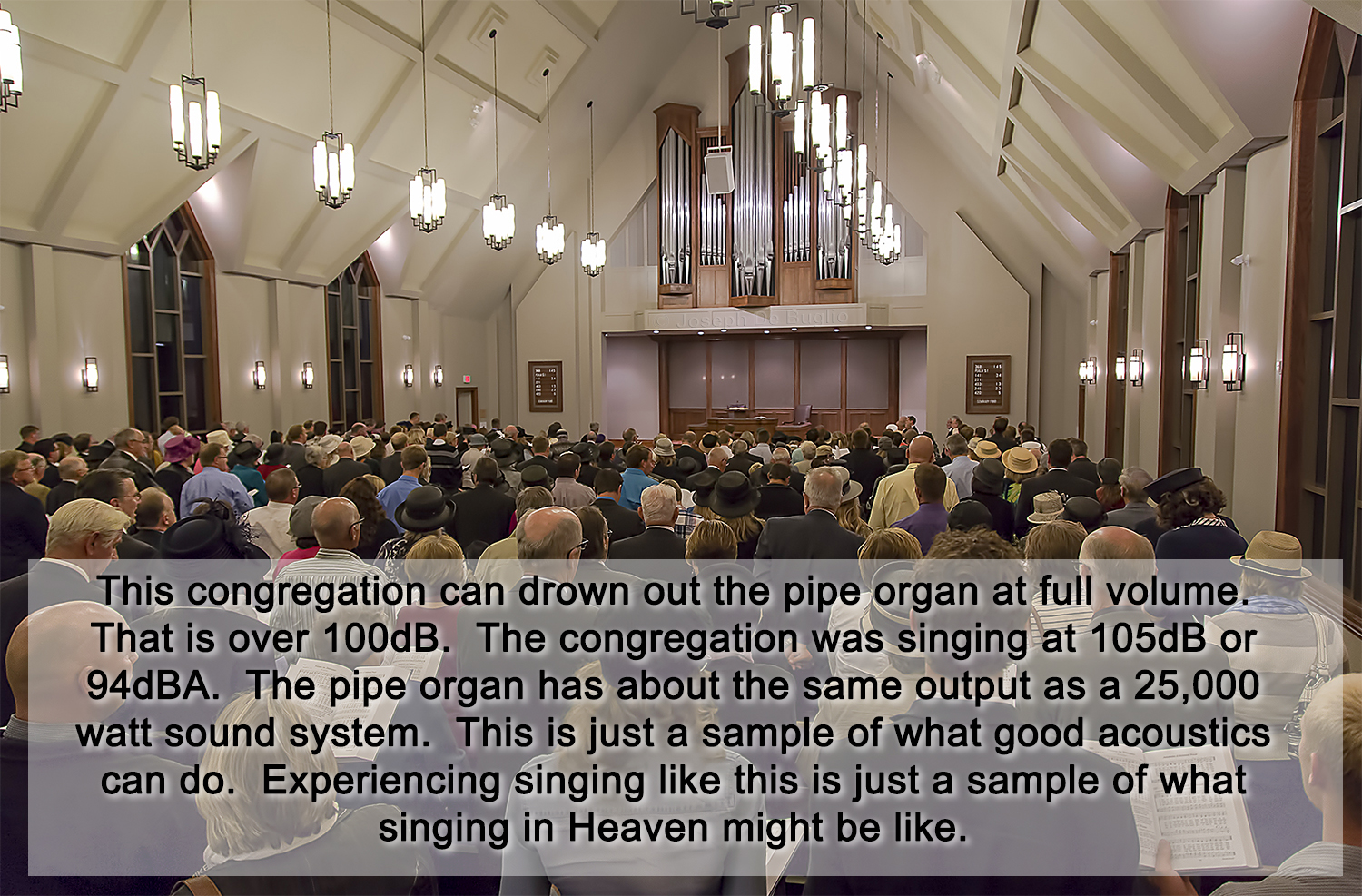
The organist of this church pulled every stop, pushed the peddles all the way down and the he had trouble hearing the organ just 20 feet away. At the back of the church at the sound booth, the organ was barely audible. I used a SPL meter, put it about 3 feet over my head at the back of the church and the congregational singing peaked at 105dB several time during a familiar hymn. There was no one behind us. There have been other times at other church where I designed or upgraded their acoustics were the congregation is singing acapella and they were peaking at 106dB. The good news is, singing like that doesn’t hurt your hearing.

Posted in Church Acoustics | Tagged: , , , , , , , , , , , , | Comments Off on The Best Worship Experiences

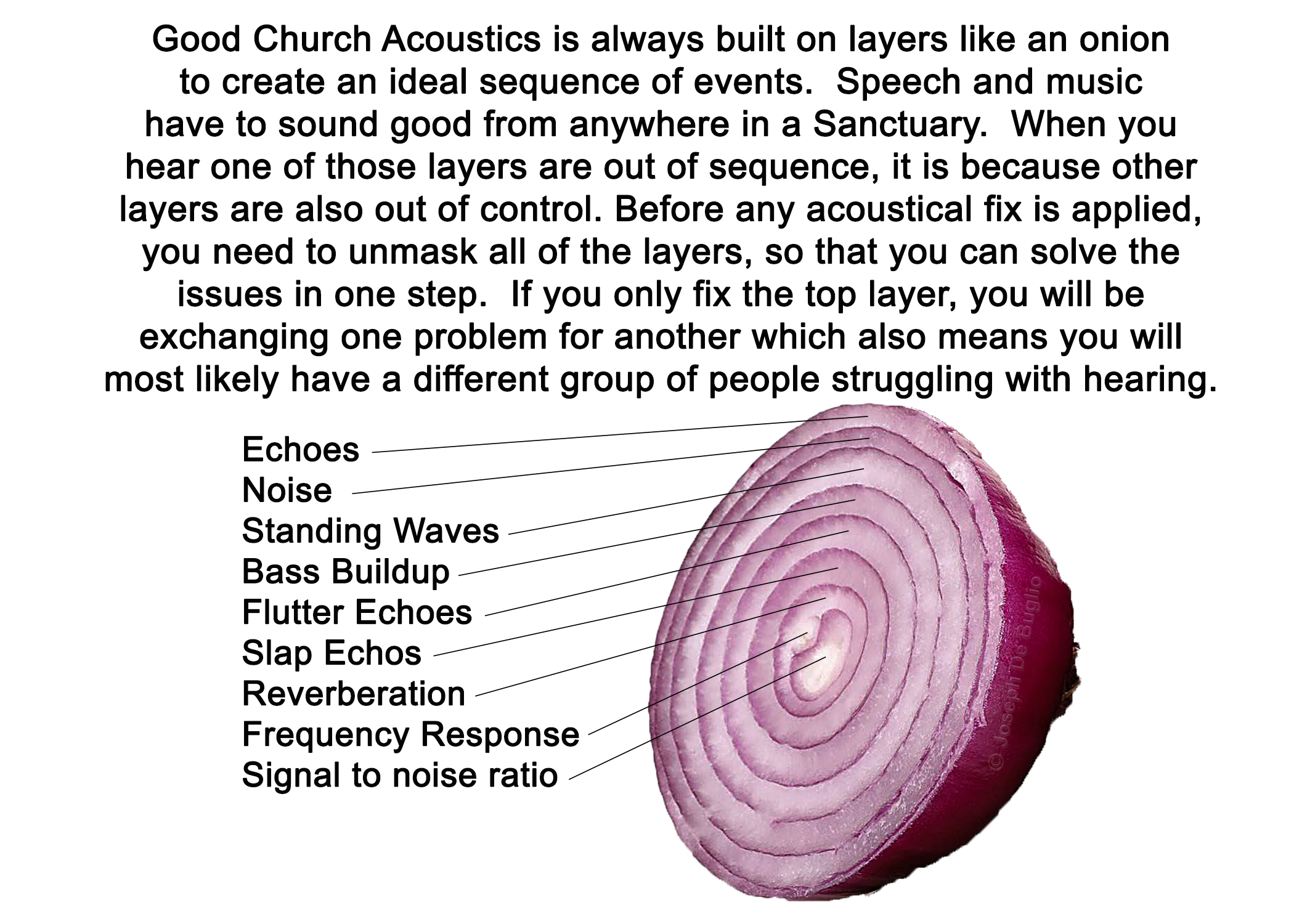
Acoustics are like an Onion

Posted by jdbsound on March 2, 2019


Posted in Church Acoustics | Tagged: , , , , | Comments Off on Acoustics are like an Onion

Churches are Tools

Posted by jdbsound on February 18, 2019


Posted in Church Acoustics, Church Sound Systems, Rants | Tagged: , , , , , , | Comments Off on Churches are Tools

Church Ceiling Height Chart

Posted by jdbsound on December 26, 2018


There are three key parts to what happens in church worship.  There is the spoken word, there is collaborative/congregational singing, and there is performance singing.  For a worship space to support these three events where speech is first, then congregational singing and performance singing, you need a specific design and dimensions to support these functions well.  High-quality speech should not come at the expense of the music.  Music should not come at the cost of speech.  There is a balance, and part of that balance is to have enough ceiling height to support both speech and music in a contained space.

Unfortunately, churches these days are building lower and lower ceilings in their worship spaces.  A person can assume that when so many churches have experienced only poor quality acoustics, many wonder what is the point of building a taller worship space.

When a church builds a low ceiling, it limits congregational singing and it makes you more dependent on technology, but guess what!  The same things that limit congregational singing are what also limits the performance of the technology we affectionately call the sound systems.  So, instead of getting 100% out of your high-quality, expensive sound system, you’re getting only 40 to 60% of the sound systems’ true performance abilities.  It is actually cheaper to build higher than the added cost of un-needed audio technology to make up the difference.   The chart below should clear the air as to the minimum height your next church should be. If you can afford to build higher, do it.  Also, a taller worship space does not mean being stuck with longer reverb times. A higher ceiling means natural room reverberation can be adjustable and is tune-able.  With a taller ceiling, you can change the frequency response of the whole room without needing a sound system or equalizer.

https://www.jdbsound.com/art/church%20ceiling%20height%20chart.pdf

Church height is important for a worship space.  One of the biggest parts of worship is singing.  Congregational singing to be specific.  When singing as a group, several elements are required for a good and healthy worship experience.  There is chorusing, harmony, sound volume, or loudness of the singing and being able to hear yourself as well as the people around you.  When all of these elements are in balance, the worship experience is like no other.  The majority of people get a lot of satisfaction from the singing experience during worshiping in rooms that have ceiling heights that match the size of the seating capacity of the worship space. The above chart is the minimum of interior ceiling heights.  If you want to build higher, you can as the singing experience gets even better.


High ceilings allow for better sound system performance with less expensive sound equipment. (A lot of pro audio contractors, installers, and equipment manufacturers don’t like hearing this.)  Higher ceiling permits better gain before feedback and it becomes easier to isolate drums and floor monitors. The performance of the sound system is much better too when that is coupled with a good quality acoustical management system.


There are economic advantages too.  The higher the ceiling, the cheaper it is to heat and cool when using a vertical displacement HVAC type system which is specifically designed for large gathering spaces for people.  Such systems cost less to install, they use smaller HVAC components and cost about 30 to 40% less to operate annually.  In addition, the cooling systems last 2 to 3 times longer before needing to be replaced. In a way, building higher cost less both in cost and in operation over time.


Another thing to consider. If building new, don’t build a flat ceiling that is parallel to the floor. (and it doesn’t count if you put in a sloping floor.)  Many churches that are moving into commercial buildings are learning the hard way that flat ceilings limit the quality of live musical performances and congregational singing.  Sure, there are acoustical panels that can slightly improve the room for amplified sound, but the cost doesn’t justify the returns.  There is little that can help congregational singing even if you have the height. Vertical standing waves are harder to manage than horizontal standing waves. If you know what you are doing, horizontal standing waves can be controlled to create an outstanding room.  It is part of the formula for that perfect worship space.  Funny though, most concert musicians that perform in a church that I have fixed, they often make comments like, “I wish our concert hall sounded and performed as well.”  That is almost like saying, “concert halls make for lousy worship space but worship spaces can perform better than a concert hall.”

Finally, there is the Biblical standard for church sound.  For a 160 seat church as detailed in the Bible, the Biblical standard is the width of the room is to be 50% of the length and the height of the room should be 75% of the length.  However, we now know that for anything over 45 feet high and less than 2000 seating, the extra height is not needed.  It is the length to width ratio of 2:1 is key and a constant height of 45 feet or 13.7 meters.  For those who don’t want long rooms, because of sound systems, we can use a length of width ratio of 2:1.7 or a room that is 100 x 70, and you must always use the room lengthways or you destroy congregational singing and speech.

God gave us the laws of physics for a reason.  When we obey God, we reap the benefits.  When we ignore God’s teaching, we will have our reward here on earth.  The sanctuary of a church is a battlefield where the hearts, minds, and souls of people can be added or subtracted people from the Kingdom of God.  The acoustics of a church plays an important part in either adding or subtracting people.  The change is slow and often not noticed, but when you visit hundreds of churches that have their worship spaces upgraded to the standards of the Bible as best as possible, there has always been an increase years later, ( unless there have been leadership or church split issues.)

If you can, to get a better picture of planning a new church, read this article on Gods Authority in Church Design.


*Note* In most countries that have freedom of religion laws, the worship space portion of a church building has no roof heights limits regardless of local city building height restrictions. 


**Note** The data is based on 1200 churches from around the world. 

Posted in Church Acoustics, Educational Must Read Articles | Tagged: , , , , , , , , , , , , , , , , , , , , , | 8 Comments »

Romanian Church gets Excellent Acoustics and Reviewed by Professional Sound Magazine Article

Posted by jdbsound on August 6, 2016


Churches don’t often get Reviews for their Acoustics and Sound System.  Kevin Young did such a review of one of my projects.  The installation company was CS Acoustics from New Hamburg, Ontario.  Here is the full Professional Sound Magazine Article about the Romanian Pentecostal Church in Kitchener, Ontario Canada.  Please leave any comments or questions below.

Should you have a chance, when your in the area, visit this church.  The people there will give you a tour. Better yet, go to a worship service.  it is different, but worth the experience.  Kevin Young is a Toronto based musician and freelance writer.

Joseph De Buglio

Posted in Church Acoustics, Church Sound Systems | Tagged: , , , , , , , , , , , , , , , , , , , , , , , , , , , | Comments Off on Romanian Church gets Excellent Acoustics and Reviewed by Professional Sound Magazine Article