Here is an updated flow chart from Old Testament to New Testament, to help lift churches out of limiting themselves to entertainment styles of worship.
I think many people would agree that there is no experience better than singing in a church, with a congregation, and where everyone wants to sing. Can you imagine singing in a church where 70% or more of the congregation sings all the time! What a concept to be singing in a room where you know that your voice is contributing along with everyone else’s. Singing in unison or in harmony sounds just as heavenly and exciting—singing in a church where it sounds just as good with or without musical instruments contributing or leading the worship. Many people dream of such a church sanctuary that performs like this. Do such worship spaces exist? Can a church be transformed into having such qualities?
When only 20 to 30% of a congregation is singing, and the rest are passively swaying to the music, some with hands in the air and others almost dancing on the spot, is that the kind of worship the Bible describes? Why don’t more people sing? Is it because of the music, the hymns, the sound system, or could it be because the room is not able to support the kind of congregational singing described in the Bible? If the room can’t support good congregational singing, that becomes an acoustics issue, and when most churches try to fix their worship spaces, they often kill the room to make the sound system perform better which makes the congregational singing worse – never better.
Evidence shows that it is easier for a church to resort to an entertainment style of worship because the secular community has not demonstrated any method of fixing the congregational singing issue in existing churches, and new churches opening these days are void of such performance qualities. That then begs the question, is the entertainment style of worship honoring God?
In the Bible, there are no examples of musical instruments leading the singing, rather, the instruments followed the singing of the people. When there is a worship team performing in most churches, the worship leader prompts the congregation to sing, and the performers who play instruments, follow the lead singers, not the congregation. Often it is because they can’t hear the congregation singing at all, and they use floor or IEM monitors to follow the lead singers. The reason the musicians and singings can’t hear the congregation is because of a room problem. This creates a room full of people passively worshiping rather than actively worshiping. That is not much different from going to a music concert. Is worship in music as long or longer than the sermon?
What does the Bible say about any of this? God designed a house of worship in the Old Testament. Why? Why didn’t God leave it up to David or Solomon to design something that they wanted? Why was God so heavy-handed and specific to its design. Was this house of worship to be a relic of the past, something for the future – and something for the present?
If the temple was to be a relic, then why are there so many specific details? Why were those details preserved for over 3500 years? What if in those details are solutions to many of the problems many churches have today – not just with sound problems, but other issues churches struggle with today?
Study the flow chart. See what happens when 3500 years of history collide with science. If there are any errors, let me know. This work is a result of 27 years of fixing and documenting over 300 churches with another 100 plus churches that copied from the 50 church examples posted who informed me of their successes and from studying over1400 churches since 1983. Visit my blog if you want to know more about the results in following God’s way to design churches and manage sound.
The Bible has a lot to say about how a modern church should be designed. Solomon’s Temple was not just a house for God to dwell in, it was also meant to be a tool to help preach and spread the Gospel in the present.
After reading this article, please pass it on and make comments below.
This article is the most comprehensive study of King Solomon’s Temple I have ever written. If you believe John 1:3, then you know who really designed Solomon’s Temple. King David only penned the details of the new temple. King David told his son Solomon that it was the hand of God that guided his hand. What was so important for God to design the temple rather than letting a man design in with whatever came into his thought?
This article gives a stronger case for what the “Inspired Word of God” means.
Winning people to Christ is not a game or something given to chance. We need all the tools possible to have an impact on this world. Jesus is Lord, and if your church is dedicated to God, Jesus is Lord over your church building too.
Congregational singing is perhaps the third most important part of worship. Prayer and preaching of the Gospel come first and second. In many church publications and websites, there are many articles about how to improve congregational singing. When you say improve congregational singing, what are you truly asking for? In almost every case, they are asking how to get more people to sing. And the theory is, that the more people are singing, the more they will be engaged. The means of how they attempt this is with a high power sound system and strong leadership of the lead singer in a praise band. You never hear them suggesting to fix the room.
Here are some of those titles.
7 Tips To Encourage Singing in Your Church – Gavin Adams
Nine Reasons People Aren’t Singing in Worship
12 Things to Avoid for Better Congregational Singing
Fifty Ways to Guarantee Poor Congregational Singing
How to improve congregational singing: 4 suggestions to …
A Simple Way to Improve Congregational Singing: Get Rid of the Carpet
There are many more.
The ideas recommended are extraordinary, and most of the time, they are putting the bulk of the load on the church leaders, including the pastors and song leaders. This is so wrong. The truth is, all of the recommendations outlined are the results of trying to put a square peg into a round hole. There is a simple solution to all of this. When you read the articles, what church leaders are doing is a direct result of compensating for poor acoustical conditions. Choosing the right keys to sing in, choosing a better selection of songs, hiring professional singers, and performers, in the end, it only helps things slightly. The thing is, what the audience keeps telling me is that when they are singing, they feel like they are singing alone, it creates a sense of loneliness. People feel as if no matter how loud they were singing, their efforts have no contribution to the overall volume of the congregation. When you can’t even hear yourself, most people just give up and don’t bother singing. Some may just mouth the words.
Sure, there are times when we see people at a concert singing a particular song, and it sounds impressive, but the reality is, those people will not sing the whole show at that volume. It is more about having an emotional high and nothing more. It is doing something to capture a moment for personal gratification and bragging rights. That is not worshiping in any sense of the word.
My take on how to get the congregation to sing is by first identifying the source of why people don’t sing in your church. In 90% of the churches that I have helped solve their congregational singing issue, it has always been around one reason – acoustics. Here is some background you should know.
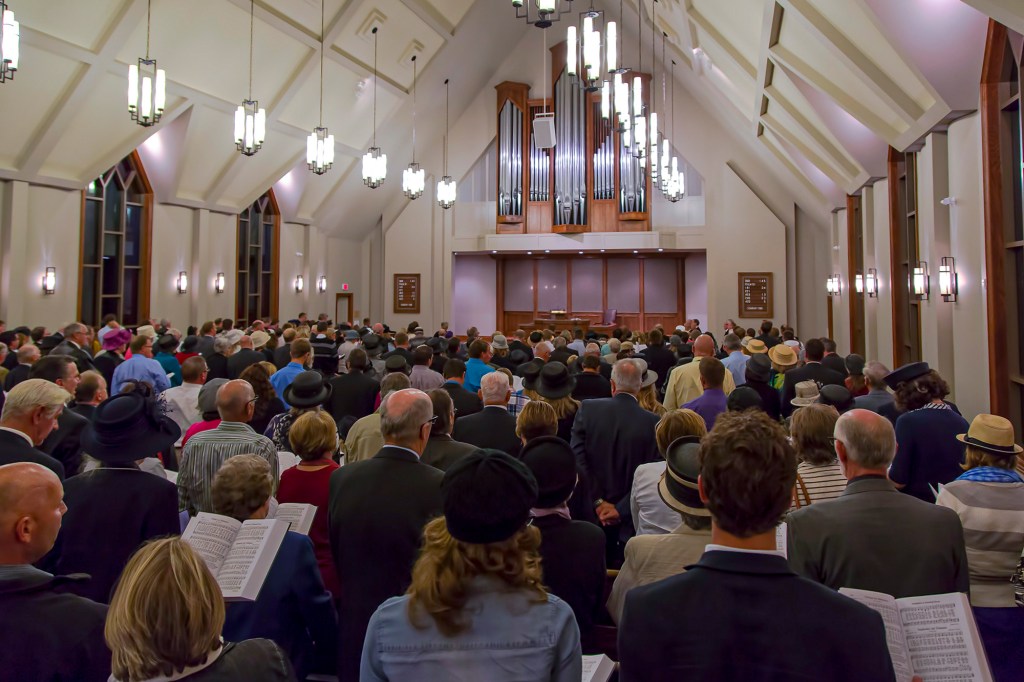
This is a new church with diffusers built into the walls. The quality of this room is such that when this photo was taken, the congregation drowned out the Pipe Organ. The organist said he pulled all the stops and he could not hear the organ for some of the songs they sang. At one point he stopped playing. With a sound meter recorder at the pulpit, the congregation hit 105dB several times and no one complained that it was too loud.
The struggles of congregational singing started long before the sound system was invented. It is my belief that Choirs were formed originally, because when Christians first started to worship in existing pagan temples, (after the edict of tolerance,) most likely, those temples had such poor acoustics that the congregations back then had the same problem of not hearing themselves. Then some talented singers found that if they stood in a particular part of a room, they could hear themselves and create an awesome sound of choral singing within the pagan temple. That talent was later included as part of the worship. When Christians started to build churches, when the buildings were finished, they asked the better singers to go to the part of the worship space where their voices were effective in creating this big sound where a few people would sound like many.
In the end, as more and more churches were built, the choir became the focus of congregational singing, and even though the congregation was encouraged to sing, the choir was the focus, not the congregation. This continued throughout church history in one form or another. Sure, some large cathedrals have these amazing sound effects. (Sound effects do not support congregational singing or speech.) Still, in the end, it is the choir and the organ that dominated worship, not authentic worship singing or hearing the Gospel.
Throughout the Reformation period to today, churches have been experimenting with worship space designs to discover the Rosetta stone of church acoustics. Churches have been trying to create a worship space without any acoustical planning. It hasn’t happened yet that we know of and if there is a church out there that works, where is it? Why would it be kept as a secret? When the room helps the singing of the congregation, the congregation will sing, and they will sing as loud as they are inspired to. The same properties that makes congregational singing work, speech will be equally as good. Around the world if there are such churches that have the proper balance of sound, for speech and congregational singing, why has no one documented these jewels or studied them to see what makes those churches better than others. No one has made permanent records for future churches to follow.
It seems that when a church gets known for its musical performance quality, it usually suffers from speech, and for years people have been brainwashed into believing that you can’t have a worship space that is good for both speech and music. That comment is true, for a musical performance space or concert hall. This is not what a church needs. A church needs a room to support congregational singing, not musical performances.
When I get hired to fix a church, one comment that is repeated often is, we can’t afford or don’t want a concert hall. That is the whole point. You don’t want a concert hall, and it would be detrimental to a church to have such a space. Concert halls do not support congregational singing, none of them do. Concert halls are awful for speech. If you look at most concert halls today, when it comes to speech, they close curtains, expose absorption panels, and they rely on costly sound systems to broadcast speech events. Concert halls are either-or spaces. They cannot support speech and music equally. Furthermore, they don’t support audience singing at all. How do I know that? When I go to most of the churches that I have fixed in the past, when the attendance is around 90%, the congregation can drown out the pipe organ, the electronic organ, and the amplified worship team. Yes, it is possible for the congregation to drown out a sound system with professional Christian performers leading the music. That is what good acoustics can do in a worship space. When people try to sing like that in a concert hall, it sounds like chanting in a sporting event. It is not very musical and singing in four part harmony is out of the question. In a worship space, a well-motivated congregation can sing over 105dB with the sound system off when the acoustics are managed for congregational singing. If only the sound system could perform that loud without distortion and without the congregation complaining about the loudness.
Consider this, the invention of the sound system and its introduction into churches merely ushered in over time, the ability for contemporary worship, with the goal to get more people singing. Yes, many churches tried amplifying the choir as a means to get the congregation to sing, it didn’t work. When it came time for speaking, the sound system failed as well to amplify speech properly without feedback – This created a dilemma. To make the sound system perform better for speech, churches add absorptive flat panels, and that usually means killing the room, which in turn, discourages singing. The sound system was believed to be the solution to improving worship, but the truth is, the sound system can only amplify what the room allows. In this struggle between the sound system and church worship, no one looks at the room as being the limiting factor. Instead, observers and people asking whomever as to what can be done, the fingers point to the technology, the pastor, the song leader, and the soundmen who get all the blame. All of the other recommendations are meaningless until the room is fixed.
The only complaint this church has is that congregational singing is much louder up front.
As I mentioned earlier, I fix the sound in churches all over the world. Without changing the leadership, the pastor or song leaders, and without changing how worship is conducted, with the methods I use, most congregations go from 10 to 30% of the audience singing to 65 to 90% of the audience singing when the room is fixed. That happens because there is a way to make the room very responsive to exactly what people need to hear and feel during the singing portion of worship. At the same time, the same system improves the quality of speech, and as a bonus, the performance of the sound system increases substantially more. Doing church acoustics correctly, is being able to have a room that does both speech and congregational singing equally well. It also winds up being a good room for Christian concert and drama performances. Is it really possible to have a worship space that does everything well? Yes. Should you think that this is about a compromise? Think again, it is not.
The method of sound management that I have been using in churches is not of my design. I cannot take direct credit for these successes. I learned from an expert in Church sound. This sound management system that is now in over 450 churches, is the same method as originated by the hand that guided the fingers of King David, who designed King Solomon’s Temple. The acoustical system that I use is the same system that was designed by God. As I said, I can’t take credit for the success in the churches that have this system. Here is condensed version of how I learned about it.
Years ago, I had read or heard this verse in 1 Kings 6:29, which says that on all of the walls within and without, there were carvings of Cherubs, Palm Trees, and open flowers. Then one day and as the pastor was reading this passage from the pulpit, it dawned on me that the palm trees seemed out of place. They have no aesthetic value. There is no spiritual, nor ritual reason for having palm tree carvings on the wall. Then the acoustical knowledge I was learning at the time kicked in. If there was no acoustical treatment within the temple, the Levite Priests would have not been able to understand each other. That room would have been ringing well over 5 seconds. Under those conditions, even at 24 inches, the reverberation would have made it difficult to impossible to understand speech. It says that in the large room of the temple called the Holy Place, that the priests taught, they read the laws, they played musical instruments, they sang and prayed. They also did rituals that would have involved speaking. What was in the room that allowed them to do all of those activities, which are also the same actions we do in churches today?
After doing a lot of testing and experimenting, I discovered that the shape of the palm tree could be mimicked with cardboard, wood or plaster tubes which come in a range of costs, depending on how important aesthetics are and the budget your church can afford. This changes the performance of any existing church into a high-quality worship space that supports both congregational singing and speech. Before installing any churches with cardboard tubes, we tested a number of churches. For the first church tested with cardboard tubes, we used 10 and 12 foot long tubes, leaned them against the walls of a church and left them there for three weeks. At the end of three weeks, not only was speech so much better, but the number of people participating in congregational singing doubled. This was a huge surprise, and it was unexpected. We repeated this test in a dozen churches, and all of them had similar results. With those outcomes, I started recommending churches to use half-round tubes around their worship spaces, and every time as a new installation was completed, the results were almost all the same. (Let’s face it, some room shapes are better than others.) Speech improved, and congregational singing always was much better.
In most cases, at the 6th month follow up to an installation, the contact person would tell me two things. The first was an attendance increase. The second was that 65 to 90% of the congregations were singing every song. In most cases, there was no change in leadership, or order of worship or how singing was conducted. All of the deadspots in the room were gone. Now you could sit anywhere and sing out and feel like you are part of something big. Sometimes I also got glowing reviews of how the sound system was fixed when nothing was done to the system except for some equalization.
Since around 1994, over 450 churches have applied this method of managing the sound in their worship spaces. All of them have reported similar results. The interesting thing was, most of these churches didn’t hire me to fix their congregational singing. They hired me to improve the performance of their sound systems. They wanted better speech intelligibility. The half rounds tubes are the most cost-effective solution to improving the performance of any sound system. This method fixes the sound system much better than using any absorptive panel.
There is also a unique feature that half-round tubes have that no other acoustical system can do. The half-round tubes, when laid out in a specific pattern, can equalize a room. By adjusting the spacing, the sizes, and when using prime number sequences, if there is enough wall space, you can cut up to 40dB of excess sound energy from 50 to 1200 Hertz. If your worship space has excess energy, for example, at 400 Hertz and it feeds back there all the time, you can space the diffusers to cut out that frequency range. No other acoustical system in the world can do that. The most powerful acoustical system in the world comes from the Bible, and it is designed by God. Many people say that the Bible is sufficient in all things, and this is another example of that Biblical truth.
We have to stop blaming worship leaders, song leaders, and pastors for the lack of congregational singing. Saying things like changing the key to sing in or changing the order of music is blaming the worship leaders, and because of acoustics, all of their efforts cannot get any significant results because the room will cancel their efforts. Song leaders are always searching high and low for answers, and if you watch them carefully, they are constantly trying new things to get the congregation to engage more. Sure, for the short term, they might get an additional number of people singing, but after a few weeks, it goes back down to where it was before. It’s not that people don’t want to engage; it is because the room will not allow them to participate in group singing. This is the real reason why so many churches with contemporary worship styles have sanctuaries that are as good or better that performance clubs in Las Vegas. So many churches have turned to an entertainment style of worship. How un-Biblical is that!
On the internet, there are plenty of videos of young people in churches with hands up in the air and swaying to the music, but if you look closely, most of them are just mouthing the words, they are not singing. That is not worship. When what goes on in a sanctuary looks more like a rock concert, it is not church or worship. It is just clean, mostly unspiritual entertainment.
If there is any blame to go around, here is an uncomfortable truth. When I am hired to help a church, congregation members always tell me how, for years, they have been complaining to the church elders. Since churches are so reluctant to share their experiences about sound to other congregations, most church elders feel helpless because there are no standards for church sound and acoustics for them to turn to. When they ask consultants for help, they say, ask 10 sound guys what to do, and you get 10 different answers. This madness has to stop. The Bible has the answers to church sound, and it is a solution that is superior to any other system at any cost.
The best way to improve congregational singing is by fixing the worship space to the same standards as outlined in the Bible. In the end, this is the only option. If your church already has more than 65% of the audience singing, you are most likely not having an issue of the congregation being engaged in worship. For the rest of the churches out there, seek out what God can do for you. You don’t need an expert or acoustical consultant or sound system engineer to have a successful transformation. Churches can do this on their own. All you have to do is look at the examples on my website and copy whatever layout you see. If you need more help and can afford the cost of a consultant, hire one who understands the Biblical way to solve church sound problems and congregational singing. There is no mystery or formula or program when solving the congregational singing issue God’s way. Congregational singing is also a spiritual issue. It is what binds up together as believers. Stop solving spiritual problems using mans’ ways. God’s way always works. Don’t take my word for it. Trust God.
Is the performance of your worship space a priority? Is the message always crystal clear in every seating position, and over 60% of the congregation is singing all the time? If you say no to either or both questions, and you want your church to sound right for speech and music, the biggest obstacle is often the acoustics. The second is money. The third is aesthetics.
Fix the room! How? Follow what the Bible says, and you will not be disappointed. After all, it is God’s plan, not man’s idea. Do you think that the results will be less than perfect if you follow His plan completely? Isn’t the Bible the Living Bible? Since when did the Bible stop teaching us new things about science? Check out Solomon’s Temple, and the answers are there. They always have been. It’s just taken a while to join the dots.
But it costs too much! Oh, you mean the cost of a few floor monitors or a couple of wireless microphones considered too much? That is often the cost of the Bible’s way of fixing the acoustics or about $3.50USD per seat for a 300 seat church. (Not including the price for the knowledge of knowing what to do.) Replacing a mixer costs about $15.00-21.00 per seat. Replacing pews for chairs cost about $75.00 per seat. Buying 10 Shure SM58 mics with cables and mic stands – costs about $1,500.00. Fixing the acoustics of a church is cheaper than you think.
If the look of any acoustical treatment is a concern, ask yourself this. Are you there to worship God or the building? Fixing the acoustics is like saying you are more interested in hearing what God has to say through your minister. Putting up with acoustical problems, poor quality congregational singing, and accepting a sound system with limited performance is like saying the building is more important than the message and having fellowship with other believers.
It all comes down to priorities. The primary purpose of any building that is a dedicated House of God is the preaching of the Gospel. A place where the Gospel message can be spoken without distortion or interface. That includes making the room behave as God would want us to have it. The second priority is the breaking of bread and drinking of wine in remembrance of what Jesus did for all of us. The worship space has to support this event as often as each church chooses to remember. The next priority is congregational singing. There isn’t any other experience that can replace the joy and excitement of a room where more than 75% of the audience is singing. Songs that tell stories of Jesus, his atonement of our sins, and of people who follow Jesus are powerful in bringing people together. It takes the same quality of acoustics to hear clear speech as well as great congregational singing. These are the things that matter when you are a part of the Kingdom of God.
While I do have a business about church acoustics and sound, there is no possible way for one person or one company to fix all of the churches out there that need help. By making this public, it means that no one can patent it and force churches to pay a license fee. It means that no one can control it and inflate the cost of fixing existing and new churches. Churches should use the Bible’s methods with confidence, to apply in faith what God teaches, even without expert help. When churches take such a leap of faith, in most cases, the results are outstanding.
This information is being shared because I care more about winning people for Christ through better sound than creating a business empire. By revealing what the Bible teaches, by showing that science backs it up, that it is affordable for every church to have excellent acoustics, this is all part of the Great Commission. If more people with a passion and skills like mine, were to apply what the Bible teaches about sound, we could make a difference. Mat-7:15. Beware of false prophets, which come to you in sheep’s clothing, but inwardly they are ravening wolves. (KJV) If you have the chance, read the rest of what Jesus said in Mathews 7:15-20. Don’t trust me. Trust the Bible.
When sharing the Gospel, so many times, someone has said that they didn’t like what the minister said during a worship service, so they left the church. They thought the minister was preaching a false message. Some people have told me that they walked out of a worship service upon hearing the distorted message. I would ask them if other people left the service at the same time. In every case, they said no. That is when I try to retrieve the audio record of that specific service. As it turned out, on the recording, the minister said the right things, but why was it heard in the sanctuary as something else?
The next step was to play the recording over the sound system and sit in the same spot the person complained about what he heard. Sure enough, the same gibberish that got the person upset was heard in that spot. When you moved several feet over in any direction, the sound was clearer, yet in other places, different words were being twisted. With the recording on a loop, we found dozens of other places where the minister’s words were warped into something else. Doing this exercise did get one person to try church again, but in most cases, when something like this happens, most people will not return to a church where the Gospel is preached.
Sound quality matters. What good is excellent speech intelligibility in one spot and a failure in another? Sound quality can save people and their souls. I have never met a person who was saved by a song, but I had met many people who were saved when they heard the clear and undistorted message of Jesus Christ and become followers of the Messiah because the message was clearly understood.
I often wonder how many other people have experienced hearing something different than what the minister said in a sanctuary. For many ministers and church leaders, it would never occur to them that the sound system was the cause of some people not returning to church. The unfortunate truth is, many churches have questionable acoustics, and when a person sits in a spot where words, syllables, or the sound volume is too low, what was said and what is heard were not the same.
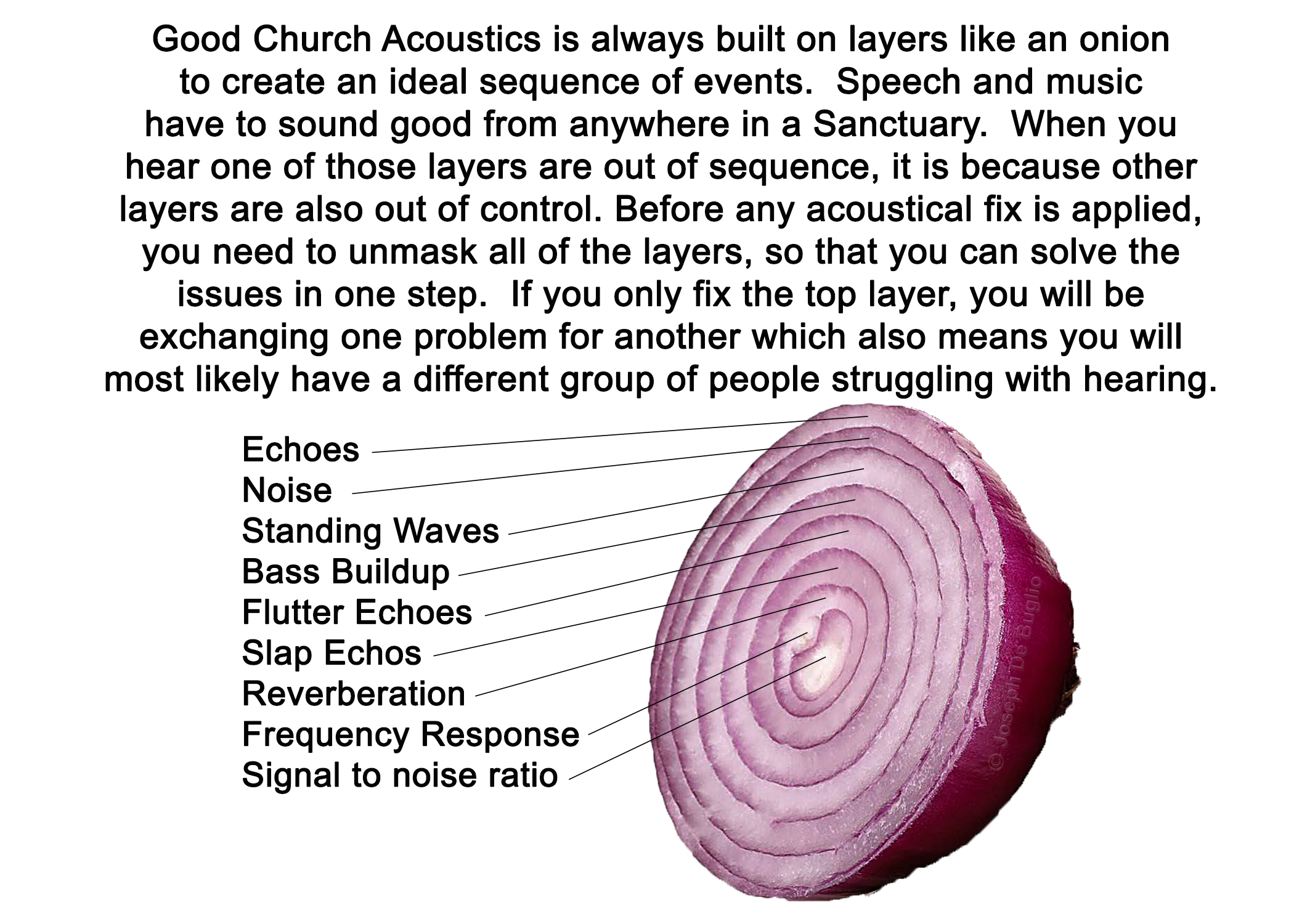
Sound systems cannot fix the acoustical problems of a church. Adding more speakers or applying the latest state of the art technology tricks are no match to Architectural failures in room design and unmanaged sound sequencing around a room. Absorptive panels are often the first weapon used to tame a room. Cutting down on the noise and reflections with absorption cannot fix deadspots or hotspots. Absorptive panels cannot change the path of sound reflections that causes uneven sound distribution. Absorptive panels have been known to make the sound harder to understand in those poor locations throughout the room, not better. What is needed is a different weapon to defeat poor sound.
To eliminate hotspots and deadspots, you need to be able to distribute sound more evenly. Scattering the sound is the most effective way to create a unified sound field throughout the whole sanctuary. When sound is managed in this way, not only does it eliminate deadspots and hotspots of any speech problems, but it makes congregational singing, praise and worship bands clearer, the stage sound is corrected, and for many churches, they bring back choral music because it sounds better than what a worship team could do before the room was fixed. In most cases, scattering the sound costs less to do than absorbing sound.
Acoustical solutions for churches that work should be common knowledge as these concepts have been around for years. Fixing a church can often be restricted by how a solution may look. It is high time that the aesthetic police take a back seat from preventing the Gospel message to be preached clearly. If aesthetics are a big deal, alternatives are always possible. In the end, it is all about priorities. You have to choose between hearing the Gospel or have a Church that looks good. What will your church do?
Here is a collection of 445 photos of 46 churches that completed most or all of their sound system and acoustical plan. My job is to design a solution that will solve all or almost all sound problems in one step. For most churches, this means getting the most accomplished in one step as most churches can’t afford to keep chasing sound problems without truthful help. The road back to great sound in the church is in the Bible, and that is what these churches did.
All of the installations of the acoustical systems and the sound systems were completed by church members or local contractors when those churches were able to afford professional installers. The final appearances are what those churches selected. I work closely with all churches for alternative aesthetics regardless of any budget limitations. When a church has to choose between aesthetics vs. performance of the 400 plus churches that have just simple painted cardboard tubes on the walls, those churches spoke with what they installed.
These churches demonstrated that they care more about hearing the Gospel than having a sanctuary that looks good. There is a high spiritual cost for poor acoustics and sound system designs. Poor sound does get in the way of people hearing the Word, and for some, it can deny people from understanding the Gospel message of salvation, and that is a cost no church can afford.
For professional, no compromise help, we can provide the highest level of expert assistance that will fulfill the Great Commission as Jesus taught. Having the skills of the world helps but God’s plan for churches demands His way of doing Church Sound. Without that knowledge, the worlds way of doing church sound always comes up short in meeting the standard that God demands of us.
Click the photo above or the link below to see what other churches have done to have great sound for speech, congregational singing and total worship in general.
The quality of church worship is critical to the
health of a church. The better the excellence of worship is, the stronger
the church will be. Quality of worship is not about packing the church
full of people for the sake of filling a worship space so much that it becomes
necessary to keep building bigger buildings. We worship God, not
buildings or pastors or knowledge. It is the Gospel, the Bible that leads
us to God. It is God’s words that keep us in a relationship with
Him. The strength of a church is not measured in numbers in the seats or
money. Jesus taught us to feed the hungry, clothe the poor, and shelter
the homeless. The Bible teaches over and over again that we are to live
by example (Psalms 1:1-6), to be a light in the world (Matt 5:16), when they
see that we are different (James 2:14-26), it will be that difference that will
attract people to God.
The strength of a church is measured by how people
support each other, and by how much a congregation supports each other as a
family first, as brothers and sisters, and then the local community. Is
the church feeding the hungry, clothing the poor, and sheltering the
homeless? The modern version of Jesus teaching for us in countries with a
democracy and wealth should look like this. Is the church cutting lawns,
clearing driveways, cleaning people’s homes, fixing up members and non-members
homes? How often are church members spending time with the widows, the
singles who have never had a partner, or the elderly? Are these not the
things included in what Jesus told us to do? Are not these the same
teachings in the Old Testament? This is just a small sample of how
Christianity should look like to the secular world.
___________________________________________________________________ After reading the full article, please comment on it. We want to get this right as the church community needs this knowledge. If you have any questions, want to learn more or see a presentation about Solomon’s Temple and the Modern Church, contact me here – jdb@jdbsound.com
You church may be one of those that has great sound for all parts of the worship service. If it is, you should let everyone know as it will help to bring more people in. You should let us know so we can tell others. If you find this article helpful, please pass it on. Pass it on to your pastor, your friends and family. Give them the chance to learn what God can do for them today!
Thank you.
All modern churches can benefit from Biblical AcousticsAll older churches can benefit from Biblical Acoustics
The goal of any worship space and the church sound system is not about loudness, gain before feedback, intelligibility, special sound effects for the organ or choir, having the most talented performers in the worship team, how many wireless mics, number of channels the mixer has or the name brand of equipment you have. The goal of a church worship space and the sound system is to be a safe place where the Gospel can be presented clearly and with little to no blemishes. Where every person within the worship space can hear and understand the Gospel as clearly as when having a conversation with someone only 4 feet away and sharing the Gospel. Anything less than that goal means that the spoken word can be corrupted in the journey between the minister’s mouth and ears of all those who are listening. The Gospel needs to be broadcasted and understood as clearly as reading God’s written words.
If your church has hot spots, dead spots, good sound in these seats and poor sound in those seats, then the Gospel is not being presented equally to everyone. If your sound system has technical problems during worship often, then it is a distraction, and it can make the difference of understanding something important.
The chart below shows tangible results when your worship and sound system are tested. There should be three tests.
The first is with a test speaker. It is a point source speaker that is small enough to mimic a person’s voice.
The next test is feeding a signal directly into the sound system and test those results. This test is just about the playback quality of your sound system.
The third test is to use the test speaker 30 inches from an open microphone such as a pulpit or any microphone on a stand and test the combined results of the worship space’s acoustics direct interaction of the sound system and open mics. You can also do a second version of this test and place the test speaker 4 inches from a microphone where the microphone is 45 degrees off axis.
If all three tests are not in the Yellow section, the results will let you know if it is your sound system, the acoustics or all of the above. This is also a better indication predicting if upgrading your sound system will improve the results you are looking for. This is also a strong indicator that your worship space needs some kind of an acoustical management system
You can get your church tested. It doesn’t cost much, and the results can save a life or many lives, depending on your point of view. As an independent consulting company, we offer church testing and results with no obligation to use our services in the future.





 Welcome to the world of Church Acoustics