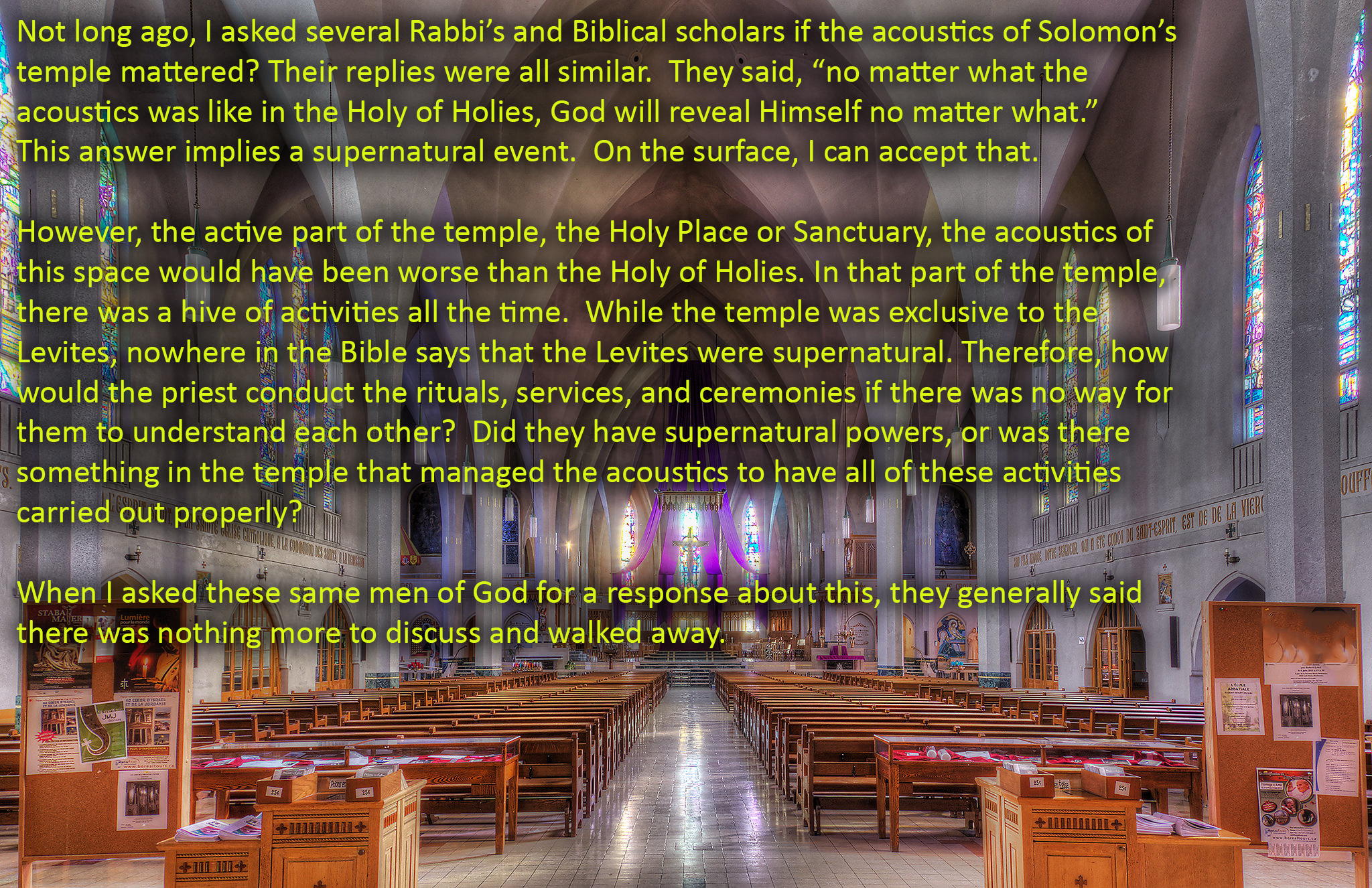
Welcome to the world of Church Acoustics

Teaching the highest quality in Church Sound excellence

  • Supported by

    Contact:
    Ph # 519-582-4443
    email: jdb@jdbsound.com

    The Bible is the de facto standard for all church worship needs including sound and acoustics.

    2 Timothy 2:15

  • Archives

  • For additional contact information scan the QR code below

    link to jdbsound.com

Posts Tagged ‘Sound System’

Half Round Tubes -Performance vs Aesthetics

Posted by jdbsound on June 9, 2020


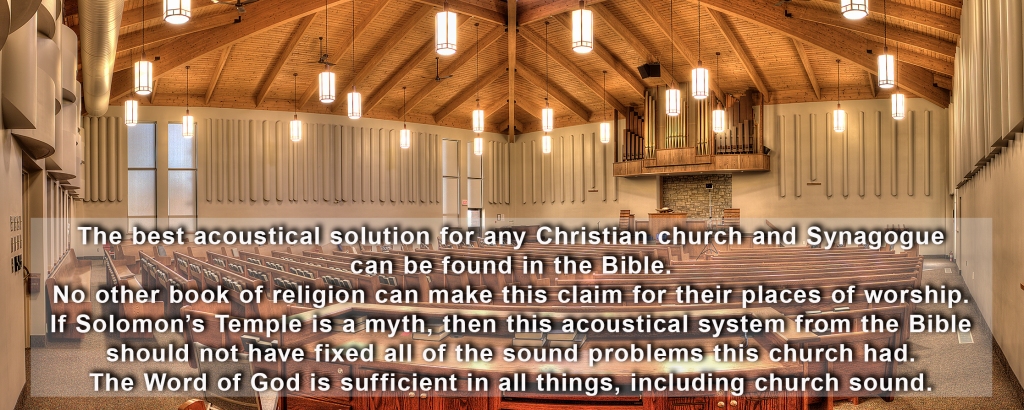
Diffusers are amazing tools when used properly in a church. They solve a variety of problems in one step. Nothing performs better.

One question that is often asked, can you turn the diffusers sideways?  This is a great question, and the answer is based on our anatomy.  As humans, our ears are on the side of our heads.  This means we get our sound information for direction and clarity of speech on the horizontal plane or side to side. The time difference between our ears give us directional info to identify where a sound is coming from, and for speech, it helps us to focus on someone talking to us.

For diffusers to work correctly and to solve multiple problems in one step, their orientation is critical.  When applied vertically, the diffusers can solve between 10 – 29 acoustical issues in one step. No other acoustical system can do this.undefined

The problems solved or reduced are:

  1. standing waves
  2. deadspots
  3. hotspots
  4. eliminate echoes
  5. eliminate flutter echoes
  6. bass build-up,
  7. speech intelligibility,
  8. increases the signal to noise ratio up to 25dB throughout the room
  9. eliminate or less floor monitor spill,
  10. less sound system distortion
  11. less bass distortion
  12. helps to equalize the bass and mid frequencies
  13. gain before feedback,
  14. even distribution of sound,
  15. elimination of delayed speakers in most cases,
  16. better stereo imaging for stereo sounds (when the right equipment is used)
  17. higher attention span,
  18. makes the room easier for the musicians to perform
  19. improved sound for people with hearing aids
  20. better congregational singing
  21. easier for the sound-person to get an excellent mix
  22. it can reduce or eliminate the need for drum shields or both
  23. makes the room less fatiguing for the minister to preach
  24. fewer to no complaints if the sound system is louder
  25. improves the sonic quality of the sound system
  26. can add up to an octave of clear bass from the sound system
  27. better bass from musical instruments both acoustic and amplified
  28. it helps to make the room more relaxing to hear speech and music.
  29. lowers the sound levels from HVAC systems

If your church has a pipe organ, you will want to know this. One of the most interesting characteristics we have learned with using this method is that for some churches that want to maintain a longer reverberation time, plus have all of the benefits of better speech quality, the half-round tubes can increase speech intelligibility without changing the reverberation time. No other acoustical system can do that. For churches that have a pipe or electronic organ and want better speech quality, this method allows a church to balance the need for music and speech.

undefined

When diffusers are installed horizontally, the list of benefits is much shorter.

  1. standing waves,
  2. bass build-up,
  3. Helps to equalize the bass and mid frequencies
  4. It can add up to an octave of clear bass from the sound system and musical instruments.
  5. Can only reduce echoes, not eliminate them

There is more to these differences.  Because we have ears on the sides of our heads, the rate of control is exponential when the diffusers are mounted vertically.  One of the principals of how these diffusers work is by phase cancellation, which is the same technique as in noise-canceling headsets.  The more random the sounds are scattered, the more the overall energy is canceled from the physics principle of phase cancellation.  As a result, when mounted vertically, the diffusers can get up to 40dB of energy reductions or absorption by air friction.  When you mount the diffusers horizontally, you will only get about 10dB of the overall reduction.

The reason horizontally mounted tubes are less effective is because you are creating large reflective surfaces on the horizontal plane that reflects enough energy back into the room, which it is adding noise back to the listener that in turn, reduces the signal to noise ratio. This cancels almost all of the benefits of using half round diffusers horizontally.

Here is a simple experiment you can do yourself. Find a round container that is at least 7 to 8 inches round.  You can every use a large cooking pot, planter, or roll up some cardboard.  Now say a bunch of words into the side of the container vertically.  After talking for about 15 seconds, turn the container sideways, and talk for another 15 seconds.

undefined

What just happened? Like most people, they notice that when the container was horizontal or sideways, there is a distinct reflection. When you turn the container vertically, the reflection goes away.

This simple experiment demonstrates how powerful the half-round shape is.  In the vertical position, when the half rounds are placed on a wall in groups, you can adjust the spacing between the tubes to determine how much reflection you want, plus shape and equalize the sound at the same time.  This is a compelling way to manage church sound once you understand how effective and simple this system works.

Just as a reminder, for all churches, you have to have a balance between absorption and reflection. The half-round tubes are not always a one and done solution. It has to be part of an integrated system. Typically, for most churches, if you have carpeted floors and padded seating, that is often all the absorption needed. If your church doesn’t have carpet and padded seating, then you will have to add enough absorption to the walls to match what would be on the floor. That is a narrow window to get it just right.

For churches that play their music loud, some people wait in the foyer until the sermon starts or they wear hearing protection during the music portion of the worship service. With the half round system, it allows the sound system to perform 10 to 20dB louder with fewer people needing hearing protection. People turn to hearing protection when there is too much distortion in the sound. A distorted sound is irritating and painful to many. People turn to hearing protection, even when the sound levels are well below 85dBa. When a room is diffused properly with half rounds, it reduces or eliminates bass and mid-range distortion. With distortion out of the way, the sound at 85dBa becomes pleasant and easy to listen to. That pleasantness remains constant over 100dBc. Consider this – in a church with this kind of acoustical system with the right room shape and height, it is common for un-amplified congregational singing to be around 100dBc. When that happens almost no one complains. Why? Because there is no distortion. Half-round diffusers prevent distortion. This transforms any worship space into a music-friendly space at any sound level.

Church acoustics and amplified sound play a significant roll in the health of a church. When sound is good, it helps to grow the congregation. When sound is bad, it gets in the way of providing a clear message, that leads to less attendance which means fewer people tithing. In the end, there is nothing more important than preaching the Gospel in the best clarity possible.

To ultimately answer the question of Aesthetics vs performance, the smart answer is this. When an acoustical system works, people don’t mind how it looks.  If anything, they grow to like it.  When other acoustical systems are used, they often fall short on the expected and promised performance.  As a result, those systems become more like wall furniture and in some cases, artwork.  This drives up the cost of those systems.  Here is the truth most experts and salespeople will never share or admit.  To get the equivalent performance of the half-round tubes as a Do It Yourself project compared to ready-made products, the cost difference is 35 to 1.  A church that fixes their acoustics with cardboard tubes as a DIY including paint and hardware for a 400 seat church may spend $2,000.00 installed.  A ready-made system of equal performance will cost a minimum of 75,000.00 installed.  That is equal to fixing 35 churches of the same size.  Even if the same church buys custom made half-round diffusers, they may spend $20,000.  When compared to other acoustical system costs, that is enough money to fix 3 churches.

There is something to be said about how people react to anything put on the walls.  When people see cloth-covered panels, there is an expectation of good sound.  When that doesn’t happen, people often resign to the notion that the problem is too complicated and too expensive to be properly fixed or that the problem is impossible to fix.  Most people just put up with the problem and accept it as normal and don’t bother with complaining.  That is a lie created by bad information and myths that keep churches from getting the sound they deserve.  Sound excellence is a necessity, not an option.

When an acoustical system works, people don’t mind how it looks.  When it doesn’t work as promised, it has to look amazing.  Do you want a church that looks good and has fewer people attending or a church that is full all the time regardless of how it looks?
Posted in Church Acoustics | Tagged: , , , , , , , , , , | Comments Off on Half Round Tubes -Performance vs Aesthetics

Church Sound. It’s all about cause and effect.

Posted by jdbsound on May 20, 2020


Sound system design has nothing to do with the equipment you use. It is about the location of speakers used to broadcast into a room and the interaction of the room with the speaker system design.  It doesn’t matter if you are using line arrays or point-and-shoot speakers. If speakers are placed in the wrong position, both systems will have the same limitations.  It is all about cause and effect.  A sound engineer needs detailed knowledge, experience, and wisdom in understanding room acoustics or when to know enough to ask help from an acoustician to understand when to use which system.  Did you know that the room will tell you where the best places are to put speakers? 

The room will tell you when to use one of the following techniques:

  • Distributed Sound System
  • Central Cluster or single speaker system
  • Left Center Right system or cluster
  • Left Right System
  • Live Stereo Hybrid System
  • Hybrid Distributed Sound System

The geometry, reverberation, surface materials, acoustical management system, and room volume must be accounted for before creating a sound system design profile.  After all of this is done, you can start to determine the size of the sound system needed. 

If you think you need to do some acoustic treatment or the church has already been treated, it should not be using the spot treatment method, which means placing a few panels on a wall or two.  Adding something to one wall or any part of a wall affects the whole room.  This also includes the placement of screens, lighting, and other items related to multimedia.  Even room renovations change how a room sounds. It is all about cause and effect. The acoustics of a church must use a planned system that treats the whole room.

A spot fix is when enough panels are added to solve one problem.  When there is a problem in acoustics, there are always other glitches that mask other difficulties that you can’t hear and often are not shown in acoustical measurements.  Here is an example: Placing sound absorbers on a balcony’s front face will eliminate an echo.  However, the added absorption often strengthens the mids and bass, making speech and music sound muddier.   This then requires adding expensive bass traps.  While you can use aggressive equalization to improve the sound system for speech, you will need a different equalization for music.  While these efforts can somewhat help with amplified sound, as long as someone remembers to switch the EQ settings, the congregational singing is degraded until bass traps are added.  Add the bass traps.  It is all about cause and effect.

However, you may have noticed that after treating the front face of the balcony and adding the bass traps, there is now a softer echo off the back wall, or the reflections off the side walls are much worse depending on the shape of the room.  Reflections off the side walls are detected when clapping from the front of the center stage.  Those reflections from the sides or back interfere with speech and music intelligibility.  It is all about cause and effect.  Change the EQ of the sound system.  Helps with speech but doesn’t help with music at all.  Despite changes to the sound system, speech is worse in the back half of the room.  Add speakers to the back half of the room.  It helps people with good hearing and doesn’t help with hearing aids.  Add a delay to the speakers.  People with hearing aids do better, but they are still not happy because someone is sitting in their spot where they know the sound is better. 

If you apply something to the sidewalls, the echo off the back wall becomes much more pronounced and interferes with hearing on stage.  Switch to in-ear monitors.  It’s all about cause and effect.

Now the drums are too loud. Add panels to the stage or get a drum shield that costs more than fixing all of the acoustical problems in one step.  With the drum shield, the drummer plays louder because they can’t hear themselves properly.  The insides of the drum enclosures are easily overloaded, making it harder for the drummer to hear all the different drums and cymbals.  After additional dampening to the drums, the drummer played even louder, getting elbow and wrist injuries.  Sound is still bleeding through the shield, even after adding a roof to it.  Some churches have turned the drum shield into a self-contained room with air-conditioning as a permanent fixture on the stage.  It is all about cause and effect.

For the time being, congregational singing has become a chore for most, resulting in less than 20% of the audience singing.  To get people singing again, you pay singers and musicians to lead the worship and keep the talent sticking with the music entertainment program.  This helps for a while, and before long, you are back to less than 20% of the audience singing.  Bring in larger screens, add lighting effects, and use lighting to help create a mode to encourage people to sing.  Again, this helps for a while, but participation drops back to 20%.  These objects change the acoustics of the room, and everyone just puts up with the sound degradation.  It’s all about cause and effect.

In the meantime, the sound system has been replaced, and church attendance is up, but fewer people come to prayer meetings or Bible studies.  Turn to home groups.  At first, home groups bring in more people, but as the church continues to grow, more people are slipping through the system and are not included in the home groups or any spiritual support.  Fewer people are growing as there is no alternative for mid-week meetings at the church.   The preaching is dynamic; the entertainment is awesome, fewer people are actively involved in the church, and more people become adherents with no real motivation to join, become members, and learn more about their faith.  The church is full of Sunday worshipers unable to defend the Gospel, but they know and sing the choruses sung by the church all the time.  It is about being part of something free of guilt, responsibility, and not knowing what salvation is.  It’s all about cause and effect.

Wait a minute, what does any of this have to do with acoustics and sound system?  The sound system is just equipment and technology.  The room is just a set of walls, floor, and ceiling.  When empty, they do nothing.  When energized with sound, an immediate cause and effect impact every part of the worship service.  Sound affects how people react to events in a church.  Consider how people respond to movies at a theatre.  When the sound is excellent, the audience will tell you how good the picture looks.  When the sound is poor, people don’t come back.  How much more does that impact a church?  Again, it’s all about cause and effect.

Next, check the acoustical condition of your church.  Have your church properly tested for all aspects of worship, not just the sound system and hardware performance.  Test for congregational singing.  Test for audience participation for prayer and testimonies from the seating area of your church.  Check for the signal-to-noise ratio on the stage and in the audience.  Check the frequency response of the room and ignore the reverberation time if there is more than a 20dB difference in the response of the worship space.  If your worship space passes, then you don’t need any help.  Your sound system is already working perfectly.  If you have any concerns or want better performance from your sound system, fix the room.  It’s all about cause and effect.

After upgrading the sound system and worship space, start mid-week Bible Studies at the church.  The congregation will become stronger and healthier if people come to the church mid-week.  Congratulations, you have just upgraded your church’s sound to meet all a congregation’s needs.

The story you have just read happens in many churches.  It is based on the testimonies of hundreds of churches around the world.  If this doesn’t sound like your church, have your worship space tested anyway if it hasn’t ever been properly tested. The results can be a surprise or a blessing. 

Posted in Church Acoustics, Church Sound Systems | Tagged: , , , | Comments Off on Church Sound. It’s all about cause and effect.

What happens when Church Architecture, Technology, Science, and meets up with the Bible.

Posted by jdbsound on April 24, 2020


The Bible has a lot to say about how a modern church should be designed.  Solomon’s Temple was not just a house for God to dwell in, it was also meant to be a tool to help preach and spread the Gospel in the present.

After reading this article, please pass it on and make comments below.

***  Article: Gods Authority in Church Design ***

This article is the most comprehensive study of King Solomon’s Temple I have ever written.  If you believe John 1:3, then you know who really designed Solomon’s Temple.  King David only penned the details of the new temple.  King David told his son Solomon that it was the hand of God that guided his hand.  What was so important for God to design the temple rather than letting a man design in with whatever came into his thought?

This article gives a stronger case for what the “Inspired Word of God” means.

Winning people to Christ is not a game or something given to chance.  We need all the tools possible to have an impact on this world.  Jesus is Lord, and if your church is dedicated to God, Jesus is Lord over your church building too.

Posted in Church Acoustics, Church Sound Systems | Tagged: , , , , , , , , , , , , , , , , , , , , , , , , | Comments Off on What happens when Church Architecture, Technology, Science, and meets up with the Bible.

Stop Sharing your Toothbrush/Microphone

Posted by jdbsound on March 17, 2020


Back in 2006, I wrote this original article about how sharing microphones can pass on colds, flues and other illnesses. In 2009, the manufacturer, Point Source Audio asked to update the article to promote good microphone etiquette after the SARS in 2008. Now with Covid-19, this is another opportunity to educate people about how to better protect themselves from communicable infections.  Since Jan 12, 2020, thousands of people have read or downloaded the article.  I thought it was time to dust off the original post from 2006.

Here is a link to the original article. Personal Microphones as toothbrushes 2006
The footnotes are interesting. Here is an example. I can’t authenticate this clip, but it is a great story.

There was a story about Elvis when recording – all morning they did take after take, none sounded right. During lunch, someone pulled the windscreen off his special mic, rinsed it in the sink – to find a bunch of black junk coming out of it. Did that a few times, put it on a low-heat hair dryer, put it back on the mic. After lunch, Elvis “hit it” with just one take.
From Blake Engel, All Church Sound

*** UPDATE ***

I’ve mentioned on other posts about using plastic food wrap or balloons over microphone capsules and windscreens.  This idea only works great if the plastic is removed between the uses of a microphone.   Passing microphones around is not a good idea either.  If you can get a second mic, the better.


Posted in Church Sound Systems, Rants | Tagged: , , , , , , , , , , , , , , , , , , | Comments Off on Stop Sharing your Toothbrush/Microphone

Is Solomon’s Temple a Myth?

Posted by jdbsound on February 6, 2020


A myth can’t fix a church. The Word of God Can!
Both Physically – including the acoustics of a church, and Spiritually.
Share this if you believe that it is true.

Posted in Church Acoustics | Tagged: , , , , , , , , , , , , , , , , , , , , , , | Comments Off on Is Solomon’s Temple a Myth?

Is Church Acoustics Easy?

Posted by jdbsound on December 23, 2019


There are two answers to this question. When you follow just the science, the correct answer is no. When you follow what the Bible teaches, the answer is yes.  Church acoustics is simple, but many will tell you otherwise. While it is easy to change how a room sounds, it is another thing to change the sanctuary to perform appropriately for a complete Christian Worship experience regardless of the denomination or congregation you belong. Christian Church worship is unique and the acoustical requirement of any church cannot be found, practiced or learned outside of any church community adequately.

Concert halls, recital halls, recording studios or any room where non-Christian people revere as great places for music or live stage performances and entertainment, these places have clouded, (Mat 7:15) the judgment of churches communities all over the world for years of what Christian worshipers need in a large room. When we turn to the Bible for the kind of worship space we are supposed to have, the answers most Christians are looking for are right there.

Science has not caught up with what is required for church acoustics. It is not able to predict the perfect acoustics a church needs. In each generation of computer modeling, it is getting much better. The good news is that we don’t have to wait for science to catch up to modeling proper worship space acoustics. The Bible has always had the solution as a tool to solve or plan church acoustics, even in the 2100 century. When such planning is applied the outcome is still what a congregation wants and needs. Here is a prime example of Biblical Scientific Foreknowledge at work. When we look past the Golden walls and floors and peel back the details of how Solomon’s Temple was designed and finished, we discover a worship space that every Christian congregation should have today.

The Bible has always had the proper teaching or formula for large room “Worship” acoustics. Did you know that without God’s design for acoustics, the Levites would not have been able to do any ceremonies or teaching in the temple? In Solomon’s Temple, there was an acoustical system given to Solomon that was applied. When employed in modern churches today, it solves almost all of the acoustical problems we can often hear and it makes the worship space better for congregational singing every time. Hundreds of churches have already been fixed or planned in this way. How many more before we can trust the Bible for modern church sound needs?

For church worship, whether in a classical or modern church structure, a commercial space, or converted space, there are many performance requirements to obtain the full worship experience which includes hearing the Gospel unfiltered by the poor acoustical performance of a sanctuary. (Poor acoustics acts like a changing filter that pollutes the Gospel. It can make similar words sound different which changes the meaning of what was said. For people familiar with the Bible, this may not be that big of an issue but for a person who has never been to church or is unfamiliar with church speak/language, when the room changes the pronunciation of a word, it can change the meaning of what they thought they heard. A church with the proper acoustics will prevent most of these mistakes regardless of what a sound system can do.) There is preaching, prayer, congregational singing, testimonies, choirs, worship teams and worship concerts. All of these parts of worship have to perform equally.

Church acoustics is not straightforward without the Bible. It is very complicated and any person designing an acoustical change should be including all aspects of worship, not just making a quick fix because of an irritation. As more churches recognize this truth, many are fixing existing past acoustical treatments that were done with good intentions and without help from the Bible. For example: Many people working in live sound don’t know that most hotspots and deadspots are acoustical problems and made worse when the wrong sound system design is installed. If your church has the right sound system design and there are still places where the sound levels and speech intelligibility is a problem, the sound system is telling you or screaming that it is a room problem -even if there is not feedback noise.

Church acoustics can be confusing, even with Biblical help. Experience has shown that there can be three churches that can have the same shape, dimensions, and age, and all three worship spaces different acoustical fixes. On the other hand, you can have three churches of different shapes, different dimensions, the same seating capacity and from three different ages and yet the acoustical solutions look almost the same to get the best performance for speech, prayer, congregational singing, choral singing and worship team performances. These differences in acoustical treatments are not easy to figure out regardless of the sound system design, equipment, and operating skills.

If the reverberation time is too long, don’t just fix the reverberation time. There are always at least two to five other problems that are being masked by the long reverberation or long time of noise. Correcting only the long reverb time, in most cases, exposes or creates bass problems that weren’t audible before, but the acoustical measurements said that such a predicament would happen. When the subs don’t sound good, you put a cage around the drums and you can’t mic the choir. When the floor monitors are too loud or as loud as the FOH speaker system and you are forced to get in-ear monitors. Then you have to get the worship team members to sign a waiver to not sue the church for premature hearing loss. Fix the room properly to meet all aspects of worship and you can avoid all of these issues.

Church acoustics is complicated and people who do Recording Studio, Concert Hall, Recital Hall, and noise control acoustics all have good intentions in wanting to help out a church. If their solutions are not based on what the Bible teaching, sure, they can change how a room sounds, but will their fixes be what a congregation needs? The choice is yours.
What is rarely taught or shared except on this website, is that a sound system is a magnifier of how a room performs. If the acoustics and shape of a worship space work, the sound system will tell you by how well it performs. If the acoustics are wrong, the sound system will be limited in what it can do. If after changing the sound system twice in the last eight to ten years, didn’t make that much of an improvement, do you really think a third sound system will be any better?

What is also not taught is that it is cheaper to bring a sanctuary up to worship space requirements that support all aspects of worship than to upgrade a typical church speaker system that can only make an incremental improvement for amplified sound. Fixing a room that meets worship space requirements often makes the current sound system perform profoundly better (unless the sound system is so poorly fabricated that it needs to be redesigned and reinstalled if the hardware is up to the task.)

Church acoustics can be easy when you follow the scriptures. Jesus never spoke of this because he already has given us the plans. Jesus said in Mat 5:17 “Do not think that I have come to abolish the Law or the Prophets; I have not come to abolish them but to fulfill them.” The Bible also says that all things were made through Him from the beginning. Jesus could not abolish the laws He created with His Father and the Holy Spirit (John 1:1-4.) There are many churches out there with poor sound, poor acoustics and have members who want to experience the full Christian life including the complete worship experience we all should be having. When you look past the gold and wealth surrounding Solomon’s temple, you will discover a blueprint from Jesus of how all worship spaces should sound. If that means duplicating Solomon’s Temple, that is what we should be doing. How is that so different in the fact the every church practices communion in one form or another. Every church has prayer, singing, reading of the scriptures, sermons and fellowship of its followers. Every part of a person’s life is in the Bible, whether any person can follow it 100% of the time or not. The same should apply to the houses we call churches that are dedicated to our Lord Jesus Christ.

Joseph De Buglio
A Servant of Jesus Christ.

Posted in Church Acoustics, Church Sound Systems | Tagged: , , , , , , , , , , , , , , , , | Comments Off on Is Church Acoustics Easy?

The Scientific Foreknowledge the Bible Teaches about Church Sound?

Posted by jdbsound on July 26, 2019


Here is a fresh look at Solomon’s Temple and how it relates to Modern Churches today. Here is link to a 13 page article about church acoustics from the Bible’s point of view.
The Scientific Foreknowledge the Bible Teaches about Sound and Acoustics?

Introduction

The quality of church worship is critical to the health of a church.  The better the excellence of worship is, the stronger the church will be.  Quality of worship is not about packing the church full of people for the sake of filling a worship space so much that it becomes necessary to keep building bigger buildings.  We worship God, not buildings or pastors or knowledge.  It is the Gospel, the Bible that leads us to God.  It is God’s words that keep us in a relationship with Him.  The strength of a church is not measured in numbers in the seats or money.  Jesus taught us to feed the hungry, clothe the poor, and shelter the homeless.  The Bible teaches over and over again that we are to live by example (Psalms 1:1-6), to be a light in the world (Matt 5:16), when they see that we are different (James 2:14-26), it will be that difference that will attract people to God.

The strength of a church is measured by how people support each other, and by how much a congregation supports each other as a family first, as brothers and sisters, and then the local community.  Is the church feeding the hungry, clothing the poor, and sheltering the homeless?  The modern version of Jesus teaching for us in countries with a democracy and wealth should look like this.  Is the church cutting lawns, clearing driveways, cleaning people’s homes, fixing up members and non-members homes?  How often are church members spending time with the widows, the singles who have never had a partner, or the elderly?  Are these not the things included in what Jesus told us to do?  Are not these the same teachings in the Old Testament?  This is just a small sample of how Christianity should look like to the secular world.

___________________________________________________________________
After reading the full article, please comment on it. We want to get this right as the church community needs this knowledge. If you have any questions, want to learn more or see a presentation about Solomon’s Temple and the Modern Church, contact me here – jdb@jdbsound.com

You church may be one of those that has great sound for all parts of the worship service. If it is, you should let everyone know as it will help to bring more people in. You should let us know so we can tell others. If you find this article helpful, please pass it on. Pass it on to your pastor, your friends and family. Give them the chance to learn what God can do for them today!

Thank you.

All modern churches can benefit from Biblical Acoustics
All older churches can benefit from Biblical Acoustics

Posted in Church Acoustics, Educational Must Read Articles | Tagged: , , , , , , , , , , , , , , , , , , , , , , , | Comments Off on The Scientific Foreknowledge the Bible Teaches about Church Sound?

Seeking the Truth

Posted by jdbsound on July 18, 2019


As an expert in Church Acoustics and in the pursuit of the truth, I have also been passionate about finding ways for all churches to afford an acoustical solution that will solve just about every sound problem most churches run into. What can be more exciting than knowing that the cheapest and best acoustical solution in the world for all churches comes from the book that all Christians follow and obey – the Bible. When a church uses the Bible’s method for acoustical management, sound problems almost all go away and in most cases, a sustained higher church attendance happens after around 18 months. God is the author of Church Acoustics and it is time for churches to seek God first for answers and God will reveal His way to solve sound problems in His Houses of Worship. Whenever a church is dedicated to God, doesn’t it become His House?

Joh_14:6 Jesus saith unto him, I am the way, the truth, and the life: no man cometh unto the Father, but by me. If we take that a step further, Jesus was present in the design of Solomon’s Temple. While Millions have already been saved in the past, present and hopefully the future, how many more can be added if all Houses of Worship were built or brought up to the same acoustical standards as in Solomon’s Temple? Since most churches don’t have that quality of room acoustics, I guess we may never know!

Posted in Church Acoustics, Church Sound Systems, Rants | Tagged: , , , , , , , , , , , , , | Comments Off on Seeking the Truth

1 + 1 = 3 or When is Doubling the Power, not +3dB?

Posted by jdbsound on June 17, 2019


Here is a simple test anyone can do to determine the acoustical condition of a church.  Physics says that when the power* is doubled or when doubling the number of speakers, the sound level will increase 3dB.  This result is real when outdoors.  This outcome can be false indoors.  When it is false indoors, it is because there are acoustical problems.  Please notice that it is problems, not a problem.  When adding a second speaker failing to increase the sound 3dB, this test shows that it is never a single acoustical issue.  It is not a sound system problem.  The sound system is exposing the root problem. (If the second speaker is wired out of phase, the sound will decrease in level.)

Outdoors, sound follows the basic rules of physics.

When outdoors, if there are two loudspeaker playing with the same volume of pink noise side by side or up to 6 feet apart, and set up a test microphone or SPL meter 30 feet away. (An iPad or phone with testing software can be used if it is calibrated.) When the second speaker is turned on or off,  the sound level will change 3dB.  This result is constant in physics.  The reason this is always true is that there are no barriers around to limit the sounds from spreading out or returning from a reflection that can interfere with the direct sound.

When indoors, depending on the size of the room, often this is not true.  This failure is noticed the most with Subs and sound energy below 500 Hertz.  Doing the same test at 30 feet inside of a church, the sound level change is often 1, 1.5, or 2dB.  If the result is 3dB, there are either a lot of open windows, lots of doors that are open, the church has more than 3000 seating or the church has great acoustics. 

Indoors, sound is confronted with many other rules of physics which changes how the first rule works.

Here are the most common reasons for the sound failing to increase 3dB when doubling the power or speakers.

  • Standing waves
  • Dimensions of the room
  • Too much-stored energy in the corners
  • Too much high-frequency absorption

Standing Waves

Standing waves are excessive amounts of energy between parallel walls within a confined space. The effect of standing waves are not always apparent. Standing waves are usually excess mid and bass frequencies of energy that masks the highs. You can’t hear a standing wave but you can hear the effects of it. To identify if your church has standing waves, go between any parallels walls. Stand about 4 feet from one of the side walls. Make a loud, sharp noise like a hand clap once. If a person hears any rapid pinging sounds, this is a sign of the presence of standing waves. The sound heard is often a higher range of frequencies, and they usually called flutter echoes. Flutter echoes are a symptom of standing waves. Bass sounds, which have longer wavelengths can’t produce the same volume of sound to hear as a flutter between parallel walls. Whenever a person hears flutter echoes, excess bass energy present too. This result is also true for all other room shapes when flutter echoes or flutters from a simple hand clap occur

A second clue to standing waves is when standing at a pulpit or where a minister preaches from. With a hand clap, if the reflected sounds are coming from the side walls or behind you, the standing waves are the cause of it. The standing waves are masking the highs, creating the effect as if it is preventing a large portion of the sound from reaching the other side of the room, and what is reflected back is being canceled out by the standing waves a second time which in turn prevents you from hearing the returning clap. Standing waves have other detrimental effects too. It has the effect of isolating everyone from each other in the room. This result is also why the drums seems to sound so loud and yet, this is also why most drummers strike the drums harder than they have too. It is because they can’t tell how loud they are playing at any volume level. This outcome is also why many people sitting in the pews comment that they can’t hear themselves when singing, and it makes them feel alone in a room full of people. This is the number one cause of people being discouraged from singing.

Any church with parallel walls will have standing waves if there is nothing to manage them

The reason the sound doesn’t increase 3dB when adding a second loudspeaker is because of the excess bass energy created by the standing waves in the worship space.  The excess air pressure is like putting a finger lightly on the woofer.  The excess air pressure acts as an acoustical load on the woofer, and that dampens the amount of sound coming from the loudspeaker.

Standing waves can only be removed with diffusion or some form of sound scattering. 

If people try to use absorption to fix this problem, while it will remove the flutter or in some cases, shift the flutters to a lower frequency, the untreated bass energy will make the standing wave problem more pronounced.  It will increase the feeling loneliness and discourage the congregation from singing even more.

The dimensions of the room

In churches with low ceilings or seating less than 200 people, the room is too small to be free from surface related sound inference reflections.  In a larger church space with a flat ceiling less than 16 feet high, the room will have standing waves floor to ceiling which limits the ability to increase sound 3dB with just doubling the speakers.

The reason the sound doesn’t increase 3dB when adding a second loudspeaker is that the room is limiting how much the space can support.  The excess air pressure from the extra speaker is like putting a finger lightly on the woofer.  The excess air pressure acts as an acoustical load on the woofer, and that dampens the amount of sound coming from the loudspeaker.

The only option is to diffuse all of the room if a small church.  If a low ceiling, diffusers will have to be added to the ceiling.  Acoustical tiles and drop ceilings cannot correct this issue.

Too much-stored energy in the corners

Another principal of physic is how sound is affected by boundaries.  A loudspeaker on a 10-foot pole measures 60dB.  We call that free space.  When we put the speaker on the ground, the speaker will be 6dB louder.  That is referred to as “half space.”  When we add a wall and the floor, we call that “1/4er space” and the sound increases 12dB or doubles in loudness.  When we add a second wall to the floor and create a corner, that is “1/8th space,” and the sound rises 18dB. 

Corners collect the air pressure that is created by longer wavelength sounds that accumulate on the flat surface of the wall.  With nothing to direct the sound, the sound pressure moves in all directions.  Eventually, the excess bass energy makes its way to the corners.  Depending on a lot of variables, the amount of energy that builds up is often too much.  Churches will low ceilings, large flat walls, or flat ceilings tend to have too much excess bass in the corners.  All other church shapes, except for domes have varying levels of corner issues if not managed.  Excess corn energy has a similar effect as standing waves.  When there is too much bass, it masks the highs.  This, in turn, creates hotspots and coldspots throughout the room. Hotspots and Coldspots are frequency dependent. If the sound level changes are of a narrow range of frequencies, it was most likely found them with instruments.  When a person notices them with their ears,  it means anyone with a hearing problem will miss out on some of what is being said, or what they heard and what was said was different. 

When the front of a church is in the corner, everything is either 18dB louder or 18dB quieter when compared with churches that have the front on an end wall.

The reason the sound doesn’t increase 3dB when adding a second loudspeaker is because of the excess bass energy created by the bare walls in the worship space.  The excess air pressure is like putting a finger lightly on the woofer.  The excess air pressure acts as an acoustical load on the woofer, and that dampens the amount of sound coming from the loudspeaker.

Keeping excess sound out of the corners is best done with diffusion.  It cannot be done with absorption unless the absorbers are as thick as the wavelength of the sound waves.

Too much high-frequency absorption

Sound arrives at our ears as air pressure vibrating at a rapid rate.  The faster the air vibrates, the higher the sound pitch.  The slower the sound vibrates, the lower the pitch. The vibrations are referred to as Hertz.  Sound travel at 1130 feet per second.  At 100 Hertz, a bass sound has the wavelength of just over 11.3 feet.  At 1,000 Hertz the sound waves are 1.13 feet, and at 10,000 Hertz the sound waves are 0.11 feet or 1.3 inches.  

When there is too much absorption in the room, what is left is too much bass. The excess bass masks the highs. 

For most churches, carpeted floors and padded seating is all the absorption needed. When this much absorption is add, the congregational singing is very dull and people have to be super motivated to see more that 20% of the audience singing.

The reason the sound doesn’t increase 3dB when adding a second loudspeaker is because of the excess bass energy created by too much absorption.  The excess air pressure is like putting a finger lightly on the woofer.  The excess air pressure acts as an acoustical load on the woofer, and that dampens the amount of sound coming from the loudspeaker.

The fix for such a problem is by removing the right amount of absorption panels and replace them with diffusers.  Then complete the room by adding more diffusion throughout the sanctuary to correct the frequency response of the room.

These four issues are never a singular issue.  They are often in combinations or can include all four.  Along with these problems, there are often reverberation issues, echoes, excess late reflections, the poor frequency response of the room, and other room problems that have little to do with this simple 3dB test, but they are usually there as well.  These problems can be heard when a person learns what to listen for.  Looking at how sound system is equalized is another clue of room problems.  The issues have the result of the high numbers of the congregation not singing. (In a church with good acoustics, they will often have more than 80% of the congregation singing every they are familiar with.)

Getting two loudspeakers and doing this test is simple and easy to do.  If the sound doesn’t increase 3dB, this means that adding more subs or more speakers into a worship space will not get the expected outcome. For example.  If the goal is to increase the bass in a worship space 3dB, and sound system has only one subwoofer, do this test, If the bass increased only 1.5dB with the second box, then it will take two more speakers just to get a 3dB increase for a total of 4 boxes. Think of the cost of adding three speaker boxes and all of the related hardware required to support that.  An alternative would be to fix the room with diffusion, the gain will be 6 to 10dB of performance without doing anything to the sound system.  It would be equal to adding 8 or 16 subwoofers depending on other acoustical or architectural considerations.  

Science is amazing when appropriately used to provide real solutions. Pseudo-Science or fake data is often used under the disguise of science and can be used to lead churches to false conclusions.  Many experts in audio and acoustics who see the same data, know these problems are present.  If they are not being addressed, it is because they lack the experience in knowing how to solves such issues.  If a person has done this test and the sound system provider or acoustical expert is not addressing these issue, they are not qualified for correcting sound problems in a church.  It’s like asking a Doctor who specializes in kidney problems to do Brain Surgery. What is needed a Brain Surgeon who knows how to fix both the acoustics and to design a proper sound system.

Get the church correctly evaluated before investing in that next sound system.  It can save those responsible a lot of disappointments down the road.  Fixing a room can cost less than replacing a sound system, or it could mean reducing the size of the suggested new sound system.

* Doubling the power required calibrated volume controls or switches to set up correctly as a viable test.

Posted in Church Acoustics, Church Sound Systems, Educational Must Read Articles | Tagged: , , , , , , , , , , , | Comments Off on 1 + 1 = 3 or When is Doubling the Power, not +3dB?