There are dozens of acoustical spreadsheets that come with the promise of a viable acoustical fix. Some sheets are for studios and some are for home theatres. There are also other spreadsheets for larger rooms. As rooms get larger, (as in Christian Churches and worship centers) those spreadsheets become less accurate. Sure, the better spreadsheets adds more variable to compensate for the limitations, but the limitations are still there. Furthermore, with all of the spreadsheets, you have to add an additional line to include a fudge factor. In some spreadsheets you need to add multiple fudge factor lines.
When a person tries to use an acoustical spreadsheet, they are only looking at one parameter of the rooms acoustics. You are only looking at “time.” The problem is, for churches, and I MEAN ALL ROOMS WHERE MORE THAN 150 PEOPLE GATHER TO WORSHIP – there are other parameters that are equally or more important than “time.” Acoustical problems always come in layers. The minimum number of layers of acoustical sound management in a worship space is 4 layers. As a worship space becomes larger, the more layers you have to attend to. “Time” becomes only a fraction of the real acoustical problems you are faced with. Obviously you can’t see them but you can measure them if you are trained to recognize when you hear them.
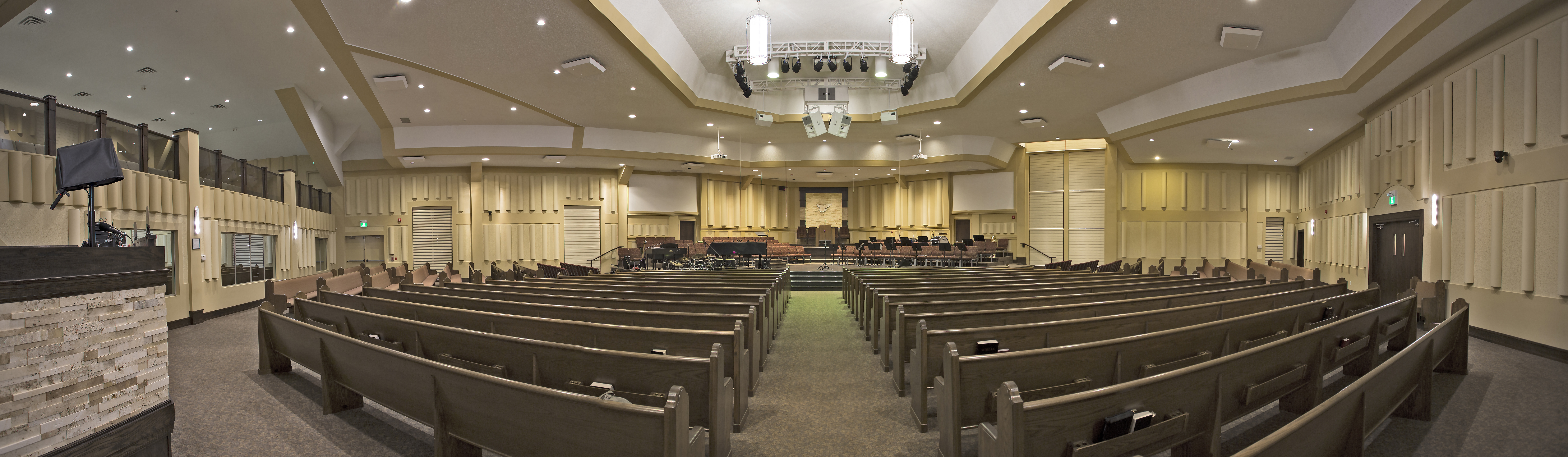 The problem with spreadsheets is that they are not looking issues such as standing waves – and every church – regardless of shape has standing waves (unless the space is acoustically managed in the first place which also means this article is not for you.) Spreadsheets are not looking at excessive noise from early and late reflections. They are not looking at bass buildup often found in the corners of a room. They are not looking at flutter echoes and full syllable echoes. These are all sound effects than can’t be dialed out with equalizers, delays, algorithms and the next miracle digital gadget or software. (Yet that is how most sound system designers try to deal with room acoustics.)
Regardless of a persons acoustical training, knowledge or experience, a spreadsheet cannot tell you when standing waves are masking flutter echoes. A spreadsheet cannot tell you when bass build up is masking a standing wave issue. A spreadsheet can’t tell you how much the early and later reflections are reducing music and speech intelligibility.
All that a spreadsheet can tell you is how much “time” it takes for a sound to decay in a room either as an average number. Some spreadsheets are much more detailed and they have been written as an attempt to calculate a room in octaves or by 1/3rd octaves. If it was only that easy. Measuring and calculating time is just a sliver of the acoustical signature of a space people worship in.

It takes a lot of training to learn Church acoustics. The same applies to Studio Acoustics, Recital Halls, Concert halls and lecture halls. All of these rooms have specific acoustical needs and they all require a unique set of skills to properly fix them.
What makes a church so complicated is in how a church is used. When a church is designed as a “church,” it becomes the most multipurpose space there is because of all the ways a worship space is used. When you say you want the worship space to be more “Multi-Purpose” or more flexible in it use, you are actually limiting what a basic worship space is supposed to be able to do.
At the end of the day, an acoustical spreadsheet is only a small snapshot into church acoustics. It can’t help with congregational singing, it can’t help with a noisy stage for a praise and worship team or choir and it can’t help with drum issues or speech intelligibility.
What often happens is with the spreadsheet, it will guide you to a solution that is based on absorption. When an acoustical fix is based around absorption, you wind up “killing” the room for all music – especially contemporary music and congregational singing – and the masking effects of the other acoustical issues get worse. Sure, the room sounds more tame than it was before, but the ability to understand speech is either no better than before or it has gotten worse. Before you know it, everyone gets in ear monitors and all of the members of the worship team have to sign an insurance liability waver stating that they will not sue the church for any future health problems with hearing loss. Seriously, is that the kind of acoustical fix you want?
 That is what you get when you turn to an acoustical solution based only on spreadsheet calculations. To top it all off, the results are not much better when using computer simulation software programs. Simulation programs only show you the results at one frequency at a time. The computer generated image may be 3D but the patterns they show are only one frequency at a time – even when it is averaged out. To see large room acoustics in a simulation, you need to be able to see the results in 4D. Hologram can’t show you 4D images. That ability hasn’t been invented yet. You need to be able to see sound in 4 dimensions because all sounds are complex. Every sound made on earth is a combination of wave lengths that are generated at the same time. Some parts of a sound are measured in feet and some in inches. There is no way to visually see 100 Hertz, which is 11 ft long, and 4000 Hertz which is 3.5 inches long, at the same time in the same place yet in real life, that is what is happening with sound. We all take sound for granted but the complexity of sound is extensive.
But doesn’t sound follow the rules of fluid dynamic and other laws of physics? Of course it does, but only when you examine one frequency at a time and that frequency is never a pure tone. It is always complex. The only place you can measure and see a pure tone is in a machine like an oscilloscope and the moment you launch that sound into the air, it becomes complex. Just as sound is complex, so are the acoustical fixes for churches.
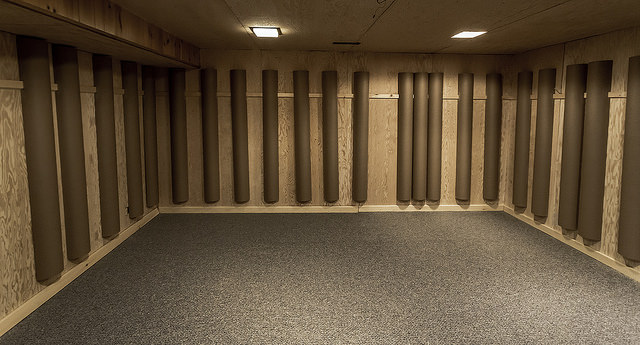
This is one way to test an acoustical solution before you recommend it to a church. Have your own testing facility. Whatever research is done in this room, it mathematical translates perfectly when it is scaled up into a larger space.
As a mantra, remember this: for all Christian churches, acoustical problems come in layers and whatever fix you choose, it has to address all of the layers in one step – which is possible if you want an affordable fix. There are many tools in the Acousticians Tool Box to fix a worship space. There are diffusers, resonators, traps and other devices that can address the needs of a church’s acoustics. There are also stand-alone electronic solutions that work in certain worship spaces. You need a lot of training to know which ones you need, what combinations you need and how to use them, and the last place you want to do your training and experimenting is on your customers.
If you are doing Church Acoustics or trying to fix your own church, don’t do it as an experiment and you know it will be an experiment the moment someone in your committee say something like, “lets try this as see what happens.” With those words, the acoustical solution is already doomed. Experts like myself can tell you the results the second you decide to try something and long before you apply the materials.
History shows that after a church spends it’s money on a thing such as acoustics, it will not be able to afford to fix any mistakes for decades. If the results makes the room worse or no better than before, then you are subjecting the church members to more sound abuse for years to come and we don’t want that. Spreadsheets don’t fix churches, good training and expert help does. (It’s also cheaper in the end to get expert help.)
Finally, consider this. The internet has become a treasure trove of knowledge. That knowledge is often presented as expert information offering sure fire solutions. I scan the internet often to see what is out there. There is a lot of great information and there are a lot of myths. When you collect all of that info, it only holds a fraction of the total knowledge about church acoustics. If we were to put a percentage on it, the internet holds about 2% of the total knowledge there is for church acoustics. The books hold another 8% of what there is to know about church acoustics. Church acoustics is so complicated that often, a seasoned acoustical expert like myself will have to fix one of a kind acoustical fixes often. Those unique fixes are often not shared because others may think that the one of a kind fix would be needed in every other church that has the same problem. You can have 10 churches with the same acoustical problem but in every one the fix has to be modified because of the other variables that have to be included. The rest of the knowledge about church acoustics is held by experts because the church community hasn’t taken ownership of that knowledge yet and there is no system in place for churches to share their experiences in order to avoid mistakes in the future. What is missing is the wisdom in knowing what acoustical fixes will enhance worship verse what acoustical fixes exchanges one set of problems for another set of problems. Problems which holds back and undermines the real worship experience the church leaders want you to participate in.
All church can have great acoustics and sound. If each church denomination or independent church were to set-up their own “Church Sound Standards” for the performance of their sound systems and worships space acoustics, churches will become the kind of places where people want to go. Once a standard is set, every church will have a Worship everyone can enjoy and appreciate.
Joseph De Buglio
Acoustician and Expert in Church Acoustics.



 Welcome to the world of Church Acoustics