The goal of any worship space and the church sound system is not about loudness, gain before feedback, intelligibility, special sound effects for the organ or choir, having the most talented performers in the worship team, how many wireless mics, number of channels the mixer has or the name brand of equipment you have. The goal of a church worship space and the sound system is to be a safe place where the Gospel can be presented clearly and with little to no blemishes. Where every person within the worship space can hear and understand the Gospel as clearly as when having a conversation with someone only 4 feet away and sharing the Gospel. Anything less than that goal means that the spoken word can be corrupted in the journey between the minister’s mouth and ears of all those who are listening. The Gospel needs to be broadcasted and understood as clearly as reading God’s written words.
If your church has hot spots, dead spots, good sound in these seats and poor sound in those seats, then the Gospel is not being presented equally to everyone. If your sound system has technical problems during worship often, then it is a distraction, and it can make the difference of understanding something important.
The chart below shows tangible results when your worship and sound system are tested. There should be three tests.
The first is with a test speaker. It is a point source speaker that is small enough to mimic a person’s voice.
The next test is feeding a signal directly into the sound system and test those results. This test is just about the playback quality of your sound system.
The third test is to use the test speaker 30 inches from an open microphone such as a pulpit or any microphone on a stand and test the combined results of the worship space’s acoustics direct interaction of the sound system and open mics. You can also do a second version of this test and place the test speaker 4 inches from a microphone where the microphone is 45 degrees off axis.
If all three tests are not in the Yellow section, the results will let you know if it is your sound system, the acoustics or all of the above. This is also a better indication predicting if upgrading your sound system will improve the results you are looking for. This is also a strong indicator that your worship space needs some kind of an acoustical management system
You can get your church tested. It doesn’t cost much, and the results can save a life or many lives, depending on your point of view. As an independent consulting company, we offer church testing and results with no obligation to use our services in the future.
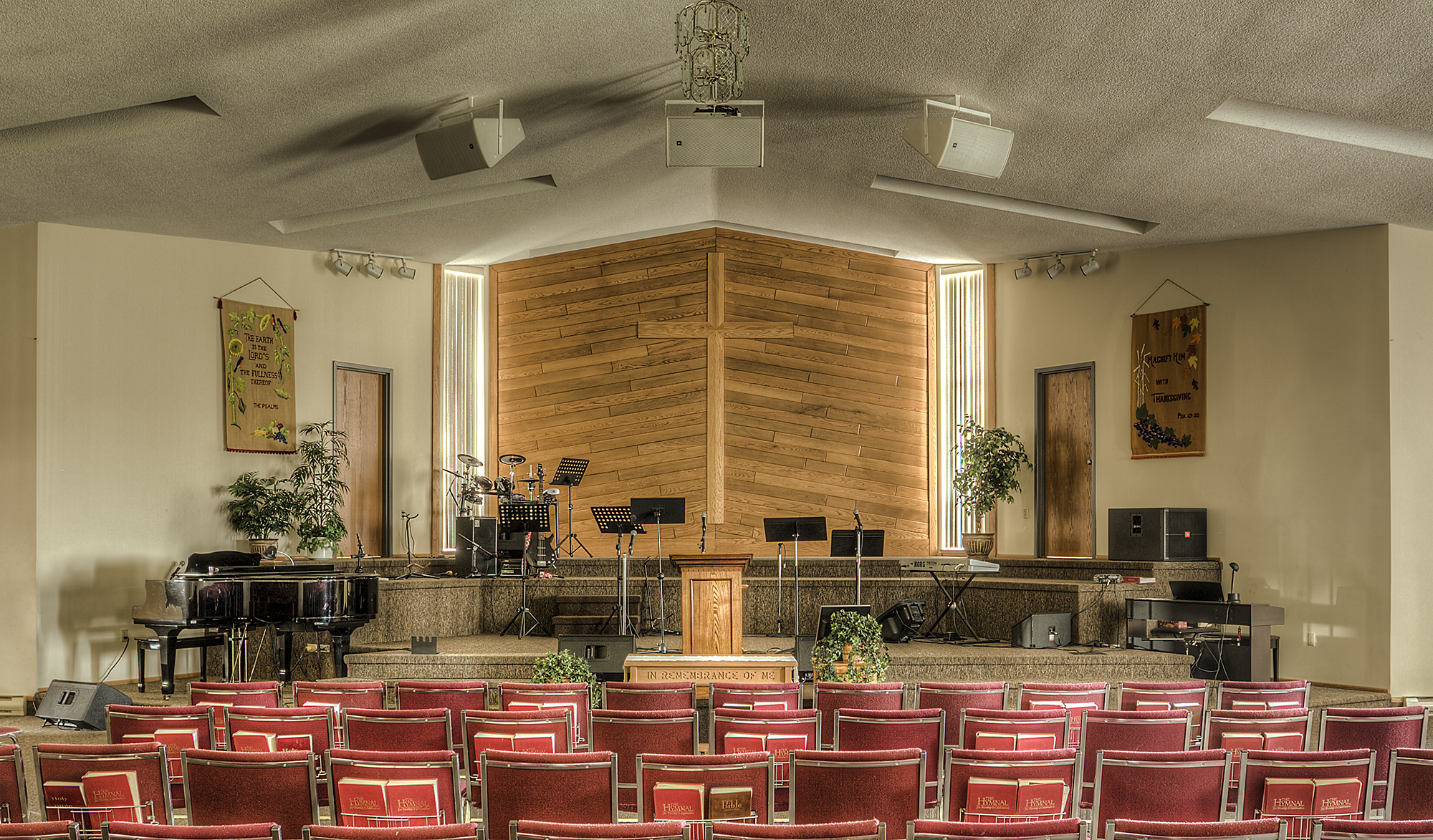
This 300 seat church already had a reasonable high-quality sound system. It was properly designed for the room and professionally installed. The acoustics were not that bad. At least it was thought that the acoustics were not such a problem. The outstanding issues they were trying to solve or improve were:
Gain before feedback,
Elimination of the few deadspots that were not solved from the previous sound system when the current new JBL speakers were installed
Reduce sound spill from floor monitors,
Better control of the drums (when using acoustic drums) and
They wanted 3dB more bass from the Sub-woofer.
These are all reasonable reasons to upgrade the sound system.
The church was considered the following upgrades.
Replacing the professionally designed and installed 12-year-old JBL sound system.
They considered going for IEM (in-ear monitor) system for up to 8 people. (This would have included a new digital mixer)
The church considered making an air-conditioned drum booth or get an electronic drum kit.
They also wanted to add a second twin 15-inch sub-woofer.
Estimated total cost, almost $26,000.00 installed.
This is what the church actually did. They changed the acoustics of the room. They installed an acoustical Tube Radiator system.
What did they gain by doing this?
The sonic quality of the existing JBL speaker system was greatly improved. The improvement was noticeable better regardless of how much equalization was added or when the EQ was bypassed. (Definite proof that the acoustics of the room changed the performance of the speaker system from the day they were installed.)
All of the remaining deadspots were now gone. (This was never a speaker system problem as the right speaker system design was already installed.)
The performance of the speaker system was such that picking up a person’s voice went from 12 inches to 35 inches with a Shure SM58 mic before feedback would show up. (Again, acoustics limits the performance of all sound system. Sure there are some very expensive gadgets that can improve gain before feedback, but such gadget can cost more than the material cost of the acoustical fix.)
The floor monitors are now well behaved. No matter how loud the floor monitors get, you definitely need to and to add the front of house to hear clear sound. As it turns out, the overall stage mix dropped around 10dB without the performers even noticing as they were now able to hear the stage mix from the monitors so well at a lower volume. You could say that the monitor spill issue is eliminated.
This eliminated the need for IEM’s.
Since the drummer can hear himself now, he gradually started playing quieter after a few weeks. The need for a drum cage disappeared.
The Single Sub-Woofer was now able to play 9dB louder without distortion. It would have taken 3 more sub-woofers to get the same loudness without distortion. That was equal to spending around $15,000.00. (Standing waves and bass buildup in the corners added air pressure onto the surface of the cones of the subs drivers. This added air pressure creates distortion. When the subs distort, the sound quality and maximum sound levels of what the sub is supposed to be able to do, can drop up to 15dB in many rooms.)
Other improvements
Congregation Singing.
The participation of people singing went up from 30% to 75%. (When people can hear themselves and the other people around them, it encourages people to sing more.) s a resulting, the congregation is singing 8 to 15dB louder. (The more people singing, the louder they will become.)
No more distortion from the speaker system with playing louder which means the perception of loudness is greatly reduced. (Standing waves and bass buildup in the corners added air pressure onto the surface of the cones of the bass driver of full range speakers. This added air pressure creates distortion. When the bass drivers distort, the sound quality and maximum sound levels of what the full range speaker is supposed to be able to do, can drop up to 15dB in many rooms.)
After two years, the congregation is starting to add harmonies to their singing. (That is what happens when people can hear each other.)
Now when people stand up to give testimonies or prayer requests, people can hear them whenever they forget to use hand-held wireless audience microphone.
The front of house stage mix is so much better. Now you can hear all of the performers without having to blast the sound system. (A well-diffused room can make the signal to noise ratio improve from 3dB to 25dB. As the signal to noise improves, the easier it is to settle into a high quality.)
The worship space is now concert quality for any high SPL event, recitals, choirs or orchestral events.
The total cost of the acoustical system including painting the whole sanctuary. $1,400.00
Since this as a DIY project, the money saved went towards a better headset mic for the pastor and the new digital mixer. Total upgrade, $5,000.00. If the church contract out the installation of the Sono Tubes, add $5,200.00. That is still 60% of the cost of upgrading a perfectly good sound system if everything is contracted out or an 83% difference.
Conclusion
One can honestly say that fixing the acoustics had a far better return on investment versus just upgrading the speaker system alone. Upgrading the speaker system can never make the room sound better, improve congregational singing and it would have not been possible to delete the deadspots without adding more speakers on delays around the room. This transformation is typical of the new worship experience when a church gets the acoustics they are supposed to have. In the battle between acoustics vs sound systems, acoustics always wins. It’s Physics. Try moving a wall with air? You can’t. Change the wall and hear what happens!
The simple answer is as follows. Half, quart or third round devices or objects individually just scatter sound. A single barrel diffuser or tube radiator as I often call them just create a very uneven distribution of sound. As single units, it gives about the same amount of performance as placing a flat object of the same size and placing at a 15 to 35 degree angle on a wall.
When using barrel diffusers in various sizes and/or in spacing varying from 0 to 30 inches and apply them to all of the walls in a confined space, you are creating a diffusive field. You’re turning the church walls into a phase coherent sound field – like churches of yester year built between the 1400’s to 1700’s. When barrel tubes are used as a system you can program them to only manage the acoustical problems you want to get rid of and at the same time create a more desirable sound field like real reverberation that is musical and supportive to congregational singing.
Barrel tubes spaced too far apart just scatter the sound and reduces some bass but does nothing much else. Instead, you can program the diffusers to manage standing waves, bass buildup, notch a frequency or two and equalize a room. You can also program them to lower stage noise, manage monitor spill into the audience and improve congregational singing. They can also be programs to make the sound system perform better.
The software to program barrel diffusers is still in development. In the meantime, a test room, and a data base of real world testing is the best way to predict the final outcomes. Try and program a digital EQ to cut 350 hertz 40dB. It can be done but it sounds awful. When you program tube radiators to cut 40dB, it sounds sweet.




 Welcome to the world of Church Acoustics