
Welcome to the world of Church Acoustics

Teaching the highest quality in Church Sound excellence

  • Supported by

    Contact:
    Ph # 519-582-4443
    email: jdb@jdbsound.com

    The Bible is the de facto standard for all church worship needs including sound and acoustics.

    2 Timothy 2:15

  • Archives

  • For additional contact information scan the QR code below

    link to jdbsound.com

Archive for May, 2019

Ten years later Kingston Rd United Church

Posted by jdbsound on May 29, 2019


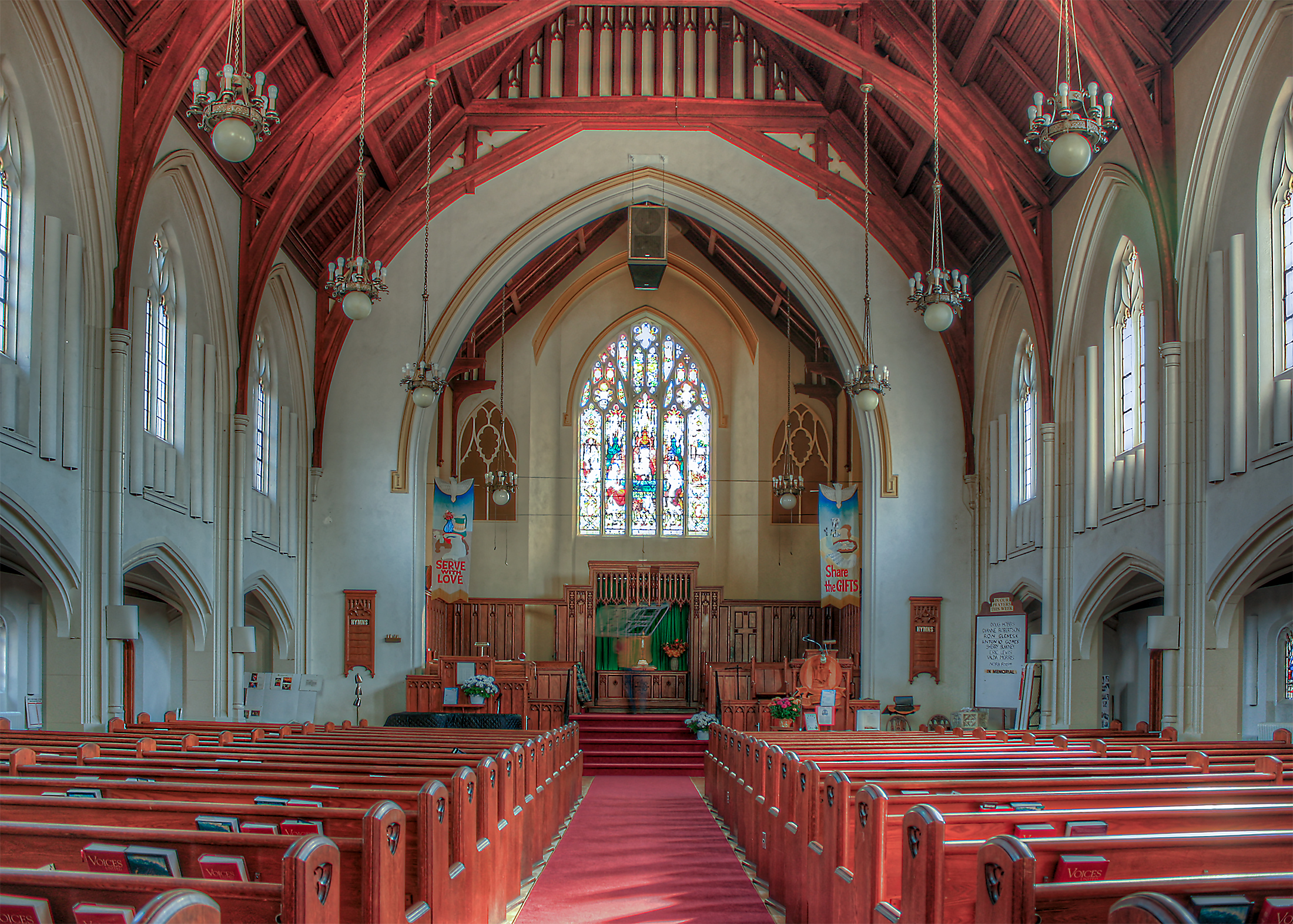
Kingston Road United Church had sound issues. They tried several sound system designs with no real success. Someone suggested JdB Sound Acoustics.  When I arrived, an elderly lady came to me and said, “If you can’t fix this room, then this church will not be around much longer.” Somehow, several people on the sound committee believed that if the church sounded better, they stood a better chance at keeping the doors open.

In 2008, I was hired to fix the room. I designed for them an acoustical and sound system solution. The sound system was completely replaced. The acoustics plan was using half-round tubes on all of the walls. The results were as several people put it – Amazing. Before, you could not understand anyone talking more than 15 feet away. After, you could talk end to end of the 120 ft — long worship space. The church seats 550 people.

Today in 2019, the church is thriving. It has become a place for concerts, drama and singing events. The church is growing in a location where there is only one parking spot. Church attendance may still be low, however it is higher than in 2009 and with all of the other activities, it has been more than enough to keep the doors open. Acoustics alone didn’t keep the church from closing, but it became a tool to attract new members and other forms of income for an inner city church. Good acoustics seemed to inspire the church leadership to have confidence in knowing that if people could have a good hearing experience, the greetings they would receive from the members would be that much better.  There is also proof that good sound means a greater chance for people to return.

A few years back. Cinemacoustic Solutions Int’l, Harrisburg, Pennsylvania, did an experiment with two theatre test rooms. Both rooms were identical the same visually with one room properly treated acoustically, and the other was not. Room “A” was treated properly; however, Room “B” was not treated at all.

Here is a summary of the results.

“Funny enough, while many of the students made comments about the sound, stating they thought the speakers in room “A” sounded a little better than those in “B”, nearly all of them said, “the picture in Room “A” was far better than that of Room “B”. The properly treated room allowed them to see & hear content at a caliber they may not have ever experienced before, to which they naturally attributed to better equipment, as opposed to the acoustical treatment of any sort. The properly treated space relaxed their senses allowing them to enjoy the environment and what they were doing as opposed to subconsciously concentrating on what they needed to do to better enjoy their surroundings.

The same subconscious energy applies to an orator speaking in an untreated room vs. a treated room. Even a boardroom with executives around tabling important and perhaps complex company matters, they can concentrate better when not “fighting” bad room acoustics while conversing or passionately presenting their opinions, vying for votes. They would never attribute the lack of ability to concentrate on poor acoustics because they simply wouldn’t know to do so, however it can very well be a culprit.”

Good church acoustics matters. Kingston Road United Church is a fine example of how acoustics made their worship space a place where people want to do activities with speech and music. A place where people want to be and where hearing the Gospel is better understood. At Kingston, you spend more time understanding what was being said rather than spending all of your time deciding what words were being said or just trying to hear.

If you would like to see more photos of this church, use this link. https://www.flickr.com/photos/jdbsound/sets/72157607243842820/

Posted in Church Acoustics, Church Sound Systems, Past Projects discussions | Tagged: , , , , , | Comments Off on Ten years later Kingston Rd United Church

Acoustics and the Gospel

Posted by jdbsound on May 21, 2019


Posted in Church Acoustics, Church Sound Systems | Comments Off on Acoustics and the Gospel

Really Useful Charts and Helps

Posted by jdbsound on May 20, 2019


This is a chart that gives you wavelengths of sound for all frequencies, speech, and music ranges.

This is a Church Height chart. These are the minimum heights. Building new churches with lower ceiling heights degrades speech and congregational singing and costs more to heat, cool, and maintain.

This chart shows the difference between the absorption rate versus decibels. For example, something that is rated as a coefficient value 0.5 is equal to 3dB of sound absorption.

How to Equalizer a church when you can’t afford professional help, or your EQ settings have been changed, and you don’t have time to get professional help. https://www.jdbsound.com/art/art537.html

Let us know if these files are useful. We would like to add more of them.

Posted in Church Acoustics, Educational Must Read Articles | Tagged: , , , , | Comments Off on Really Useful Charts and Helps

Saving Souls – Priceless

Posted by jdbsound on May 16, 2019


What are your church priorities? Fixing the acoustics of any church is affordable.  A person will spend over a thousand dollars to help with their hearing.  Sound equipment tools for worship are affordable and do a lot of work.  Few people fuss over how an audio system looks after it is installed.  When it works, it looks great.  The same is true with acoustics.  If it works, it looks and sounds good.  If it doesn’t work, it has to look amazing because acoustics that doesn’t fix all of your churches needs is nothing more than wall furniture. What’s on your church walls that helps preach the Gospel?

Posted in Church Acoustics | Comments Off on Saving Souls – Priceless

Was Solomon’s Temple for real? If it was, how would it sound?

Posted by jdbsound on May 7, 2019


Was Solomon’s Temple a fairy tale? I don’t think so. I think Solomon’s Temple was as real as touching your own skin. Why? Solomon’s Temple was designed over 3,000 years ago. When you study the sound quality of the two rooms, it describes spaces that were purpose built for specific functions. The room that reflects modern day acoustics is the Holy Place or Sanctuary as we like to call it today. How can the design of a room from 3000 years ago be so good if it was never built or a fairy tale or myth? Do you think that King David or Solomon knew anything about acoustics back then? Did God tell King David and Solomon’s how to design rooms where hearing would be easy or difficult? Could the acoustics of the Holy Room reflect todays demanding needs of sound for worship? Yes. Absolutely!

The only difference between what a traditional worship space and a contemporary worship space would be the need for is adding carpeted floors and padded seating for worship team lead services. Churches with similar dimensions and shape as Solomon’s Temple have a way better worship experience over churches that have other room shapes. That is not to say you can’t have a good worship experience in other room shapes, but if you can remember your best worship experience in other rooms with good acoustical sound management, it is way better when the room is a rectangle. This only happens when the room is twice as long as it is wide, and with a very high ceiling that is 75% of the rooms length. With those dimensions and with the same type of acoustical treatment system as used in Solomon’s temple, regardless of your worship style, the only experience better than that would be in Heaven. And yes, the carvings of Cherub, Palm Trees and open flowers was actually an acoustical system designed by God. The updated version of it work great in modern churches today.

The modified version use half round shapes like the Palm tree. An affordable way to fix any church is with cardboard tubes. Such tubes using a water based glue meets fire codes in almost any place around the world, and does as good of a job as the carvings in Solomon’s Temple. For churches that have little to no money to spare, this is the cheapest way to breath life into all of those existing churches out there regardless of their room shapes. This is the only acoustical system that improves congregational singing (even is dead rooms), and doubles the loudness of the sound systems performance without distortion and without buying more equipment. (assuming that the equipment you already have is up to the task of performing at these levels in the first place.)

Now when I say doubles loudness of the sound system, it means that if you total the components of your speaker system, amplifiers and processors, and multiply the equipment 10 times, that is doubling the loudness. Remember that doubling the equipment or doubling the power only gives you a 3dB increase, but it take 10 times the power to double the loudness without distortion which is equal to 10dB. In most churches, an acoustical fix such as this has a one time costs of about $5.00 per seat. A typical speaker system for a church cost around $30.00 per seat and up. To get the same performance through sound equipment as a room treated with Cardboard Tubes, the speaker system goes up to $300.00 per seat or ten times the cost. If you do a reality check, you would actually have to spend more because you are still fighting the room to keep the sound distortion free. Even at $500.00 per seat, you may not be able to get double the loudness without distortion. To apply this kind of acoustical system as in a church as in Solomon’s temple, it lowers the cost of a sound system while increasing it’s performance. There is no other acoustical system that can do that.

Now Solomon’s Temple was built over 3000 years ago. How did they know how to do acoustical treatment that works in churches today? How is it that something designed 3000 years ago is so sound system friendly? The reality is, God inspired it’s design. Many Christians believe that the Bible is sufficient in all things and that should including church design and acoustics. Shouldn’t we be following what the Bible says and teaches, even in worship space design? (Ecclesiastes 1:9)  The thing that hath been, it is that which shall be; and that which is done is that which shall be done: and there is no new thing under the sun. If there is nothing new under the sun, then why do churches keep trying to design something original or different when there is nothing better out there? Worse yet, why don’t churches know that for preaching the Gospel there is no better room than a room with the dimension ratio’s as in Solomon’s Temple? Furthermore, why are so many churches determine to solve acoustical problems with electronics when they don’t have to?

Solomon’s temple was small. It could only seat around 150 people if used as a church today. Apparently, you can scale the room up to any size and have the same performance results. Why hasn’t the church community figured this out? (Why aren’t Synagogues built this way either?) From my own experience, if you use these dimensions, such a room will sound amazing as long is the walls have the right shapes added on them. At the same time this room will awful if you don’t include the same type of acoustical system as used in Solomon’s Temple. Please notice that I use the term “System”, and not “Treatment.” When you call it a system it is about a planned acoustical space or a system that treats the whole room. When you call it a treatment, it is as if the acoustical products are used as an after-thought. Such acoustical products are used only do spot treatments and they provide minor room fixes, and cost so much more expensive.

The most important roll of a House of Worship is to preach the Gospel. No other room shape, dimensions and wall finishing’s does it better. Why would any church design the most important room with a lesser goal? The foyer, fellowship halls, classrooms, office and the shell of the building can be any shape you want but the worship space should be designed for the sole purposes of teaching the Gospel and for a full worship experience. All other room shapes and treatments, regardless of the sound system design and equipment fall short in meeting the standard found in Solomon’s temple.

If you believe as I do that the Bible is sufficient, then it should be sufficient in the design on your next church sanctuary. Oh, didn’t anyone tell you? A room built to Solomon’s dimensions costs less to build, heat and cool and maintain. Solomon’s Temple is a fine example of “Nothing new under the sun.”

For the 400 plus churches that already have such an acoustical system, what further proof do you need that Solomon’s temple was real? If you want to take it a step further, since science cannot predict how this acoustical system works, a system that you have to apply in faith, does that constitute a miracle?

Posted in Church Acoustics, Educational Must Read Articles | Tagged: , , , , , , , , , , , , , | Comments Off on Was Solomon’s Temple for real? If it was, how would it sound?