Welcome to the world of Church Acoustics

Teaching the highest quality in Church Sound excellence

  • Supported by

    Contact:
    Ph # 519-582-4443
    email: jdb@jdbsound.com

    The Bible is the de facto standard for all church worship needs including sound and acoustics.

    2 Timothy 2:15

  • Archives

  • For additional contact information scan the QR code below

    link to jdbsound.com

Watch out for the Aesthetics Police!

Posted by jdbsound on November 28, 2018


acoustics predicable

Here is a simple truth. Acoustics is all about the math and a combination of a variety of principles of physics – at least that is how I do acoustical design. Then there is the aesthetics. Here is a second truth.

If a room sounds great for worship, speaking, music and children’s programs, people don’t pay to much to the aesthetics.  It becomes easier for them to pay attention to the message and join in on the congregational singing. However, if what is on the walls doesn’t significantly  improve congregational singing and all of the other aspects of worship, then what you have is wall furniture and it has to look great considering how expensive that it is. The installation shown above was done by church members. Originally there was a different design based on the same concept. Once the church members understood my plan, they suggested this. With a few adjustments, this is what worked. This did cost more than half round tubes but it is way less expensive than the alternatives. Believe it or not, it also meets fire code.

Joseph De Buglio

Share your comments.  Was this article helpful?

Posted in Church Acoustics | Comments Off on Watch out for the Aesthetics Police!

The Rabbit Hole

Posted by jdbsound on September 11, 2018


red-pill-blue-pill-Recovered

How good is your worship experience? Sound Systems play a large part of the picture. The sound system is used 100% of the time in most churches. That includes streaming, hearing impaired systems and recording of the worship program. However, a sound system broadcasting live sound to the audience can only perform as well as the room allows it. Sure, getting the latest and best State of the Art Technology in sound does sometimes gain you a slightly better level of performance but how good can a sound system be?

If we do a checklist of all the things a sound system is supposed to do, most churches that don’t have any acoustical treatment only get about 50 to 60% out of their sound system’s performance regardless of the quality of the equipment and the design of the speaker system. When a church does get the right acoustical system or if the acoustical system is built in, those churches get over 85% performance out of their sound systems, even when using just entry-level professional live sound equipment. Churches that have the right room shape that is within the Golden Ratio, they usually get a performance level over 90% out of their equipment with the right acoustical management system.

An example of system performance would be in how much gain before feedback there is. In one church, they had so much gain before feedback after their church had an acoustical change, that during a children’s play, one child was helping another child who was struggling with their lines. The nearest microphone was over 9 feet away. The sound operator was able to raise the gain to where you could hear both children. This in itself was no big deal but it was huge for the parents listening to the play. They loved what they heard. When the parents could hear the one-child coaching the other with their lines, it was a great example of how people need to encourage each other and work together. Both children were complimented for their performances. The parents felt included in all of the things happening on stage.

In most churches, experiences like this never happen. Instead, most parents complain that they couldn’t hear their child or the other kids, or get upset with the sound guys for not having enough microphones for them, or get upset with the Sunday School teacher for not teaching the kids how to use microphones. The performance of a sound system can make the difference between having a blessing and hearing the message or being so distracted that person leaves upset and any message given is totally missed.

In another example, a church had floor monitors that were so loud that the main speaker system couldn’t be used without blasting everyone in the audience. The monitors are almost as loud at the back of the church as well as up front. The worship team switched from floor monitors to in-ear monitors. At first, it seemed to work. However, if you were sitting in the front 5 rows of seating, the sound coverage was poor in about 70% of the seating. Before, the floor monitor spill helped to fill in the coverage of the shortcoming of the main speaker system design. After getting the in-ear monitors, the church went through 3 speaker systems and 3 different speaker system layout designs. The coverage issues never were resolved, even with loudspeakers recessed in the front of the stage on delays and the whole ten yards. The shape of the church didn’t help either.

Eventually, the church had to fix their acoustics because those front 5 rows of seating were always 80% occupied and that is where the Pastor’s wife always sat. With sound coverage issues resolved, the acoustical fix also resolved a boat load of problems including monitor spill. The acoustical fix made it possible for the worship team to go back to using floor monitors months later. The church was only a 500 seat space and over a 6 year period, they spent over $200,000 on just speakers, processors, amplifiers and mixers. the acoustical fix was only $4,000. Had the church addressed the acoustics first, they would have had an extra $150,000 invested into other programs or missions or helping church growth and health. Many churches are going through this process today.

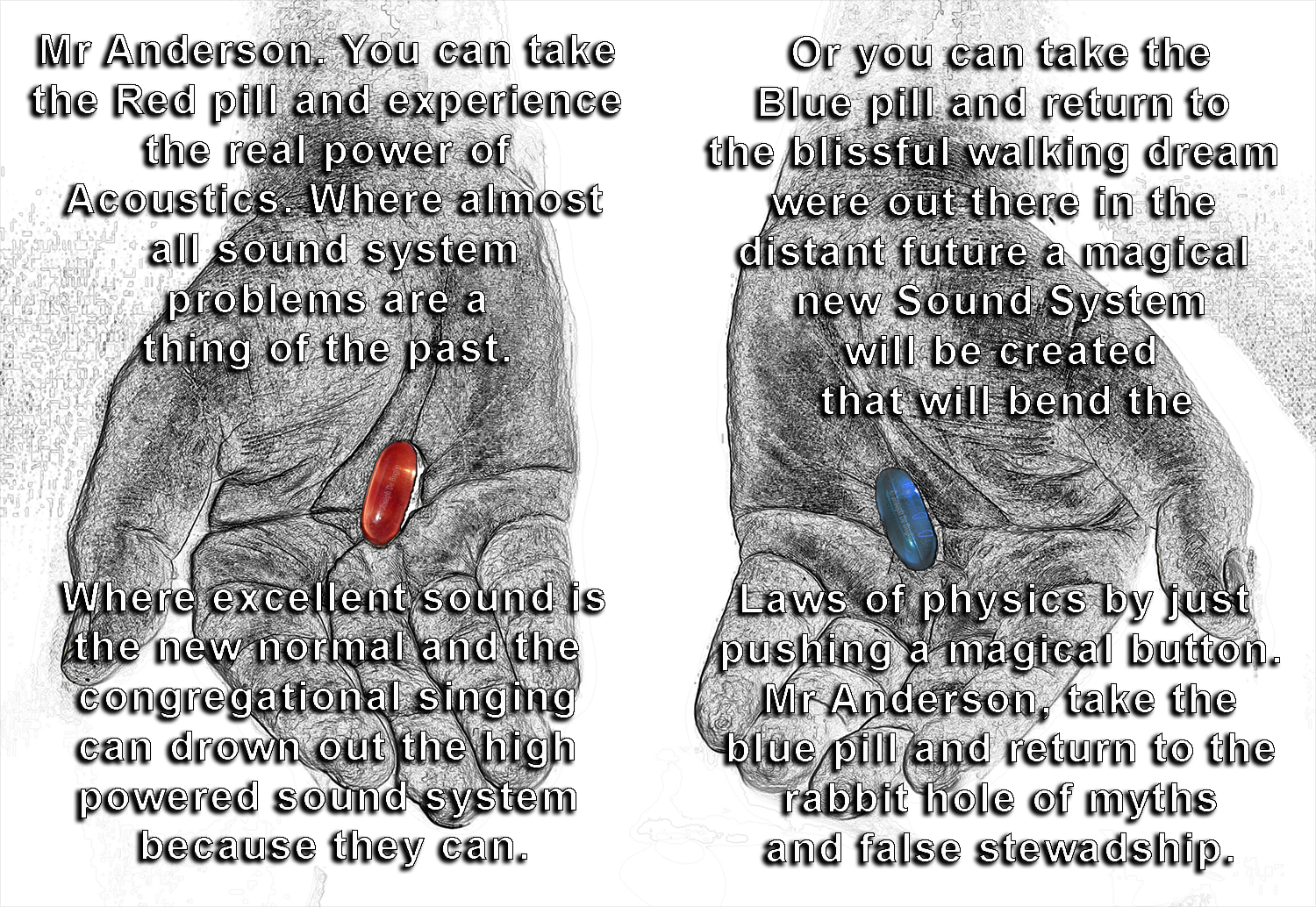
A lot of churches just keep taking the “Blue pill.” Churches with money keep turning to esoteric audio hardware and hope that physics will take a back seat to the latest technology and software to help them. For churches that don’t have the funds, they just put up with bad sound and for some, declining or very high turnovers in attendance.

For those churches that take the “Red pill,” they spend way less on sound equipment and have systems sounding and performing in ways other churches can only dream about. These same churches have more enthusiastic congregational singing, better sound teams and almost zero complaints about the sound, even when the sound system is keeping up with a congregation singing over 95dB! Some Worship team members find that their talents improve. Ministers find that more people are paying attention and are asking questions or commenting on the weekly sermons through the week.

The choice is yours. Taking the “Blue pill” means one kind of outcome down the rabbit hole where magic is not real and taking the “Red pill” gives a different result. The thing is, there is no downside to taking the “Red pill” but there is for taking the “Blue pill.”

By Joseph De Buglio

Share your comments.  Was this article helpful?
Posted in Church Acoustics | Comments Off on The Rabbit Hole

Poster of the Day

Posted by jdbsound on August 2, 2018


laws of physics poster_s

Blessings

Joseph De Buglio

Posted in Church Acoustics | Comments Off on Poster of the Day

What will give you the biggest bang for the buck in upgrading the Sound of your church?

Posted by jdbsound on May 2, 2018


This 300 seat church already had a reasonable high-quality sound system.  It was properly designed for the room and professionally installed. The acoustics were not that bad.  At least it was thought that the acoustics were not such a problem.  The outstanding issues they were trying to solve or improve were:

  1. Gain before feedback,
  2. Elimination of the few deadspots that were not solved from the previous sound system when the current new JBL speakers were installed
  3. Reduce sound spill from floor monitors,
  4. Better control of the drums (when using acoustic drums) and
  5. They wanted 3dB more bass from the Sub-woofer.

These are all reasonable reasons to upgrade the sound system.

Good Speaker System setup_s

The church was considered the following upgrades.

  1. Replacing the professionally designed and installed 12-year-old JBL sound system.
  2. They considered going for IEM (in-ear monitor) system for up to 8 people. (This would have included a new digital mixer)
  3. The church considered making an air-conditioned drum booth or get an electronic drum kit.
  4. They also wanted to add a second twin 15-inch sub-woofer.
  5. Estimated total cost, almost $26,000.00 installed.

This is what the church actually did. They changed the acoustics of the room.  They installed an acoustical Tube Radiator system.

What did they gain by doing this?

  1. The sonic quality of the existing JBL speaker system was greatly improved. The improvement was noticeable better regardless of how much equalization was added or when the EQ was bypassed. (Definite proof that the acoustics of the room changed the performance of the speaker system from the day they were installed.)
  2. All of the remaining deadspots were now gone. (This was never a speaker system problem as the right speaker system design was already installed.)
  3. The performance of the speaker system was such that picking up a person’s voice went from 12 inches to 35 inches with a Shure SM58 mic before feedback would show up. (Again, acoustics limits the performance of all sound system. Sure there are some very expensive gadgets that can improve gain before feedback, but such gadget can cost more than the material cost of the acoustical fix.)
  4. The floor monitors are now well behaved. No matter how loud the floor monitors get, you definitely need to and to add the front of house to hear clear sound. As it turns out, the overall stage mix dropped around 10dB without the performers even noticing as they were now able to hear the stage mix from the monitors so well at a lower volume. You could say that the monitor spill issue is eliminated.
  5. This eliminated the need for IEM’s.
  6. Since the drummer can hear himself now, he gradually started playing quieter after a few weeks. The need for a drum cage disappeared.
  7. The Single Sub-Woofer was now able to play 9dB louder without distortion. It would have taken 3 more sub-woofers to get the same loudness without distortion. That was equal to spending around $15,000.00. (Standing waves and bass buildup in the corners added air pressure onto the surface of the cones of the subs drivers. This added air pressure creates distortion. When the subs distort, the sound quality and maximum sound levels of what the sub is supposed to be able to do, can drop up to 15dB in many rooms.)

Aylmer EMC Church Pano 2017_ss

Other improvements

Congregation Singing.

  1. The participation of people singing went up from 30% to 75%. (When people can hear themselves and the other people around them, it encourages people to sing more.)  s a resulting, the congregation is singing 8 to 15dB louder. (The more people singing, the louder they will become.)
  2. No more distortion from the speaker system with playing louder which means the perception of loudness is greatly reduced. (Standing waves and bass buildup in the corners added air pressure onto the surface of the cones of the bass driver of full range speakers. This added air pressure creates distortion. When the bass drivers distort, the sound quality and maximum sound levels of what the full range speaker is supposed to be able to do, can drop up to 15dB in many rooms.)
  3. After two years, the congregation is starting to add harmonies to their singing. (That is what happens when people can hear each other.)
  4. Now when people stand up to give testimonies or prayer requests, people can hear them whenever they forget to use hand-held wireless audience microphone.
  5. The front of house stage mix is so much better. Now you can hear all of the performers without having to blast the sound system. (A well-diffused room can make the signal to noise ratio improve from 3dB to 25dB. As the signal to noise improves, the easier it is to settle into a high quality.)
  6. The worship space is now concert quality for any high SPL event, recitals, choirs or orchestral events.

The total cost of the acoustical system including painting the whole sanctuary. $1,400.00
Since this as a DIY project, the money saved went towards a better headset mic for the pastor and the new digital mixer. Total upgrade, $5,000.00. If the church contract out the installation of the Sono Tubes, add $5,200.00. That is still 60% of the cost of upgrading a perfectly good sound system if everything is contracted out or an 83% difference.

Conclusion

One can honestly say that fixing the acoustics had a far better return on investment versus just upgrading the speaker system alone. Upgrading the speaker system can never make the room sound better, improve congregational singing and it would have not been possible to delete the deadspots without adding more speakers on delays around the room. This transformation is typical of the new worship experience when a church gets the acoustics they are supposed to have. In the battle between acoustics vs sound systems, acoustics always wins. It’s Physics. Try moving a wall with air? You can’t. Change the wall and hear what happens!

Share your comments.  Was this article helpful?
 

Posted in Church Acoustics, Church Sound Systems, Photos of Church Projects | Tagged: , , , , , , , , , , , , , , , , , , , | Comments Off on What will give you the biggest bang for the buck in upgrading the Sound of your church?

Acoustics for only $0.20 per square foot

Posted by jdbsound on February 24, 2018


What is four inches thick, eight inches wide and comes in length up to 32 ft that can absorb sound down to 80 Hertz and preserves sound energy above 2000 Hertz?

What is six inches thick, twelve inches wide and comes in lengths up to 32 ft that can absorb sound down to 50 Hertz and preserves sound energy above 2500 Hertz?

What is eight inches thick, sixteen inches wide and comes in lengths up to 32 ft that can absorb sound down to 20 Hertz and preserves sound energy above 3000 Hertz?

Tube Radiators. It’s all about the shape and not what they are made of. Nothing controls sound at this rate that is also affordable for everyone to use. They make churches to sound great, home theatres sound amazing, cut production time in a recording studio up to 50%, and manage noise in the work place at less than $0.20 per sq ft. Who knew?

Sono Tube Diffuser profile_s


Posted in Church Acoustics | Comments Off on Acoustics for only $0.20 per square foot

The two edge sword of Church Acoustics

Posted by jdbsound on February 13, 2018


The Rectangle is the best sounding room with the right acoustical management system. The Rectangle is the worst sounding room without an acoustical management system.

An Acoustical Management system is being able to anticipate all of the ways a worship space is used and then design a custom acoustical system that can be installed to manage all or most of the worship acoustical events in one step.

By Joseph De Buglio

Posted in Church Acoustics | Comments Off on The two edge sword of Church Acoustics

Don’t Share Microphones!!!

Posted by jdbsound on January 30, 2018


Hi Everyone,

With cold and flu season hitting everyone so hard, just thought to remind those who sing or preach in church to not share microphones. Microphones are a great way to pass on the cold, flu and other contagious illnesses. You voice is a musical instrument and you need to do everything to keep it in good working order. For this reason, you should own your own microphone. By not sharing you mic, you can avoid getting sick or at least get sick less often. Here is an article I wrote in 2009 that is still relevant today. https://www.jdbsound.com/microphone_health.pdf

Joseph De Buglio

Posted in Church Acoustics | Comments Off on Don’t Share Microphones!!!

Before and After results of a Real Multipurpose Hall

Posted by jdbsound on December 4, 2017


This is a before and after test results of a multipurpose room.  The room is a converter steel factory.  The purpose of the room is for multi use including banquets, acoustical and amplified musical performances, teaching and general meetings.  While the room has a fixed sound system, the  room performs equally well regardless of the orientation of the seating or event layout.

sandbox B-A results

From the graph, it shows the before and after.  Before the room had an average of 2.1 seconds of reverberation.  That said, at around 400 Hertz, the reverb time was 2.85 seconds. This made the room unacceptable for all uses.  It was hard to have a simple conversation with someone only 5 feet away.

The acoustical treatment in this case require 3 different acoustical system.  Tube Radiators were used for controlling sound from 200 to 2000 Hertz.  The tube radiators have only a profile depth of 4 and 6 inches and the idea that something so small can control sound down to 200 Hertz is amazing.  The tube radiators only covers 12% of the total wall space of the room.  

The second system was outround diffuser panels.  They covered another 10% of the available wall space.  These panels were used to manage sound from 100 to 500 Hertz.  By combining these two system with the limited wall space, we were able to cut the reverb time at 400 and 800 Hertz 1.8 seconds.  That is a massive amount considering that 400 Hertz is a wave length of about 33 inches long and 800 Hz is about 17 inches.

The third acoustical was a fiber absorber.  The fiber absorber covered 40% of the ceiling and 10% of the side walls.  The fiber panels covered the outrounds on the side walls.  It is rare to need absorption in such projects but when you have a concrete floor with no carpet, you have to replace the carpet with something similar.  Here is the thing about carpet.  Carpet, which is always within 4 to 7 feet of our ears works very efficiently.  The shallow angle of most sounds we hear in a large room event gives a 1/2 inch of carpet the acoustical performance of 2 inches of a typical wall panel absorber.  Since one of the requirements of this room is to include music that can reach 100dB, it was planned to have a reverb time of 1 second, +/- .2 tenths of a second.  That goal was met and the range it was met is typical of our acoustical fixes.  If you look at the before and after, the room now meets that goal from 150Hz to 4,000Hz.  Before, using the same criteria, the room had a average reverb time of 1.8 second with a +/- of 1.1 second variance.

percent alcons 4 sandbox

The critical question is, how does the room sound for speech, talking and for music.  For speech, the change was from 14% Alcon’s (rated as poor) to 4% Alcon’s.  At 4%, it means that you can talk to someone from end to end of the 55 ft long room with a slightly raise voice.  When you add a properly equalized sound system, you can better the speech intelligibility to 3.5%.  For talking across a table during banquet or social events is easy in this space.  You can talk to someone 15 ft away while the person next to you is talking to someone across the table without having to raise your voice to compete with other conversations.

As for music, so far, for the high energy high SPL events the room has been well received by musician and audience members.  That has meant fewer events with drum shields, fewer events with IEM (in ear monitors) and very little floor monitor spill that degrades the sound for the audience.

At the other end there have been a few recital type performances where the even was all acoustical.  One person who was a graduate of a royal conservatory of music remarked that the room was similar to recital rooms at a well known royal conservatory school in Toronto, Canada.  One violinist said that while she would have liked a longer reverb time, the quality of the sound of her expensive instrument was amazing.  The last time she heard her violin sound so great was at a high end recording studio that was  acoustical treated.  She was also stunned that it didn’t matter where in the room she performed, the violin sounded great.

There is one down side to the new room.  Since there is no carpet, when the room is empty, you do notice the reflection off the floor. This does make the room a little challenging for those who do rehearsals when the room empty and before any table and chairs are set up.  Once tables and chairs are setup, the room behaves well.

In the real world, there are a lot of rooms that are used as multi purposed spaces but perform poorly.  Most facility owners don’t worry about acoustics because they may have the only place in town that can accommodate such events.  That said, if they were to get 10 to 20% more bookings per year, they would recover the cost of investing in an acoustical fix in less than a year.  Furthermore, it would allow the facility owner to charge a hire fee if the place gets too busy.  There is no down side to having an acoustically friendly community center, convention hall, rental hall or banquet facility.


Posted in Non Church Projects | Tagged: , , , , , , , , , , , , , , , , | Comments Off on Before and After results of a Real Multipurpose Hall

Vintage Balcony Delay from the 1950’s

Posted by jdbsound on November 25, 2017


This is a vintage passive Analog delay. Most likely installed in this 1800 seat church in the late 1940s or early 1950s. When this delay was installed, there were no electronic devices invented yet to give a long enough delay that this church needed. This delay was used to manage sound under and above a balcony for around 700 seats. It is a 2-inch conduit pipe with a high-frequency horn driver at one end and a quality microphone on the other. The length of the pipe is about 25% longer than the distance between the pulpit to the front face of the balcony. Whoever designed this understood very well about the HASS effect. This system was working very well into the 1990s where it was upgraded to a digital delay and new speaker system to accommodate the transition to a contemporary worship service.

Vintage passive delay

If you look closely you can see the wire for the microphone on top and the Green Altec high-frequency compression horn at the bottom. The microphone was moved back and forth in the pipe until they got the best delay setting. Then the pipe was sealed. The frequency response of this setup was very good. It was +/- 2dB from 1800 to 6000 Hertz. If this church continued with their traditional worship service, this delay could have continued to serve the church.

For most under balcony installations, you don’t need full range boxes. All you need is sound from 1200 Hertz and up as the low-frequency information will go around objects and under the balcony. If you ever walk into a church and hear great sound under the balcony and don’t see any speaker boxes and grills, if you look closer, you will most likely see just tweeters mounted with or without a small baffle about 6 x 3 inches. Using this approach means that a budget limited church can afford a very high-end quality sound under the balcony with better, even sound distribution. This also allows you to use a lower cost 25-volt distribution system for each delay line and you can tap off each tweeter at 1 watt as that is all you will need.

Oddly enough, today, a digital delay is often included in Digital mixers and speaker processors. To build this passive today would cost as much or more than a 16 channel digital mixer (as of 2017). Historically, this church could have used a reel to reel tape recorder on a loop to create the right delay. In those days this passive system may have cost around $500.00, whereas a reel to reel system would have cost around $2,500.00. And consider this, the tape would have had to be replaced often, the belts inside of the recorder would have to be replaced often and delay drift would require readjusting as belts would stretch over time. A reel to reel loop system would have been an ongoing expense that most churches would want to avoid.

I don’t know who coined the phrase, “set it and forget it” (Ron Popeil is credited for using that phrase in infomercials of the 1980s.) but this passive delay system was just that. Once set, you could forget about it and it would last forever. This is an excellent example of high-quality sound churches can afford. Whoever designed all of this did an excellent job.

(This is information is not yet in Wikipedia. Nov 2017)

Posted in Church Acoustics | Comments Off on Vintage Balcony Delay from the 1950’s